

A quick note before we begin: This article is intended to provide a brief general overview of the tax changes that organizers now need to address. It does not claim to be exhaustive, nor can it replace professional legal or tax advice. For specific questions regarding your conference and any potential special regulations, please consult a tax advisor.
In a previous article, we already addressed the question of which tax rate applies to a conference and when. Nothing will change in that regard for the time being—other than the fact that from July 1 to December 31, 2020, only 16% or 5% VAT will be charged instead of the previous 19% or 7%.
Do all prices and invoices for conference tickets need to be adjusted now?
For many conferences scheduled for the second half of 2020, ticket sales have either been underway for a long time or have already concluded. This means that invoices have been sent and services have already been billed, even though the conference has not yet taken place. The basis for taxation was the previously applicable tax rates, which would now be obsolete under the new regulation.
This would mean that all previously issued invoices and receipts would have to be retroactively amended. It goes without saying that this would entail a massive amount of effort. Furthermore, it would create more work for tax firms, which are already stretched thin due to short-time work schemes and government bridge programs. The German Association of Tax Advisors has therefore submitted a petition to the federal government, advocating for a transitional arrangement where previously billed sales are not challenged retroactively.
However, nothing has been definitively clarified yet. Currently, the only guidance is that the time at which a service is provided determines the exact tax rate. In the case of a conference, this would consequently be the period during which the event takes place.
Will conference participants now automatically pay less?
The organizer still has the final say on this question. It is unlikely that changing ticket prices due to the new tax rates will trigger a wave of protest, as the difference between the old and new amounts is certainly not significant.
Nevertheless, if sales have already begun, it could be rather cumbersome to communicate the new prices. Those who simply adjust the amounts on the conference website quietly and without notifying participants are not doing anything illegal, but they might raise suspicions about their transparency in other areas as well.
Organizers whose conferences are taking place in the next six months should generally calculate using the new tax rates, but they are not obligated to change their conference participation prices. No one is required to pass on the VAT adjustment to participants. This is also unlikely to happen in hotels and the catering industry. This would mean that the total on the invoice (the gross amount) does not change at all, even though a reduced tax rate was used for the calculation. The new tax rate will be shown, but participants will pay the exact same amount as before the adjustment. This applies at least to private individuals purchasing a ticket for the conference. The situation is different for business customers, for whom almost exclusively the net amount is relevant, which in this case would be higher than before.
The alternative would be to maintain the net prices. For corporate clients, nothing really changes, while private individuals pay less because the gross price is lower due to the new tax rates. However, this also means the organizer earns less. Therefore, someone will always feel the impact of the VAT reduction, so you should carefully consider which approach is best for your conference.
How can you calculate with the new tax rates?
Regardless of this, organizers must still take changed tax rates into account in their calculations. The extent of the bureaucratic effort involved depends to some degree on the software an organizer uses to create and manage invoices for the conference.
As soon as it is clear which tax rate is being used, the adjustment should be completed as quickly as possible. This means: The conference software must offer the option to set the tax rate yourself. If organizers can only choose between the preset 0%, 7%, and 19%, there is a problem: the amounts would have to be calculated and entered manually to create an invoice—a task no one will be eager to take on.
With Converia, the adjustment is quick: In the conference administration area, users can create new tax rates themselves. As soon as it is determined which tax rate should apply to which offer, the system automatically calculates with it and outputs the corresponding invoice amounts. Individual notes regarding the tax rates used can also always be added to invoice documents and receipts.
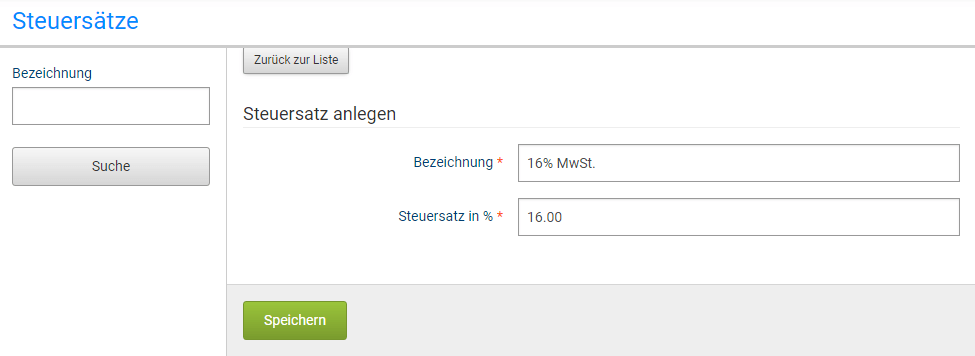
Converia allows you to create new tax rates or adjust them for individual offers at any time. This feature remains useful even after 2020, because German tax rates do not apply to every conference.