


Virtual conferences won't be crawling back into the niche they have occupied for the last few years anytime soon. This is not only because there is so much talk and experimentation with the format right now, but also because at this point, no one can say how long the pandemic and its associated restrictions will be with us.
And even if many are willing to accept a temporary break from events, things should really get moving again by the end of the year at the latest. It remains unclear to what extent this will be in the form of an in-person event. A few small surveys on the topic have already been conducted, and the results at least suggest that it could be difficult to convince people to attend a "real" conference as long as safety measures are in place but no vaccine is available.
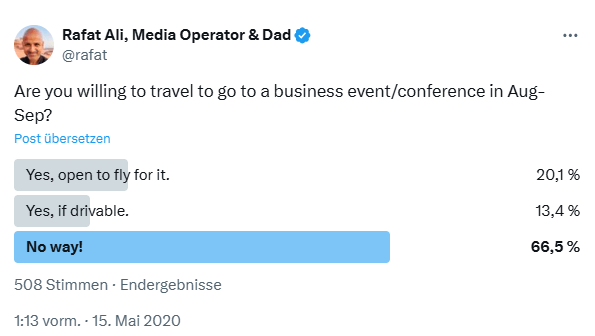
This can be seen as an indirect call to action for organizers to shift their planning toward a digital approach. Turning a blind eye to a virtual interim solution is effectively no longer an option.
This aligns with the coronavirus study by the GCB German Convention Bureau e.V., which examined the attitudes of organizers toward virtual and hybrid events. As recently as early March 2020, there were significantly more voices attesting to stagnant development for virtual event formats or even considering them overrated and not viable for the future. Now, the responses are suddenly much more positive—the crisis has given virtual conferences a boost.
Nevertheless, anyone who has never hosted a virtual conference—and we are still talking about the majority of organizers—has every right to be skeptical. Before embarking on a virtual conference experiment, it is primarily the finances that cause concern.
The distribution of costs is shifting
No one wants to spend a lot of money without knowing how the result will be received. At best, there should or must be a profit at the end. Professional societies, for example, rely on revenue from conferences to fund their other activities. Other organizers, for whom generating large profits from their conference is not the primary goal, must at least break even.
Given this, it is not so far-fetched to first look at the new expenses that a virtual conference entails. Above all, video content must be produced or streams broadcast, which means additional costs primarily for technology, software, and hosting that did not exist in that form before.
At the same time, other cost drivers disappear that were associated with the conference venue: A location does not need to be found, rented, prepared, or decorated; there are no costs for on-site staff, and catering is not required. Depending on how and where the streams and videos are to be produced, it is sometimes impossible to avoid renting space. However, the scale is much smaller. A large hall is not necessary for a virtual conference.
Printing costs can also be eliminated if all conference materials are provided in digital form. Furthermore, the virtual space does not require excursions or dinners as part of the social program.
A direct comparison helps to look beyond just the additional expenses. This is important because costs for virtual conferences are distributed differently and can often be set lower overall.
How much do participants pay for a virtual conference?
Even the most frugal budget leaves the question of revenue open. In this respect, the difference from a traditional conference is less drastic than one might initially think. Participant fees and sponsorships remain the two main sources of revenue for virtual meetings.
In a survey we conducted among more than 200 people, it turned out that more than half of the respondents would still be willing to pay at least 50% of the regular fee if the conference were held virtually. 22% would even find at least 75% of the price to be reasonable. However, the survey participants had previously only had experience with simple video conferencing tools. With a correspondingly more extensive offering and a dedicated platform for the virtual conference, the willingness to pay would likely be a little higher.
In general, however, it is advisable to set prices slightly lower than for on-site events and to offer different packages in order to appeal to more people. One could imagine offer packages tailored to different groups of participants or focusing on the program. This represents a great opportunity for virtual scientific conferences: Traditional conference formats have for some time been in danger of becoming exclusive events that shut out young researchers in particular. If they have to pay their registration fee plus accommodation plus travel out of their own pockets, it is unaffordable for many.
Bookable packages can also be offered to sponsors, who also pay to participate and, in return, receive a space where they can introduce themselves and their services and engage in conversation with participants. Theoretically, sponsors are available around the clock, making them accessible for much longer than at non-virtual conferences.
Are entry controls missing at virtual conferences?
No check-in means open doors for everyone and less revenue—one of the main criticisms from an organizer's perspective. The objection is not entirely unfounded, as virtual conferences do indeed make it easier to sneak in people who have not paid a registration fee. A registered person can, for example, pass on the links to the presentations to their colleagues, or several people can gather around one screen in time for the stream.
Bad? Not really. If you value conferences primarily for their networking opportunities—as most attendees likely do—you won't want to miss out on that online, either. If your virtual conference offers space for interaction rather than just videos, the event becomes more attractive, and interested parties are more willing to pay for the conference experience combined with the content.
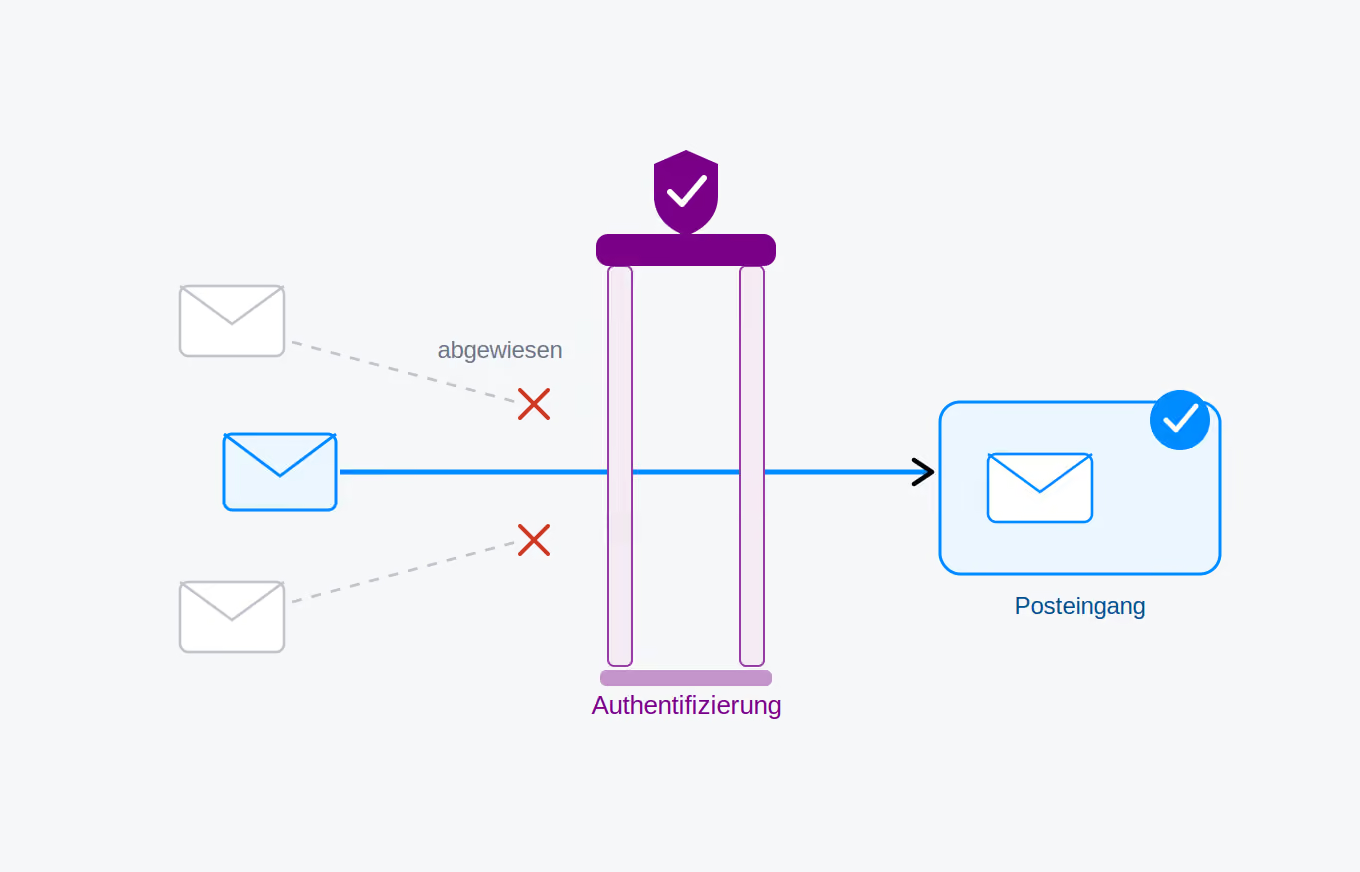
A platform solution for virtual conferences can restrict access to the virtual conference so that sharing a link won't work and accessing the content always requires a login. If the platform is linked to the online registration, you can specifically control who sees which content based on the package they booked.
Regardless, the reality is usually this: people who like a conference are happy to support it. Virtual conferences that manage to capture the charm of their in-person events in the digital world don't need to worry that "freeloaders" will jeopardize the event's future. The Chaos Communication Congress and re:publica, for example, have been filming talks and discussions for years and making the videos available online for free. Yet, tickets for their in-person events still sell out incredibly fast.
Finally, there is the reassuring thought of the aforementioned larger and more diverse target audience that a virtual conference reaches much more effectively. Incidentally, this also applies to purely German-language events, which some people wouldn't have attended under normal circumstances—whether due to scheduling conflicts, time spent abroad, or travel distances perceived as too long.
When attendees end the conference
Careful planning is only half the battle; ultimately, the success of a virtual conference depends on its utility and added value, as event strategist Kerstin Hoffmann-Wagner points out after gaining her own experience with online events. Even with paid attendance, it takes much less effort to simply close the browser window in front of a screen. In person, it takes more effort to just walk out in the middle of a session. As an organizer, you may have received the money, but you will find it difficult to convince those people to attend again the following year.
The reason for an early exit isn't necessarily the content. Organizers of virtual conferences often still run the risk of overwhelming less tech-savvy attendees. They face significant hurdles when redirected multiple times to different tools that they may need to install or are unfamiliar with. Tech-savvy attendees, on the other hand, might be more annoyed by the cumbersomeness of constant tool switching than by the operation itself. Anyone who has had such an experience will likely prefer to wait until things are back in person.
This is another argument for a platform solution that consists of various components and requires only a single login. The effort of creating a separate account for lectures, another for the poster session, and yet another for discussions seems like a bit much to ask for a single conference.
Don't completely lock down virtual conferences
In this way, the action takes place largely behind doors that only open for paying attendees. However, sealing yourself off completely doesn't answer the question for interested parties of what they are (potentially) investing in. Because this plays a crucial role in whether someone registers or decides against it, the virtual conference website should provide an initial glimpse into the program and schedule. What materials are needed? How long does the conference last? Do all program items have to be completed in one day, or will the materials be available for longer?

The team behind the Agile Circle ONLINE conference, which we supported with attendee registration, addressed exactly this before the event while providing an overview of the various formats of their first virtual conference. Such a teaser is an excellent compromise and builds curiosity for the experiment—a new terrain for both organizers and many attendees—which, in the end, hopefully proves to be a success beyond just the financial aspect.