


Starting January 1, 2027, most event organizers will be required to issue e-invoices to their corporate clients. This mandate initially applies to those with an annual turnover exceeding €800,000, and will extend to everyone by 2028. While implementing this might sound like a simple technical formatting task to be handed off to IT, the devil is in the details when it comes to conferences—specifically, down to the very last cent.
What is an e-invoice—and what isn't
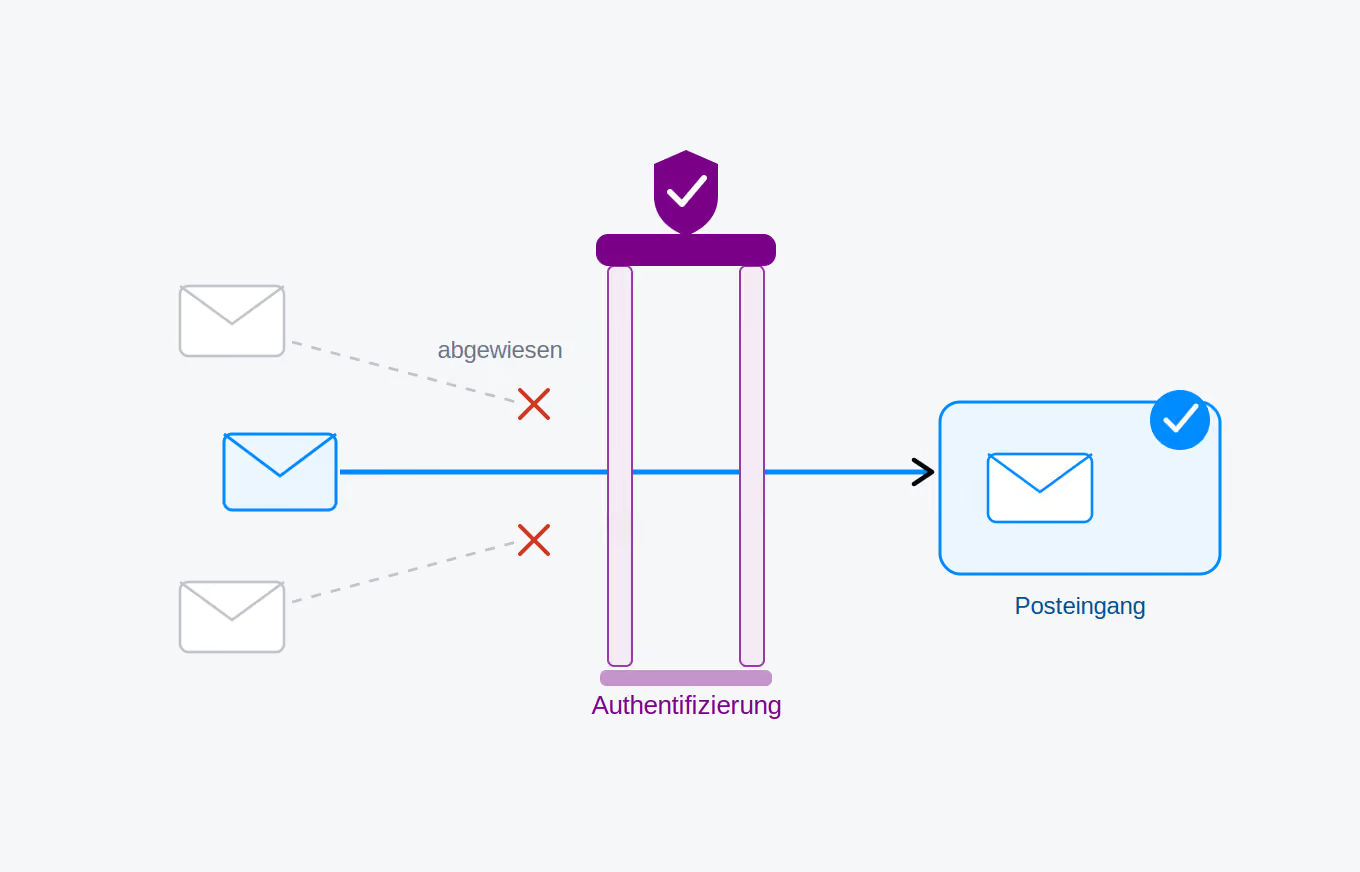
An e-invoice is not simply a standard PDF sent via email. It contains standardized, structured data that can be read and processed by software without the need for manual entry. It is based on the European standard EN 16931. In Germany, two formats have become the industry standard:
- ZUGFeRD is widely used, particularly in the corporate sector. It combines structured invoice data with a human-readable PDF in a single file—accounting software reads the data, while people see a standard-looking invoice.
- XRechnung is primarily used by public authorities and contains only structured data. For the average user, it is only readable with the help of additional software.
You can find more information on formats, mandatory details, and deadlines in our glossary entry on e-invoicing.
The real problem: Conferences have two target audiences
The technical transition to one of these formats is not particularly difficult on its own. It becomes tricky because, in most cases, conferences target both businesses and private individuals—who are considered consumers in the legal sense. The doctor whose clinic pays for her attendance sits next to the doctoral student paying for his ticket out of his own pocket.
For these two target groups, price and tax calculations work in opposite directions:
- Consumers are quoted gross prices. Value-added tax is included in these figures and is calculated and remitted in the background. €349.00 is €349.00—regardless of the tax components involved. Consumers have a legally guaranteed right not to be charged more than the advertised price.
- For businesses, net prices must be consistently defined, with VAT added on top, at the latest in line with e-invoicing standards. This is because EN 16931 calculates from the bottom up: quantity × net unit price equals the line item amount, VAT is calculated on the net total per tax rate, and this results in the final invoice amount.
Where the cent comes from
In itself, this wouldn't be a major issue—if the technical requirements for e-invoices didn't mandate rounding in several places. Line item amounts, tax amounts, and totals must each be rounded to two decimal places. These rounding rules mean that the exact same target gross price can result in different invoice totals depending on the calculation method used. Here are three examples using a 19% VAT rate:
Example 1: A workshop for €15.00
An additional workshop is priced at €15.00 gross. If you calculate the net price, you get €12.605…, which rounds to €12.61. On the e-invoice, this becomes:
- Net: €12.61
- Sales tax 19%: €2.40
- Invoice total: €15.01
If you round down to €12.60 net instead, you end up with €14.99. There is simply no net price with two decimal places that leads exactly to €15.00.
Example 2: Three tickets at €349.00 each
An institute books three tickets that are offered to consumers for €349.00 each. For a single ticket, the net price of €293.28 still leads cleanly to €349.00. But for three tickets:
- Net: 3 × €293.28 = €879.84
- Sales tax 19%: €167.17
- Invoice total: €1,047.01 instead of €1,047.00
For comparison, the consumer invoice for the same amount: €1,047.00 gross, including €167.17 in sales tax—meaning a net of €879.83. A one-cent difference, appearing in a completely different place.
Example 3: Two tickets at €249.00 each
The effect also works in the other direction. With a ticket price of €249.00 gross (€209.24 net), two tickets on a corporate invoice result in €418.48 net plus €79.51 VAT – in other words, €497.99 instead of €498.00.
Depending on the price, quantity, and tax rate, the total may be a cent higher, a cent lower, or exactly right. With mixed tax rates in a ticket or larger group bookings, the difference can even amount to several cents.
How we are solving this in Converia
With the introduction of the e-invoicing function, we will therefore handle separate prices for consumers and businesses in Converia: gross prices for private individuals, net prices for corporate customers. At the same time, we are separating the booking process even more consistently for these two target groups, so that it is clear from the start whether a booking is being made as a consumer or as a business – and which pricing logic applies.
Because, as always, we want to provide legally correct solutions. And above all, we want to spare organizers from having to answer questions from private individuals as to why their invoice suddenly shows one cent more than what was displayed during booking. The cent probably doesn't really hurt most participants. Nevertheless, it is not correct – and from a strictly legal standpoint, consumers do not have to accept it.