

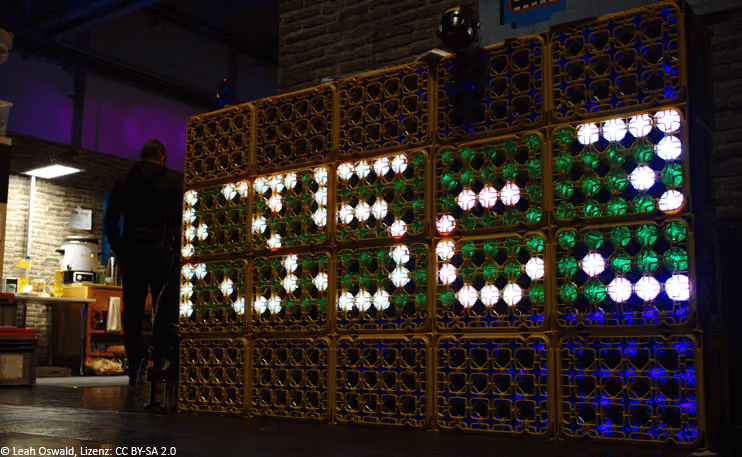
Image by Leah Oswald. License: CC BY-SA 2.0
An event whose audience consists of out-of-touch nerds who only stare at their screens and deal with things no one else understands—this is the image that is unfortunately still sometimes invoked when reporting on the Chaos Communication Congress. However, it is usually overlooked that, in addition to excellent presentations that often deal with the exciting intersections between technology and society, a whole range of innovative solutions for event planning await on-site. These, in particular, deserve attention outside of Chaos events. We have put together a few of the best congress hacks here.
1. Crowdsourcing with empty bottles—the Bottle Drop Points
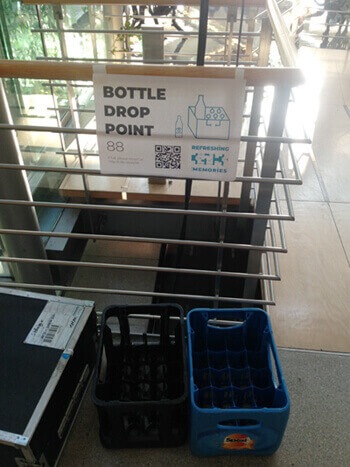
The Congress is unimaginable without Mate and the hacker cocktail "Tschunk." Thirsty visitors were once again busy emptying countless Mate bottles during the four days in Leipzig. Numerous bottle collection points and trash cans proved practical and were well-utilized. Now, with 17,000 visitors, it is unfortunately not easy to constantly keep an eye on how quickly each individual bottle drop point or trash can is filling up, which is why a simple but quite ingenious system comes into play: Each of the points is marked with a number and a QR code. As soon as someone notices that there is no more room for their empty bottle, they just need to take out their smartphone and scan the code. This sends a notification to the assigned volunteer, who immediately knows which collection point they should check next.
In this way, all participants can help prevent the Congress from having too many empty bottles and too few empty crates—the "Bottlecalypse," as the developers aptly call it. The necessary software can be used elsewhere under a free license and is available here. There, it is also explained in detail how the technical side of the application works.
2. Online shifts for volunteers—the Engelsystem & c3loc
To cope with all the tasks at hand, the Congress relies on the "Angels," numerous volunteers, every year. At 35C3, several thousand people followed the organizers' call to take on one or more work shifts. The tasks are extremely diverse and include, for example, press work, answering visitor questions, catering for other Angels, or technical support for presentations or streaming. In Leipzig, there was even a volunteer medical team on-site.
To keep track of all the Angels and individual work shifts, the Engelsystem was used again at 35C3, which has already proven itself at other events. This is software that effortlessly handles thousands of Angels and tens of thousands of shifts, including a messaging system and an attendance management function. To manage some tasks, some of the Angels relied on trucks and other vehicles or pallet jacks. Using the open-source software c3loc, it was possible to determine via GPS at any time where the vehicles and the required equipment were located.
Some of the Angels were also active on Twitter and shared their impressions there:
https://twitter.com/JayDi_/status/1079425271252570112
https://twitter.com/sosicles/status/1078811067827015681
Quite apart from the great software, the Congress obviously has no trouble finding enough volunteers time and again. That might seem surprising at first, after all, the Angels perform their duties without any pay. Why do so many sign up anyway? This could be due to the atmosphere, which has remained familiar despite the scale of the Congress, and the non-hierarchical concept, as former volunteers write quite enthusiastically in their reports. Because the Angels are allowed to choose which tasks they want to take on at the beginning, everyone is involved with enthusiasm. According to an Angel experience report, the positive, casual atmosphere is also very well suited for quickly making new friends. This even works without problems for those who sometimes struggle in social situations. Profitable networking therefore also takes place away from the regular program schedule. And for particularly diligent Angels at the last Congress, there was also a voucher for the 35c3 ticket pre-sale—certainly a reason for many to sign up again, because the tickets are highly sought after.
3. More knowledge for everyone—the video recordings
To enjoy the 35C3 presentations, the trip to Leipzig was not strictly necessary. Everyone for whom the journey was too far, the time too short, or the unique presentation experience not enough can therefore enjoy the extensive Congress archive. The videos are available in more than one language (thanks to the translation Angels) and are transcribed—thanks to the subtitle Angels. A multitude of specially developed software solutions are used as technical infrastructure. These can be found on the GitHub profile of the CCC Video Operation Center.
A little fun fact on the side: To find out if all the video cameras were still working, they used to use waving cats. These were placed on the podiums of empty stages. As soon as a standstill of one of the cats was detected in the control room, it was a sign that the stream was frozen. Today, the waving lucky charms not only act as mascots for the Video Operation Center but have long since become a meme and can be found everywhere at the Congress, for example as a loading animation in the presentation archive.
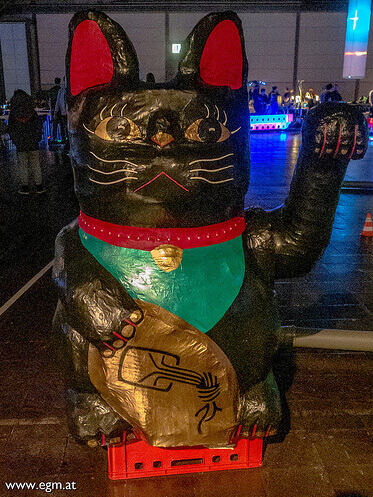
Image by egm. License: CC BY-SA 2.0
4. Safety first - support services
The 35C3 also set an excellent example in resolving conflicts among participants, for which several support services were available. This was not always the case. Just a year earlier, the Congress faced serious allegations: among the speakers were individuals accused of predatory behavior by programmers. Although the organizers had been aware of this months in advance, the official side struggled to find a solution, as the tweets from one of the victims show. While the Chaos Computer Club admitted to mistakes at the time, its overall response was unconvincing, unstructured, and, above all, too late - resulting in unsettled participants, some of whom stayed away from the event entirely. A significant problem that did not go unnoticed outside the Congress itself and had the potential to cause long-term damage to the event.
A year later, a lot has changed: instead of ignoring the issue, the Chaos Computer Club addressed it head-on and created a structure through some entirely new support services for participants that is hard to beat in terms of transparency. Help.ccc.de provides a clear summary of all services, offers a wide range of contact options, and answers the question of which point of contact is the right one for each case. For the first time in 2018, an arbitration board was established to provide support in serious conflicts. If visitors turn to them, the board ensures that all parties involved in an incident are heard and ultimately makes a decision that can include sanctions ranging from a warning to exclusion from future events. This model could also prove helpful for other events struggling with the same issues but which have not yet established a consistent approach.
The Infrastructure Review, a staple of every C3, also provides a look behind the scenes of the 35C3's infrastructure. There, the individual organizational teams explain the solutions they created and evaluate what worked and where problems arose. This is often supported by statistics and figures.
Consequently, the organization at the 35C3 was not chaotic in the slightest. On the contrary, the Congress impressively demonstrates that it is possible to create smooth processes where participants actively contribute, support one another, and make the event a unique experience. The fact that the Congress manages to retain its originally anarchic character despite, or perhaps because of, this is arguably the best side effect imaginable.