

What is a call for papers and why does it matter for conferences?
A call for papers is the invitation to submit scholarly work for presentation at a conference. It is sometimes also called a call for abstracts.
The call for papers is issued by the congress president or the institution behind the event – a scientific society, an association or a university. It is addressed to everyone who wants to contribute to the conference topic and help shape the program.
Common call for papers challenges
High manual workload
Many organizers still run their call for papers by email, and that is how the submissions arrive, too. The organizing team has to sort them, forward them, convert files into a consistent format and often follow up with questions. The more submissions come in, the more work piles up.
Time pressure
Deadlines are tight, yet submissions keep arriving at the last minute and put the review team under pressure. Without buffers and clear processes, schedules quickly start to wobble. Realistic planning and automatic reminders prevent a lot of stress.
Lack of overview
As soon as several people are involved in the call for papers, it gets confusing: Which contributions are still with the reviewers? Who has not revised their abstract yet? Without central management, information ends up in emails, spreadsheets and to-do lists – and sometimes they contradict each other.
Communication with authors and reviewers
Countless emails go back and forth between submission, review and the response to authors. Without automated processes, you send confirmations, reminders and queries by hand. Even with text templates this takes a long time and is error-prone (wrong salutation, missing salutation, forgotten attachment …).
Unclear requirements
Without clear requirements, contributions arrive in every possible shape. Some have the wrong file format, others are too short or incorrectly formatted. They go back for another round – which means more work for you.
Data protection and compliance
Personal data of authors and reviewers often ends up in unprotected Excel lists or email attachments. That is risky and may expose the data to unauthorized people. Universities and organizations in the EU are bound by the General Data Protection Regulation (GDPR), so this would be a clear violation.
Complex review processes
Many conferences use multi-stage blind reviews in which several reviewers assess each contribution. Scientifically, this is particularly thorough – and particularly demanding, because after every round the right contributions have to reach the right next person. Read more about double-blind review in our glossary.
Checklist: Preparing your call for papers
- Who are your potential reviewers?
Do your reviewers come from the scientific society or the faculty? Will you invite leading experts in the field? Or are the reviewers themselves among the submitting authors? - How many papers should one reviewer assess at most?
Ask yourself: How many papers can you reasonably expect one person to review? Who are the reviewers and what other duties do they have? How familiar are they with the topic? What can each of them realistically manage? - Is the review simple or complex?
Simple means: the congress president looks through all contributions and decides alone whether they become part of the conference. This is the time-saving option. Nobody else has to contribute, and there are no back-and-forth questions between reviewers and president.
Complex usually means a multi-stage process. Several reviewers assess each paper. As the organizer, you need a well-paced schedule with buffers in case a phase takes longer. Always plan backwards from a key date such as the program release. - By when do you need to inform the authors?
Authors often wait to see whether their contribution is accepted before they buy a conference ticket.
By then, special booking periods with early bird rates are often over – and some authors are annoyed when only the expensive ticket is left. Consider offering special rates for authors. - By when do you need authors to confirm their attendance?
Obviously, you can only lock a contribution into the program once you know the author will attend. This is quick if you publish your program digitally only – then even last-minute changes are no problem.
Printed programs are different: you have to plan backwards.
First pick the day you want to send out the program.
Then work out how long each step takes until the program is finished (printing, approval, proofs, layout, completing content).
Timeline: Planning call for papers deadlines backwards
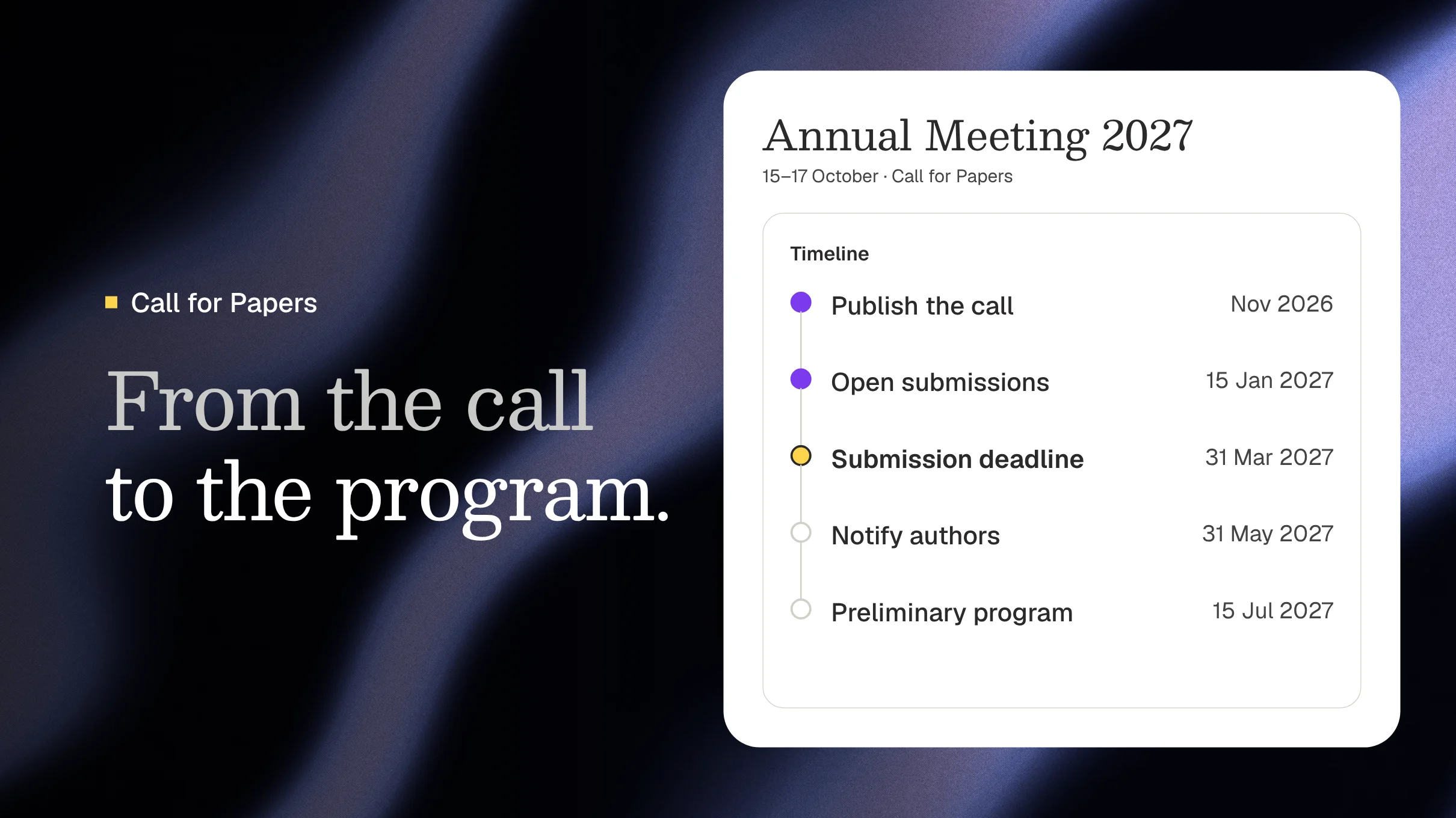
The most important date is not the submission deadline but the event itself. Plan backwards from there – and make sure authors are notified before the early bird deadline ends. The overview below shows proven intervals, using an annual meeting on 15 October 2027 as an example:
Allow a buffer of one to two weeks between the submission deadline and notification. If you have to extend the deadline – which happens often – the whole chain up to the program would otherwise shift.
Checklist: Writing your call for papers
- Invitation or foreword by the congress president
Not a must, but it gives the call for papers a personal touch.
It shows appreciation for authors and invites them to enrich the scientific program with their work. - Main topics of the conference
They give potential authors orientation and answer the most important question first: "Does my work fit this conference?" - Topics you would like submissions on
If these are the same as the main topics and your call is broad, there is no need to list them separately.
If you have several topic areas, list them here. - Presentation formats (poster, talk, workshop, sessions etc.)
Let submitters pre-select a format.
They decide how interactive and practice-oriented they see their own contribution – which matters for your program planning. Posters can be displayed throughout the conference. Workshops are limited to small groups but very hands-on. And each format has its own requirements for rooms and technology.
Present all the options you offer, always with a few details on how they work. Example for talks: 40 minutes in total, including 10 minutes for questions. - Conference language
It depends on your target audience. International conferences usually choose English as the general conference language. - Link for submitting papers or abstracts
The conference website serves several purposes. It tells authors where and how to submit, and the organizing team uses it to publish updates. - Deadlines
- How long can contributions be submitted?
Submissions typically start slowly and pick up shortly before the deadline. Many organizers therefore extend it. Check early whether you have room to do so. - When will authors be informed of the results?
This is a key date for submitters, because many authors decide whether to attend depending on whether their contribution was accepted. - When will the program go online?
Once authors see their talks in the program, they decide whether to attend the whole conference or only the day of their presentation. Always call it a "preliminary program": experience shows you will still need to move a few items, often because authors cannot present on the originally planned day.
- How long can contributions be submitted?
- General conference information (website URL, dates, venue)
Submitters will most likely attend the conference too, so they need more information about the event and at least a link to the conference website. - Special conditions and registration periods for authors, if any
Authors of free contributions supply a large share of a conference's content. Thank them with special registration fees and periods. - If known: submission of manuscripts or presentations
If authors know this, they also know what else they need to prepare and how much work a submission involves. - Poster or presentation awards, if planned
Awards create incentives and will probably bring you more submissions.
Call for papers template to copy
The following template contains everything authors expect before they submit. Replace the details in square brackets and delete anything that does not apply to your conference.
[Conference name] [Year] – Call for Papers
[Date], [Venue] | [On-site / hybrid]
Dear colleagues,
[Society / institution] cordially invites you to submit contributions to [conference name]. Under the theme "[Theme]", we aim to [one or two sentences on the goal of the conference].
Topics
We particularly welcome contributions on the following topics: [Topic 1], [Topic 2], [Topic 3].
Formats
Talk: [20] minutes including [5] minutes of discussion
Poster: [A0 portrait], presented in the poster session on [day]
Workshop: [90] minutes, maximum [25] participants
Submission
Please submit your abstract (maximum [2,500] characters including spaces, structured into background, methods, results and conclusion) by [date] via our online portal: [link]. Each person may submit a maximum of [two] contributions as first author.
Review
All contributions are assessed by at least [two] reviewers in a [double-blind] process. Criteria are [relevance, originality, methodology and clarity].
Key dates
Submission deadline: [date]
Notification: [date]
Speaker confirmation: [date]
End of early bird period: [date]
Preliminary program: [date]
Conditions and publication
Accepted speakers register by [date] at the [early bird / speaker] rate. Accepted abstracts will be published in the [book of abstracts / proceedings]. By submitting, you agree to publication.
Contact
The organizing team will be happy to answer questions at [email address].
We look forward to your submissions!
[Name], [Congress president]
The checklist above explains what to write in each section. If your congress also accepts proposals for entire program blocks, add a section on the call for sessions.
Checklist: Promoting your call for papers
- Direct mailing to potential participants
The most direct way to reach people. You may have addresses from previous meetings or research them – think of physicians for a medical congress or researchers from specific fields. - Inserts in professional journals
Every topic and discipline has its renowned journals. Check publication dates in advance and consider how they fit your call for papers timeline. - Displays at universities and research institutes
Unlike journal inserts, which tend to be expensive, this option is low-cost. You still have to research addresses, though, and it is hard to check whether the call is actually posted or ends up in the recycling bin. - Inserts in conference bags at related conferences
A great way to reach potential participants while they are already in conference mode. Perhaps you can strike a deal with the other organizing team so your events promote each other. - Announcements at related congresses
An alternative to the previous point. If the other congress has no bags or inserts are too expensive, a short announcement may be enough. - Member mailings by professional societies
Societies often support each other – as long as they are not competing on the conference topic.
Example: the member addresses of a general practitioners' association are certainly interesting for the annual congress of a hypertension society, since its members often deal with blood pressure. - Websites of related societies and institutes
You will rarely get access to member addresses. But members visit their society's website regularly – ask whether a short note about your call for papers is possible. - Event calendars
Some societies run their own event calendars, which also offer space for your call for papers. - Social media
News about the call for papers or your finished program belongs where potential participants spend their time – perhaps LinkedIn, perhaps ResearchGate. - Open distribution
More relevant for public or lay events; otherwise conventional flyers easily get lost. We do not recommend it for professional conferences.
Checklist: Information authors need before submitting
- General notes on the submission process
When will authors be informed of the review results? When will the preliminary program appear on the website? - Submission format
The key question is whether abstracts consist of text only or include other data – in which case an upload is the better option.
There are several options:- plain text
- HTML form
- file upload
- a combination of plain text and upload
- Formatting requirements
You decide whether to give authors freedom or prescribe a structure (introduction, main part, conclusion).
Provide a downloadable template if you are planning proceedings, so all papers arrive in a consistent format. - Maximum number of characters or file size
Base this on planned print products: How many characters of body text fit on an A4 page, for example? - Use of special characters, formulas, images etc.
This depends on the scientific field. A psychology conference can often do without formulas; a physics conference cannot. If authors enter text directly when submitting, special characters and formulas should be available. - Consent to publication terms and/or terms and conditions, if applicable
Consider the legal side from the start. For example, state clearly that by submitting, authors also grant permission for their contribution to be published later. - Planned publications
Authors should know where, when and in what form their contribution will appear. A publication notice protects you regarding the use of the papers. - If limited: maximum number of submissions and paid presentations
More and more organizers charge a higher fee for speakers who want to give more than one talk. Authors should know this in advance. - If possible: session submissions
At some conferences, participants can submit not just individual contributions but entire sessions (call for sessions). Note that this requires professional software – simple forms usually cannot handle it. - Required data for authors and co-authors
Ask submitters to pay attention to the order of authors. Who is the author, who are co-authors? The order is often based not on the alphabet but on importance or share of the work.
More questions from practice
How do you handle a very large number of submissions?
Clear review guidelines and a structured assignment of contributions to reviewers help when submissions pile up. Professional abstract management software handles this well. If there are many good papers, convert some of them into posters or short talks.
What if too few contributions come in?
If fewer authors submit than expected, it usually helps to promote the call for papers more actively. Think about where else you could publish it (again). Extend the submission period. Or identify people who could contribute to the conference and ask them directly whether they would like a speaking slot.
How do you keep authors informed about the status of their submissions?
Regular status updates are key. Your conference website should state when reviews are completed. Are there changes to the schedule? That belongs on the website and in a newsletter to all authors. A transparent communication process, ideally through a central system, builds trust and reduces email inquiries.