
In this article, we highlight five classic pitfalls in conference program planning—and how to avoid them. This will ensure your conference not only impresses academically but also truly engages your attendees.
Mistake 1: Starting by collecting abstracts.
A vague call for papers leads to vague submissions.
Organizers often start with a call for papers rather than the event's goals. Researchers then submit abstracts that might fit the theme loosely, but lack a clear focus. If you are hosting a conference on tourism studies, you might receive abstracts on sustainability, general travel behavior, or online reviews. You get a bit of everything, but one thing is missing: a common thread.
🎯A cohesive program starts with a clear goal.
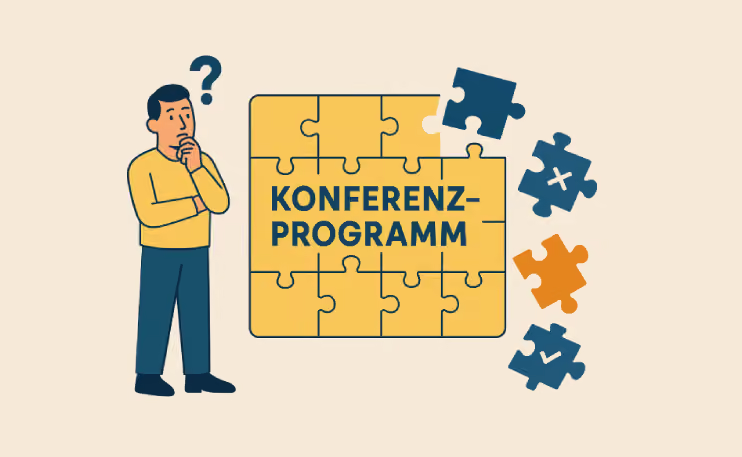
Publishing a call for papers without a clear direction is like starting a jigsaw puzzle without knowing what the final picture should look like.
Always ask yourself these questions first:
❓What is the goal of the conference?
❓What key takeaways should the attendees leave with?
The clearer the goal, the greater the value for everyone involved.
Mistake 2: The conference program is packed with lectures.
Lectures dominate many conference programs, and that is a problem.
While they are a standard academic staple, they should never be the only format your conference offers. When people listen for hours on end, they quickly tune out, resulting in less attention and less value.
💬A good program needs more than just speeches.
Attendees should still have their say, but perhaps through direct exchange. Why not experiment with interactive formats like a World Café, breakout sessions, or workshops?

✂️Shorter lectures make a bigger impact. Topics can be revisited later in interactive formats, giving others the chance to contribute, learn together, and spark new ideas.
💡For a deeper dive, you have the opportunity to participate in a training session and receive additional materials:
Mistake 3: Prioritizing a keynote above all else.
A bit of star power in the program is nice, but a famous name alone adds little value if the keynote itself lacks substance.
Choose your speakers wisely. What matters is their professional expertise and the relevance of their topic to the conference. Prestige is secondary. Ideally, your conference should offer far more than just one highlight.
🔎Don't force a keynote speaker.Your top choice might not be available on the day of the conference. Either plan for other speakers in advance or skip the keynote entirely. Sometimes, a lively panel discussion is more productive than another lecture.
Mistake 4: The sessions lack a narrative arc.
A good session has a sense of drama. Like a well-written piece, a session should develop over time: starting with a theoretical foundation, moving through a practical example, and ending on a point that will play a major role in the future. Alternatively, you can intentionally pit different positions against each other. Planning this way creates space for debate and deeper insight.
🎤Moderation gives a session its voice. A moderator does more than just welcome guests and introduce speakers; they weave a common thread throughout the event. They connect individual contributions, pose key questions, summarize insights, and spark discussions. This transforms a session from a series of isolated presentations into a shared space for ideas.
Mistake 5: The conference program is too static.
A good program is dynamic. Many organizers finalize their schedules too early and plan the flow too much from a top-down perspective. Why not give participants more room to actively help shape part of the program?
⏲️For example, set aside an hour or two in the afternoon of each conference day. You provide only the time frame; the participants decide the content through proposals and voting.
A vibrant program emerges when participants are invited to help shape it.
✅Here is how:
- Open sessions ("unconference") with proposals via voting
- Afternoon exchange formats with open topic selection
- Feedback loops for program optimization
💡Trusting participants to help shape the conference program will reward you with a particularly lively event and many valuable ideas. The program becomes a space for resonance as soon as everyone is allowed to participate.
As you can see, a good conference program is no accident.
Take time for clear goals, well-thought-out formats, and the needs of your participants. This lays the foundation for a conference that continues to resonate long after the final slide.
It is not about doing everything differently than at the last conference, but about planning more intentionally. The best programs emerge where a thoughtful structure and open formats do not exclude, but complement each other. That is exactly where good science communication begins.
Conference training for academics: Take your conference organization skills to the next level!
Use this Converia voucher code to get a 10% discount: Converia_Earlybird_10
👉 DESIGN successful events: Where creativity meets strategy!
Do you want to design events that exceed your attendees' expectations?
This training will ensure your events are inspiring and memorable!
👉 PLAN conferences stress-free
Would you like to start planning conferences with seasoned ease?
Get the methodological expertise you need for a successful project launch!
👉 EXECUTE conferences successfully
Would you like to start running conferences with seasoned ease?
Gain the methodological expertise to guide you through the event day with confidence and calm.