


Backsliding into old habits
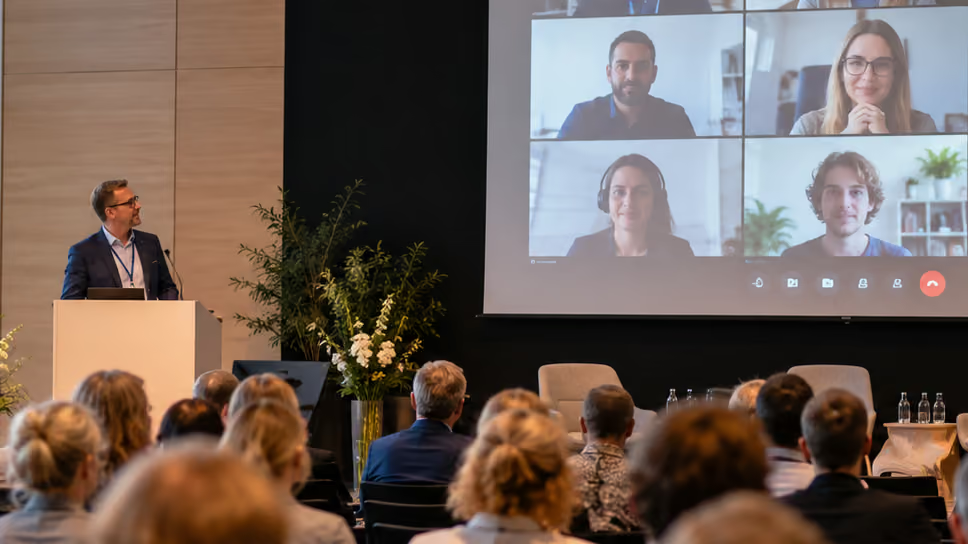
It used to be much harder to convince people to attend an online-only event. Now, there is hardly any way around it. Unfortunately, we are increasingly seeing modern, alternative concepts for knowledge transfer being abandoned online, even though offline conferences have been moving toward these very concepts for years. In the virtual space, learning is suddenly reverting to a lecture-style format.
This regression is the fault of an approach taken by some organizers who fail to observe the following principles:
- The more webinar-style content a virtual conference has, the less attractive it is to attendees.
- If participation requires the use of many different tools, it negatively impacts the conference experience.
What exactly is supposed to be wrong with webinars?
Webinars (short for web seminars) are not inherently bad. They focus on a specific topic that one or two people present to an audience. This is well-suited for providing insight into a subject or offering a guide—comparable to a tutorial or a workshop. The focus is on conveying knowledge; attendees are essentially just watching and listening, with very limited ability to influence the proceedings themselves.
Sometimes, attendees are asked during registration which aspects they would like covered, or there might be a Q&A session at the very end, but otherwise, the audience remains invisible. Pure webinar formats tend to be anonymous, and it is often unclear who else is participating. Webinars are generally not designed for real-time discussion.
Meeting new people and reconnecting with acquaintances are two things that are highly valued by conference attendees. More than half of the over 200 organizers and attendees we surveyed in the spring mentioned networking and discussing with old and new acquaintances when asked which elements they would be reluctant to give up at virtual conferences.
Conference attendees want to engage with one another, but webinars force them into a role where that is impossible, focusing instead on content consumption. Organizers who view knowledge transfer solely from a one-way perspective are making a critical error, because virtual conferences without interactive components feel lifeless and incomplete, or in short: not like a conference at all.
What can a virtual conference do better?
Participating in a webinar often involves using typical tools like Zoom or GoToWebinar. Since a conference usually includes other formats, the toolset must be expanded to include appropriate applications, such as those for file sharing or collaborative document editing.
However, if using each of these tools requires a separate login and perhaps even a download and installation on one's own device, it becomes increasingly demanding and cumbersome.
If a virtual conference instead combines various tools on a single platform, the constant switching of tools and repeated logins are eliminated—and attendees are more deeply integrated into the conference experience, for example by receiving targeted contact suggestions based on their interests.
At an in-person conference, much of the experience happens spontaneously outside of the sessions: the coffee break conversation, the discussion about the lecture just attended, the encounter with a sponsor who mentions an interesting job opportunity, etc. Such encounters have no chance of happening if the conference consists only of webinar videos.
And eventually, even those become monotonous because they leave little room for variation and the setting is inevitably repetitive. Furthermore, it is impossible to engage with the content in any depth. Since questions or facts raised in lectures and discussed afterward are more likely to be remembered, it helps if attendees can post them directly under the video. This allows the content from the lectures to be revisited and discussed or expanded upon at any time—the pure webinar character is lost, which should be seen as a good sign.
Webinars don't get everything wrong
At the same time, webinars are often very practical in design and therefore—at least in terms of subject matter—an approach that a conference program can be based on. Webinar content often revolves around current questions or problems that attendees face in their daily lives. If organizers know what moves their audience, they can align the program accordingly and expand the session topics with a mix of interactive elements and formats. These include, for example:
- Discussion rounds and panels
- Polls
- World Cafés and breakout sessions (many alternative conference models can also be well represented online)
- 1:1 chats
- collaborative formats where attendees work together on a virtual whiteboard
- formats for sponsors and exhibitors who are represented with their own profiles and banners, have information material available, and are available for chats
- online coffee breaks
- contact suggestions to more quickly find people with the same interests
Ultimately, all these elements create an environment that gives attendees the feeling of being part of a conference that combines learning and networking, making it very close to a physical conference.
Individual sessions with a webinar feel do not necessarily harm a conference. However, they should not make up the bulk of the program, and organizers should ensure there is always an opportunity to continue the discussion afterward or to break up the rigid webinar format by incorporating spontaneous input from the audience.
While participants may be better informed after a webinar, only a conference provides the added value of a shared learning experience.
How does this look in your planning? To what extent is your virtual conference moving away from a pure lecture format?