


When industry representatives support healthcare professionals with financial contributions, it sometimes leaves a questionable impression. Is this still professional, or is it already indirect influence on the sponsored individuals? They might, after all, show their appreciation in one way or another later on. Whether that always happened or not could never be predicted with certainty, but the risk of corruption was reason enough for MedTech Europe to officially put a stop to sponsorship in its previous form as of January 1, 2018. Since then, the Code of Ethical Business Practice of the European medical technology industry association has been in effect. All MedTech Europe member companies are now prohibited from directly sponsoring the conference attendance of healthcare professionals. MedTech Europe is not a pioneer in this regard. Similar regulations have existed for some time in the USA, Latin America, and China, and European countries such as France, Slovakia, Denmark, and Portugal have also had specific regulations for greater transparency for several years.
In Germany, direct sponsorships are not yet illegal, but the MedTech Code, in particular, has sparked a discussion about their ethical justification. In the Medical Devices Code, the German Medical Technology Association (BVMed) distinguishes between the legality of cost coverage based on whether the company organizes the conference itself, where it takes place, and whether a sponsored person participates actively or passively. Because there is no case law on this yet, the legal situation is very confusing. In principle, companies can very quickly fall under suspicion of corruption when it comes to sponsorships. Once such a suspicion is raised, the public prosecutor's office is forced to initiate investigations. Those who do not want to recklessly jeopardize their reputation in light of this are likely to stop providing financial support altogether.
Educational grants as a replacement for direct sponsorships
However, the goal of the codes is not to ban industry sponsorships entirely. For medical conferences in particular, that would be a fatal decision. Congresses are profitable for organizers. But if industry support is absent, the number of participants could drop drastically. This effect was observed five years ago in the USA, when new legal transparency requirements resulted in a decline of up to 50% in congress registrations – not a pleasant thought for organizers. Beyond all financial losses, this is also harmful to career development and the promotion of young talent. Young professionals and scientists, in particular, should be given the opportunity to attend conferences. However, large and long-established events usually charge very high participation fees, which keep many interested parties with tight budgets from buying tickets.
How can this be prevented without excluding the industry entirely? Educational grants have proven to be a worthwhile solution that the law does not object to and that function in a very similar way: manufacturers of medical software and technologies, as well as pharmaceutical companies, continue to provide money for conference attendance to professionals, but are no longer allowed to decide for themselves who exactly benefits from it. Instead, the amount first goes to PCOs or medical institutions such as hospitals that are organizing a conference. Subsequently, the organizer or a PCO selects the individual recipients – indirect sponsorship, so to speak.
Why award educational grants?
The problem described above is by no means limited to doctoral candidates or young professionals. Educational grants also help doctors or scientists from low-wage countries, for whom attending international congresses is often out of the question due to high costs. If their experiences and ideas are heard and they acquire additional knowledge, it could mean a gain for many others and also for the quality of medical care in their respective home countries.
Furthermore, companies from the industry are naturally interested in the further development of applications, technologies, and skills. And because bundled, often even interdisciplinary expertise is still most easily found at conferences, there will likely continue to be great interest in supporting such events. Often, conferences are precisely the places where participants learn how to effectively use the products developed by the companies. Educational grants ultimately help ensure that conferences remain relevant and do not turn into exclusive events for those who can afford to finance their visit out of their own pockets.
Integrity and transparency
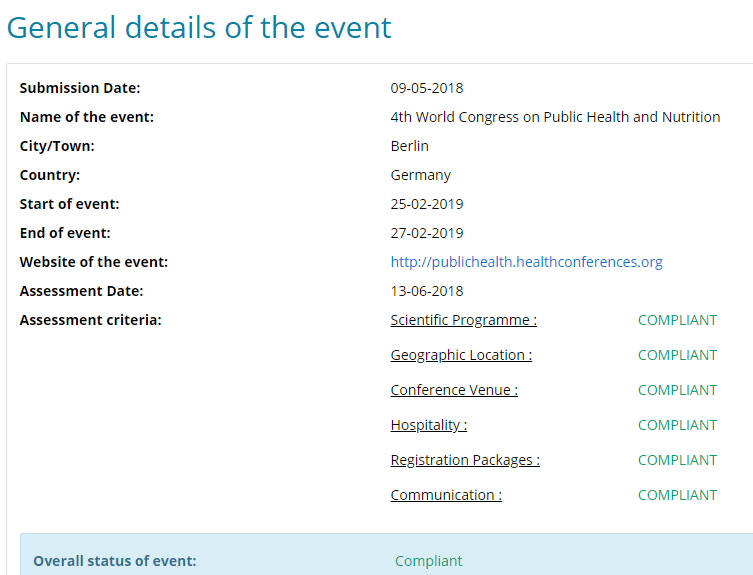
With the code, MedTech Europe has introduced another innovation: educational grants may only be used to support conferences that have previously undergone a compliance procedure ("Conference Vetting System"), which checks whether the event can be classified as worthy of support at all. Events without a sound and relevant scientific program are filtered out, as they do not count as further education according to the guidelines. All others that have successfully completed the process are recorded, along with the decisive criteria, on the Ethical MedTech portal, which is also used for submitting new events for review.
In addition, companies and associations often have their own, sometimes strict, regulations regarding the awarding of grants to conferences. From a legal perspective, there is nothing to object to regarding such requirements – companies and organizations are allowed to decide for themselves whether and which events they want to support, just not the participants who receive the money.
Companies that award educational grants were also required to disclose by January 1, 2019, at the latest, which financial resources were contributed to which conferences. In addition, a written contract with the PCO or the medical institution is required, which specifies, among other things, how the money is used and what obligations the beneficiaries have. Incidentally, MedTech Europe also certifies PCOs in addition to events, ensuring compliance with the code during the planning of the conference and the grant application process.
Sponsors usually pay a fixed amount per participant, which is also agreed upon in advance. Furthermore, it must be regulated before the start of the application phase which costs are covered by the educational grants. Usually, this includes registration, accommodation, and travel for the participants. Sometimes, additional extras such as a free, time-limited membership in a professional society are included. Precise information on cost coverage should in any case be available on the conference website. The names of the companies providing educational grants can often be found there as well.
Educational grants and event management software
Since the new MedTech Code has only been in effect since this year, the educational grant application process is still relatively cumbersome for many conferences. Unlike in the past, interested parties must now apply for a grant. For this purpose, a form is usually provided as a PDF file on the conference website, which is filled out, signed, and returned to the organizer. In addition, a letter of recommendation and sometimes a letter of motivation are often required for the application. Some organizers work with survey tools instead of PDF templates, which, while keeping the process digital, are not really suitable – partly from a data protection perspective, and partly because the tools are not functionally designed for such use.
It is easier with conference software that is capable of mapping the application process. Organizers thus either provide a separate online form on the conference website or offer the grant application as an option during participant registration.
Although companies are not allowed to decide for themselves who receives their educational grants, they are permitted to set requirements that applicants must meet in order to obtain subsidized conference attendance. It is often required that they be a member of a specific professional society, come from a specific country, belong to a specific age group, or have not already received a grant in the previous year. For scientists, other criteria such as the number of previous publications are sometimes included in the decision. The Hirsch factor (h-index), which evaluates a scientist's output based on the number of publications and the number of citations they have received, sometimes also plays a role. The final decision is then made by a committee or the PCO responsible for the conference. Subsequently, the applicants are notified by email whether their application was successful – a task for which the same software can ideally be used. Those who receive a grant now have time to register – also with the help of the software. This also has the advantage that the data of the individuals does not have to be entered multiple times in different systems.
More to do, but...
Since the introduction of the MedTech Code, increased transparency has initially meant more work for medical conference organizers. Where attendees previously handled their own ticket funding, there is now a multi-stage process for distributing educational grants. However, organizers can counter the increased administrative and planning burden with a software solution. Ultimately, this also benefits the attendees and the event itself, because as long as educational grants remain available, neither the significance of the event nor the diversity of the participants will suffer.