

1. Livestreaming
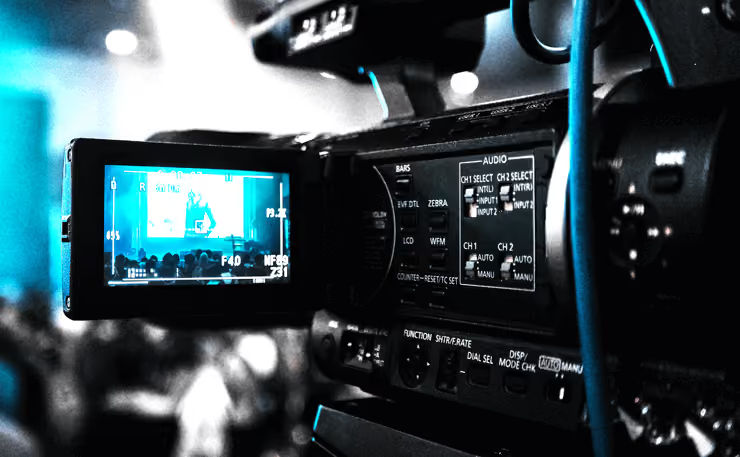
If you believe the general predictions, moving images are currently the gold standard and something no event organizer will be able to ignore in the future. Whether that will eventually apply to everyone remains to be seen. The fact is, however, that videos generate attention and are particularly effective now that everyone has their smartphone within reach. Where there was previously only disappointment at not being there in person, a stream now bridges the physical distance. This doesn't always have to be implemented as an elaborate live broadcast of the entire event; it works just as well on a smaller scale. Apps like Snapchat are perfect for capturing the action, sharing it with others, and sometimes even providing an exclusive look at what is happening behind the scenes at an event.
Because there is still a big difference between being there live and just watching the action on a screen, livestreaming can definitely serve as promotion for a conference. Good streams have the power to make many viewers wish they were there in person. Even better if some of them actually become ticket buyers next time.
2. Augmented and Virtual Reality
Even if you didn't go hunting for them yourself last summer, you couldn't have missed the Pokémon Go hype. For some users, the app is already "so 2016" and a thing of the past, but the technology itself remains absolutely groundbreaking. In any case, the game provided a taste of what is now possible.
The development of virtual and augmented reality is, of course, far from over. VR headsets like Oculus Rift or Google Daydream impressively show where the trend is heading—though always only for the person wearing the headset. Because events are also a shared experience, future developments will place a stronger focus on social aspects. The virtual world will then become something that multiple people can experience simultaneously.
3. Self-Service
Why do people actually choose to attend an event? Certainly not to spend way too much time standing in a queue. An effective remedy for this is self-service check-in solutions. After a quick scan of the ticket, the rest happens automatically. Once the attendee is found in the system, they can pick up their printed name badge just a moment later.
Overall, this cuts check-in time by more than half. The staff also benefits from the increased independence of the attendees, as they no longer have to worry about mixed-up badges. Instead, there is more time to answer questions.
4. Wearables
It’s great to be able to keep an eye on all important data. However, that is hardly possible without a laptop, tablet, or smartphone close by. This could become a bit problematic during a conference opening speech, as it doesn't look very elegant to pull your smartphone out of your pocket just to check the current attendee numbers. Thanks to wearables, this is no longer necessary. If the smartwatch can be linked to the event management software, you can wear the most important conference metrics on your wrist instead of having to navigate to a dashboard.
Since wearables aren't going anywhere anytime soon, it will be exciting to see how they develop further. Perhaps in a few years, everyone will be checking in on-site using their smartwatches.
5. Green Events
Do you remember August 8, 2016? That was the date of the last Earth Overshoot Day, the day when the Earth's capacity for the year was exceeded. Consequently, the annual supply of renewable resources was already used up by the beginning of August 2016. For comparison: the first Earth Overshoot Day was calculated in 1987 and fell on December 19th back then. It’s not a pleasant thought, and many organizers now feel the same way, which is why "sustainability" is becoming a major topic in trade journals and relevant industry blogs more and more often. Fortunately, thanks to the volume of articles and discussions, the likelihood of sustainable events being a passing trend is very low. Establishing environmentally conscious green meetings is ultimately something every organizer can do. Reducing paper consumption and choosing event management software providers that use green electricity are just two steps on the path to a greener event.
6. Event Apps
In the context of green events, event apps are also likely to become more important in the future. In the long run, they could even completely replace printed conference programs. On one hand, they can react to changes at short notice, and on the other, they are highly extensible. For the event, this means that organizers can update the conference schedule immediately whenever something changes, and the latest version is then displayed directly on the attendees' smartphones.
The practical thing about event apps is their versatility. They can be used to rate individual presentations, create personalized conference schedules, or follow all news related to the event thanks to social media integration.
7. APIs
Compared to other trends, the API—a rather inconspicuous programming interface—receives far less attention. Yet it is groundbreaking, as it ensures that different applications work together, thereby reducing the effort involved in conference organization. This is practical when, for example, data from event management software needs to be transferred to an accounting system. The two applications do not need to be from the same provider to exchange data. In this regard, the API replaces a great deal of manual work; invoice data does not need to be re-entered, and existing member logins for an association do not need to be recreated. Given the many different systems used alongside core conference management software, APIs will remain significant in the future. They are a tremendous help, with their greatest strength being that the user doesn't even need to think about them.