

A healthy lifestyle and sustainability have become increasingly important in recent years. That this trend is also reaching conferences was made clear when the World Obesity Federation began awarding the "Healthy Venues" title to particularly health-conscious event locations, including the Messe Wien Exhibitions & Congress Center in the German-speaking region. This is not just a PR label, as venues must prove they actually meet the specified requirements before they can use the title.
However, there is likely a long way to go before healthy conferences become the standard, as shown by the results of a study on wellness at events recently published by the Incentive Research Foundation (IRF). Beyond a general smoking ban and the availability of low-calorie drinks, not much usually happens at conferences to benefit the health of participants. On the other hand, the majority of the 300 organizers surveyed claim to place great value on health and wellness. This seems to apply primarily to those employed by agencies, who are clearly a step ahead in this area and are now focusing more on health-conscious planning. So far, however, only 5% of respondents would describe the conferences they organize as "very healthy."
Why is progress not happening faster? Do healthier conferences fail due to tight budgets, like so many other things? The IRF study paints a different picture. Financial constraints play only a minor role in the results. According to the responses, if organizers had more money available, it would not necessarily be spent on more healthy conference offerings, as one might prematurely assume. Therefore, the lack of healthy options cannot be blamed entirely on additional costs.
Many small steps
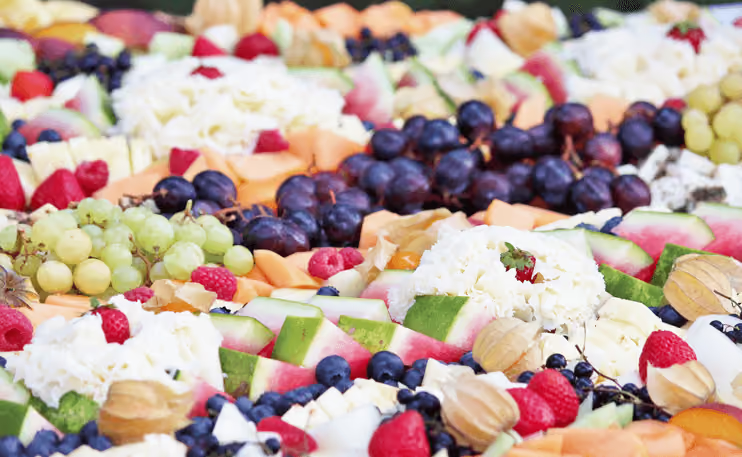
Why are healthy conferences important in the first place? Healthy nutrition and more physical activity have an impact on the general receptiveness of participants. When the nerves and brain are supplied with sufficient nutrients, it boosts both concentration and productivity. To ensure the effect lasts, it is advisable to provide catering that includes whole grain products alongside fruits and vegetables. Avoid sweets and generally look for sugar- and salt-reduced foods, as too much salt increases the risk of cardiovascular disease. To meet fluid requirements, water instead of sugary soft drinks is a good choice. Because many find plain water too bland, you can alternatively provide infused water—flavored water that is very easy to make. Nothing is needed except water and a handful of fruit, vegetables, and/or herbs. For a very simple version, just add a few slices of cucumber or lemon to the water and chill it for about an hour. Since lemon stimulates the metabolism and provides energy, this has even more positive effects. The drink becomes even more beneficial for concentration and memory by adding rosemary. If you choose the infused option, feel free to prepare a little extra, as experience shows that people drink more water when it contains fruit. You will likely observe something similar if you serve fruit in sliced form rather than as whole pieces.
Staying active
A packed schedule that takes place almost exclusively indoors and primarily while sitting is still the rule, except at sports congresses. However, if you want to encourage more movement, you don't have to rent a gym and force everyone into a rigorous fitness program.
Measures for more physical activity during a conference can be integrated into the schedule in other ways. For example, you could offer rental bicycles to get to the venue faster or to explore the surroundings during breaks. Nearby parks or forests are perfect for exploring on foot. Incorporate excursions and outdoor trips into the supporting program. Even in bright rooms, natural light is often blocked out during presentations when the windows are darkened. Therefore, consider whether it might be possible to move a workshop outdoors—provided, of course, it is not the middle of winter and the weather cooperates.
Sitting for hours is not ideal. Combat this during breaks by not having tables and chairs everywhere. Some organizers offer participants the opportunity to network at standing tables. In principle, this is not wrong, but it is not ideal for people in wheelchairs. For the same reason, it is not a good idea to take elevators out of service during the conference to encourage taking the stairs. Since the idea behind it is not bad, you could place a sign in front of each elevator suggesting the healthier option for changing floors.
Despite all the health-conscious ambition on the part of organizers, the principle should always be that these are merely suggestions. If everything healthy is declared a mandatory requirement with no alternative, it might not be well-received by some. It is better to provide a health-conscious environment without forcing anyone to do anything. What the participants make of it is up to them. Those who have a choice are more likely to try something new.
You can be a bit stricter when it comes to smoking by declaring the location a smoke-free zone. An interesting range of activities for more movement during breaks might keep a participant from reaching for a cigarette and prevent another visitor from using their free time just to check emails. The spectrum of ideas is broad and can include everything from fitness exercises and learning relaxation techniques to yoga. For example, conference organizer and yoga teacher Sarah Robinson invented #DevYoga for this purpose. It is a yoga session for programmers that requires no equipment or special clothing, making it accessible to everyone at tech conferences who wants to live healthier. And since we were just on the subject: many yoga exercises are also well-suited for people in wheelchairs.
You can integrate even more exercise by expanding the offering to include existing facilities, such as negotiating when booking hotel allotments that conference participants can use the hotel's fitness rooms. However, this is more recommended for larger events where you might already know that you can expect some sports enthusiasts.
Another approach comes from the field of gamification. Playful elements are used by organizers in the form of pedometers given to participants. At the end of a conference day, the data is compared, and the person with the best result receives a reward.
Start with a short survey beforehand to find out how much interest there is in various physical activity and sports offerings. Purely outdoor options are not advisable here, because as soon as it rains, the offer is gone. Make sure that the exercises are simple, require no special experience, and can be continued outside the conference. The idea behind all of this is that a little movement in everyday life is not a bad thing, which might be the start of a long-term shift in thinking. Also, preferably offer fitness sessions lasting 15 to 20 minutes. These can already achieve a lot and are less intimidating for beginners who probably wouldn't want a two-hour workout. Again: create an offer for everyone that acts as food for thought, but without any mandatory participation.
A question of cost?
Those in the fortunate position of not having to work with a strictly limited budget have a free choice among countless possibilities when putting together vital offerings. However, it is equally wrong to think that only the most investment-happy organizers can pull off healthy conferences. Fitness coaches, for example, are certainly not affordable for everyone, but they are also long since not a must for a conference. Small measures are similarly effective and involve at most minor additional expenses. Smaller portions, more fruit, or longer breaks with walks between sessions enrich the program without harming the finances. Unfortunately, healthier conference catering often comes with higher costs than a fast-food option would. Overall, however, healthy foods are more satiating, which means less needs to be ordered. Anyone who also pays attention to sustainability from the start will end up with less waste and thus save money. We have summarized how organizers can counteract food waste before the conference in this article. With conference software, registration can be designed, for example, so that you can ask participants about their preferred diet (vegetarian, vegan, etc.). With this information, you are better able to estimate how many portions of which variety you need.
Furthermore, communicating the activities is comparatively inexpensive. Use the conference website to explain which routes in the area are suitable for a jog or a walk. Are there sights or interesting places that can be reached on foot?
On the other hand, you can skip some well-intentioned aids entirely. This applies, for example, to the once very popular exercise ball, which is suitable for training at most, but not as a furniture replacement for long conference sessions, and is even said to be harmful in the long run.
Don't forget the team
When planning for a healthy lifestyle, don't forget the hardworking on-site teams who should also have access to these options. While no one on the team is likely to complain about a lack of movement during the conference, the most important factor here is catering that shouldn't differ significantly from what the attendees are served. Always ensure that everyone on the team has enough time for meals. This is a targeted way to combat stress, which will be in abundance once the conference is underway.
After the event, it is also a good idea to collect feedback via email from all participants. By using a survey, you can find out how satisfied everyone was with the healthy options and how likely they are to make long-term changes to their behavior. Perhaps the responses will even spark a new idea for the next conference. Positive feedback will certainly give you the rewarding feeling that your conference provided value that extended well beyond the event's actual content.