
1. What do you find exciting about graphic recording?
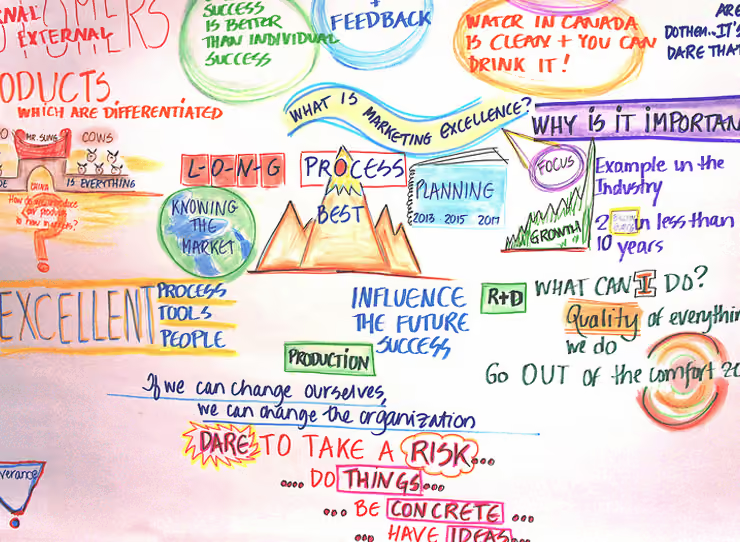
The "real-time" creation of a visual impression of a discussion or speech.
When a graphic recorder truly listens attentively, the graphic recording visualizes the emergence of collective intelligence. You can visually witness the process in the drawing itself and follow the developmental stages of the discussion.
2. Is graphic recording better suited for soft or hard facts?
Graphic recording is suitable for all topics! I have used graphic recording for both natural scientists (Prof. Dr. Ernst von Weizsäcker) and humanities scholars (Prof. Dr. Dr. Andreas Kruse). However, the way these experts communicate differs. That is when the ability to listen well and attentively becomes particularly important.
Graphic recording is a valuable addition to conferences (e.g., lectures, panel discussions) and large-group events (e.g., World Cafés). However, graphic recording can also be very useful for smaller discussion groups (strategy sessions, team meetings, focus groups, etc.).
3. What added value does graphic recording offer the client?
Graphic recording allows us to view the content of a discussion from an entirely different perspective. With the growing desire to foster creativity and innovation, graphic recording should be used in many more situations. Through the unique integration of shapes, colors, and words, both sides of our brain are engaged. Most meetings are planned in a rather factual and analytical way. Using graphic recording brings another dimension into the room: the creative, intuitive, and artistic. When a meeting is accompanied by a graphic recording, this side of the brain—this way of thinking—is present in the room.
During a conference or meeting, participants watch the image take shape. This observation encourages a new way of thinking, enabling the development of new connections and ideas in the audience.
4. How is the result communicated to the conference? By a moderator?
How a graphic recording is used to convey the results of a conference varies greatly. Sometimes the graphic recording is used as a visual aid for a summary of a panel discussion or a conference. The drawings are hung in the conference halls to give participants the chance to take a closer look. Often, photos are taken and sent to all conference participants. One client even had a mousepad made from my drawing as a keepsake! Ultimately, the way a graphic recording is used is determined by communication needs. There are many ways to use these visual summaries as an additional communication format after the event.
5. What happens to the graphic records after the event?
The original drawing belongs to the organizer. Sometimes the drawings are framed and hung on the walls of organizations or companies. I take digital photos of all my graphic recordings for my virtual portfolio. These high-resolution images allow the drawings to be sent via PDF or reproduced in publications—articles, newsletters, websites, blogs—or as mousepads, screensavers, banners, etc.
6. What is your take on digital approaches to graphic recording, such as using tablets?
I am a big advocate for "live" graphic recording, where the image is created right before the eyes of the conference participants. I believe such a process has a special power to attract and inspire. There are many colleagues who use tablets and other digital media for graphic recording. It is simply another technical method for capturing ideas. With the help of video cameras, these emerging images can be projected onto large screens or flat-panel displays.
I think the true potential of digital media lies in fostering visual thinking for all participants at an event. Ultimately, everyone at an event can use graphic recording to visualize and structure what is being discussed; whether you use a tablet or a sheet of paper is entirely up to you.
7. How did you get into this?
I was at a conference held by the founders of the World Café in California. There was a lady—Susan Kelly—who was drawing in the room. No one had introduced her role at the conference. I watched Susan's work with great fascination. That is always the first reaction to one's first encounter with graphic recording! During the break, I went up to Susan and asked her what she was doing. Her answer led to my first graphic recording workshop with one of the best graphic recorders in the world!
Months later, I flew back to California. I completed a masterclass with Susan. Since then, I have enjoyed every opportunity to practice graphic recording, whether alone or with others. It is simply a fantastic job that is a lot of fun!
We would like to thank Pat Munro for taking the time to answer our questions about graphic recording in such detail. Her expertise as a moderator and live illustrator (graphic recorder) for planning meetings, lectures, and conferences is in demand across Europe. Pat Munro is a co-founder of WORLD CAFÉ EUROPE e.V. and co-author of the book "Wegweiser Evaluation" (oekom Verlag). You can find Pat Munro's visual portfolio here: http://www.flickr.com/photos/36938917@N02/