

Unfortunately, many articles on the topic of cloud vs. on-premise hosting are very one-sided and take a firm stance in favor of cloud solutions because the provider—unsurprisingly—is promoting its own cloud hosting solution. This does not answer the question of whether you should really prefer the cloud for managing your conferences. And even though the cloud is generally perceived as progressive, the number of people who do not (or no longer) quite trust this hosting variant has likely grown since the GDPR was introduced last year. Are these concerns justified? We have taken a closer look at the pros and cons of hosting solutions for our conference management system, Converia.
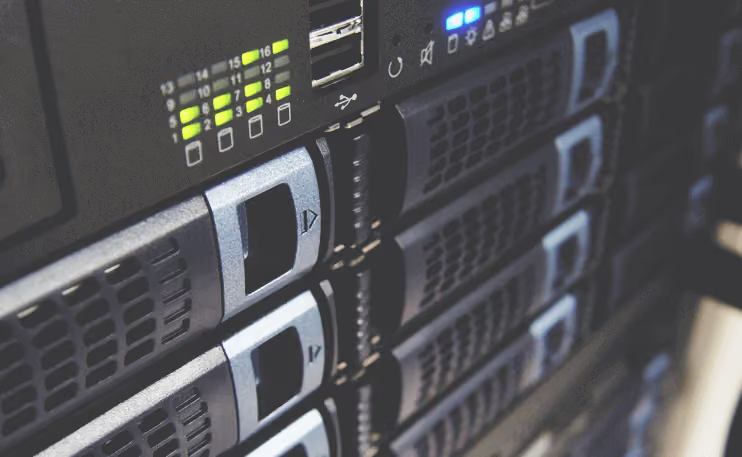
Option 1: Self-installation in your own data center
How secure is it?
If you were to ask proponents of the on-premise variant, where conference management software is operated from your own data center, for their reasons against the cloud, the word "loss of control" would certainly not be long in coming. This argument is more than justified, especially for conferences: when massive amounts of personal data are collected, data protection can quickly become critical. If you don't know exactly where specific conference data is located and who else might have unauthorized access to it, you also don't know if all data protection requirements are being fully met. In that case, it makes sense not to relinquish control and instead take care of it yourself, ensuring that sensitive information and critical data remain on your own, self-secured systems.
What is important to know?
You should only pursue the "do-it-yourself" approach if your company or organization is truly capable of handling the task. The requirements are strict, non-compliance is expensive, and a data leak at a conference is not a cheap affair. Generally speaking, the latter is not true for on-premise hosting either. Before actual hosting can begin, you must first calculate the costs for existing hardware and hardware yet to be acquired, which can make the start quite cost-intensive. Is a new server necessary? Is the existing storage space sufficient, or does it need to be expanded? What about backups? Who will take care of operating the software? Is additional staff required? And: How quickly can someone be reached if the website is unavailable? If registration for one or more conferences is already underway, downtime should be kept to a minimum. If you host the installation yourself, this also falls within your area of responsibility.
Without a functional and proven security concept, even a DDoS attack can cause a server failure. In such an attack, a botnet overwhelms the server with so many requests that it collapses under the load. As a result, the conference website is completely paralyzed.
How is billing handled?
If one of our customers decides to operate Converia in their own data center, we always charge for installation and setup based on the time and effort involved. These costs can only be precisely determined once we know more about the exact IT infrastructure; however, experience shows that they are higher than for an installation on our servers, as additional adjustments are usually required until the conference management system integrates seamlessly into the existing environment.
A cost plan helps with the estimation, and it is more effective the more forward-looking it is created. What costs will be incurred after one, two, or—better yet—more years? It is possible that server hardware will need to be replaced if the software is operated for many years. While the timing of such a new purchase cannot be planned for an unforeseen defect, you should still consider the scenario, because the purchase of new hardware is entirely in your hands.
Naturally, this is primarily suitable for organizers who have access to a data center or at least already own a server and who are planning multiple conferences. For one or two events a year, the effort is definitely not worth it. Furthermore, you should be absolutely sure beforehand that the software is the right one for your conference management, as there is hardly anything more annoying than being stuck with hardware and software costs if the team is dissatisfied with it. Therefore, always ask the provider for a test account before signing anything too hastily.
Sometimes, on-premise hosting can even be mandatory for corporate compliance reasons, which would rule out any providers that do not have a self-hosting solution in their portfolio. On the contrary, many now only provide their software as a service hosted on their own servers and have completely removed the on-premise variant from their offerings.
Hosting the conference management software yourself is therefore recommended at most for universities with their own data centers or technically very savvy PCOs.
Option 2: Self-installation on Converia servers
How secure is it?
With the second hosting variant, your data is entrusted to a third-party server—in this specific case, a Converia server. Consequently, the organizer no longer has any influence over the security measures. While European providers are obligated to adhere to the requirements set out in the GDPR, you should not trust them blindly. Always inquire about where your conference data is hosted. Where is the data center located? What happens if a short circuit causes a fire there? What if the hardware fails? Who has access to the data? What is the provider doing to protect it?
Converia's servers are operated in an ISO 27001-certified high-security data center in Germany, which is committed to data security and risk minimization. We have summarized all technical and organizational measures that ensure compliance with data protection requirements in a single document. Furthermore, we provide our customers with detailed information on how conference data is secured, at the latest when providing a specific quote. This data should always be available as a backup on an additional server so that if one fails, the system can automatically switch to the other. Resolving a malfunction is therefore the responsibility of the software provider, and the faster this happens, the better for the customers.
Some US providers have started hosting their European customers' data on servers in Europe and are promoting their supposedly good intentions regarding data protection quite prominently. This is somewhat misleading, because as soon as a company is based in the USA, American authorities have the right to demand the disclosure of data—regardless of whether the server is located in the USA or in Europe. This is stipulated in the Cloud Act, whose entry into force last year received little media attention, which is why the regulation is largely unknown. However, since this conflicts with the EU GDPR, it remains to be seen how the legal situation will develop. Due to the still unclear situation, conference organizers who rely on purely European hosting solutions are on the safe side.
What is important to know?
Despite having its own installation, the server also has space for other clients' conferences. This is not a cause for concern, as the system is multi-tenant capable and consists of several independent client spaces. Each client manages their conferences completely separately from other clients, whose installations are not visible to them. If Client A logs into Converia, no events from Client B appear in their conference selection – on the contrary: the two do not even see whose other data the server is storing.
Since the provider supplies the components, clients do not have to worry about hardware. Once access is set up, you can get started right away, which saves a great deal of time. Even if you have your own data center, hosting the conference management software directly with the provider makes sense. Your IT staff can simply continue focusing on their existing tasks instead of having to take on yet another piece of software.
The decision regarding how much storage space an organizer receives for their conferences lies with the provider. Converia provides 10 GB as standard for framework agreement clients with their own installation. This is more than enough for a large number of conferences and can be expanded if necessary.
How is billing handled?
Financially speaking, having your own installation on a third-party server is only worthwhile if you are holding multiple conferences over a longer period. The more conferences you set up, the more lucrative the hosting option becomes. For very few events per year, however, it would still be too cost-intensive.
The fixed cost structure is a major advantage of this hosting option. The provider charges you a hosting fee and, in return, takes care of all tasks, including providing the necessary hardware. When hosting the conference management software in your own data center, however, it is impossible to predict whether new hardware will need to be purchased sooner than planned due to unexpected equipment failure.
Option 3: Using a cloud installation
How secure is it?
As with the second option, conference data is hosted on a provider server by default. The difference is that each of an organizer's conferences is treated completely separately. Therefore, there is no URL like client1.converia.de where all of a single client's conferences are displayed together. This does not compromise data security, however, as only your own conferences remain visible in the software backend, and no one else has access to them.
Many cloud providers are extremely well-informed when it comes to data protection. After all, their entire business model depends on how well they comply with data protection requirements: if client data cannot be adequately protected, organizers will likely choose a different provider for their next conference. Especially with conferences, the number of affected individuals can quickly skyrocket in the event of a data leak.
What is important to know?
Can data still be accessed after the conference without having your own installation on the server? This question is important because the conference management software provider is not permitted to host conference data indefinitely after the event ends; rather, they are legally required to delete it under data protection laws. If you still need the data, you should therefore have the option to back it up. Converia offers archiving in the form of exports, where the data is transferred from the server into your possession.
Otherwise, this type of hosting offers you the same advantages as having your own installation on the software provider's servers: full focus on the conference without having to deal with hardware issues. This is, of course, also worthwhile for smaller organizations that have already migrated the majority of their applications to the cloud.
Because the provider knows the system and their own infrastructure best, this generally also has a positive impact on maintenance-related downtime. Usually, the system is back up and running after just a few minutes, so there is no risk of maintenance or installing an update dragging on throughout the entire day. However, the provider must ensure that no updates are installed on the day of your conference.
How is billing handled?
This version of conference hosting is the standard at Converia for all clients who only host a conference every now and then. Many of our clients organize an annual meeting, for example, which is why a framework agreement with our own installation or an installation in your own data center would be overkill. The web hosting for the conference is already included in the price for individual conferences and is not billed separately. As always with cloud installations, the organizer incurs no costs for the hardware used.
Clients who create their entire conference website with Converia also usually want their event to be accessible via their own domain. Anyone unfamiliar with domain registration should let the software provider handle this, for which a one-time fee is usually charged.
The decision
Regardless of the specific task, planning a conference should always follow the principle of "reducing work in the long term rather than creating new work." This also applies to hosting conference management software. Those who do not want to deal with hardware issues do not even have to start, thanks to cloud solutions. Regarding data security, the cloud has also caught up and is recommended in this respect—at least when a European provider is behind it. At the same time, the self-hosting variant still has its place, especially where compliance requirements leave no other choice.
Converia is happy to support and advise you on planning and hosting your conference. You can find out immediately whether our software is a good fit for your event by clicking through our short questionnaire. The result will also tell you right away which license model or hosting solution is the best match for your conference.