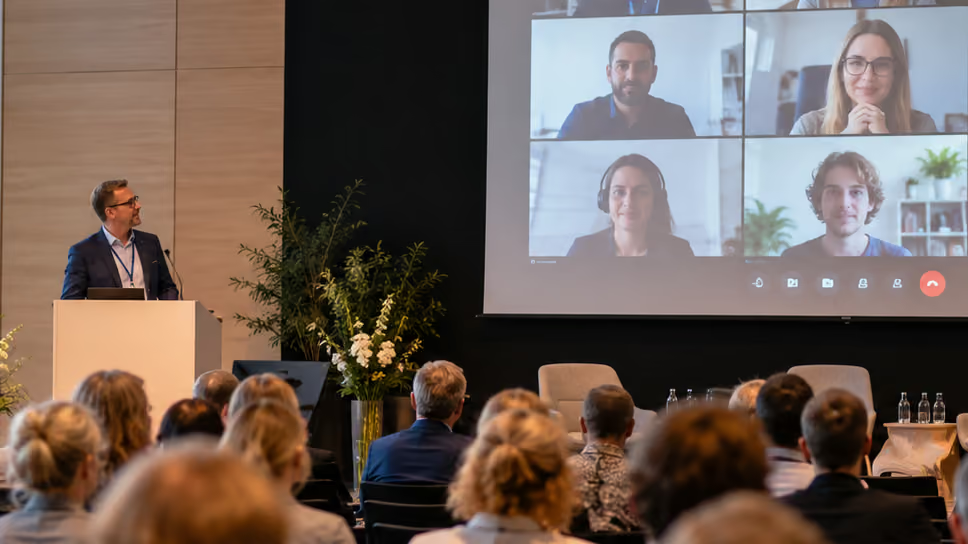




With the unavoidable cancellation of events due to the coronavirus pandemic, many organizers developed emergency solutions for their online congresses with admirable speed and creativity, though these often did not yet adequately address this aspect. While casual communication between attendees seems the most difficult to replicate virtually at first glance, the careful selection of appropriate approaches offers new, and in some cases even more effective, possibilities than in-person events.
What defines personal contact during in-person conferences?
At in-person conferences, contact with other attendees happens almost inevitably due to physical proximity. Typical situations include:
- Spontane Diskussion mit der Sitznachbarin über den letzten Vortrag
- Small-Talk in der Kaffeepause oder am Buffet mit einer Person, die ihren Pausensnack am gleichen Stehtisch einnimmt
- Das Gespräch beim Gala-Dinner mit den Nachbarn am gleichen Tisch
- Der Austausch im Gang mit alten Kolleg*innen oder Mitgliedern des internationalen Projektteams und viele andere mehr
Advantage in all cases: Starting a conversation is more or less natural in these situations, and for many, it serves as a pleasant side effect to a primary activity (eating, listening to a presentation, etc.). It requires almost no special effort to strike up a conversation if there is mutual interest.
Easier at first glance, but perhaps not on second thought: Body language helps in person to see whether someone wants to be approached or not. The person being approached does not have to do much to signal (dis)interest in a conversation with strangers. However, such signals can easily be misunderstood, especially in an international environment where different cultures meet. I still vividly remember a congress encounter with an Indian participant many years ago who, in response to my questions about whether he had a good journey or was satisfied with his accommodation, consistently shook his head while saying "Yes." It took a moment for me to correctly interpret his head-shaking and reconcile it with his verbal response. A signal that is understood as rejection in a Central European context means exactly the opposite in other regions of the world. Without his "Yes," I would have completely misunderstood his answers.
Disadvantage in many cases: With new contacts, I don't know who I'm dealing with. While this is fundamentally appealing, it can occasionally lead to realizing after 30 seconds that you have very little in common with your conversation partner, leaving you to spend the next fifteen minutes caught between awkward silence and helpless attempts at conversation until lunch is finished.
How can you establish good contacts at virtual events?
At an online event, you aren't standing together at a buffet, nor are you sitting within earshot of other attendees. How can you still facilitate casual conversations between participants? And how can these become even more meaningful than they are in person? To get ahead of the answer: We at Converia are certain that the solution should not be for online congress attendees to walk through eerie-looking 3D virtual event halls as 3D avatars to make contact with other 3D avatars.
As with the general transfer of traditional in-person events to online meetings, all considerations regarding this topic should be guided by the question of what constitutes the essence and purpose of the event for all involved, and how one can derive the greatest benefit from the new situation. We see the following possibilities and incorporate them into our online congress platform, Converia Virtual Venue:
1. Connect people based on similar interests rather than pure chance
Instead of relying primarily on chance, virtual or online conferences allow for a data-driven approach to networking people as effectively as possible. Institutions, research interests, or the individual selection and rating of specific presentations can serve as good criteria for identifying which attendees share the greatest overlap in interests.
2. Provide shared spaces for attendees of a session who wish to delve deeper into the topics afterward.
While space is inevitably limited on-site and further discussions at the buffet may only flare up briefly, attendees at online congresses who see a need for further discussion at the end of a session can simply start their own meeting. In addition to video and text chat, whiteboards and collaboratively editable documents can be used there to discuss effectively and ensure the results of such rounds can be used sustainably, even beyond the congress.
3. Offer an unlimited number of breakout rooms to enable spontaneous meetings for like-minded people or working groups
The digital meetings just mentioned can just as easily be used by existing working groups or other people coming together spontaneously. Unlike in-person events, the number of such meetings is limited only by technical constraints, which should not be noticeable with forward-looking planning.
4. Provide a meaningful substitute for coffee breaks
Online coffee breaks are no longer primarily about caffeine intake; instead, they clearly focus on getting in touch with other attendees. Organizers should ensure that meetings are provided for the smallest possible groups so that everyone involved has the opportunity to speak and such situations are not dominated by particularly talkative participants. A particularly nice approach is a method based on classic speed dating: two attendees with a potentially high overlap of interests are randomly brought together in a video chat. There, they have a limited amount of time, e.g., 3 minutes, to get to know each other and decide whether they would like to stay in touch. Once this time has elapsed, new pairs are formed.
With these and other approaches, organizers can make optimal use of the possibilities offered by virtual conferences and generate added value for the large portion of attendees for whom contact with colleagues is also important.