
If you haven't yet decided on the right networks for communicating with your participants, you can catch up with the help of the advice in the first part of our social media series.
During the event
What is actually going on here?
You should ask yourself this, because it is of interest to your participants and those who couldn't make it alike. Use your networks to provide answers.
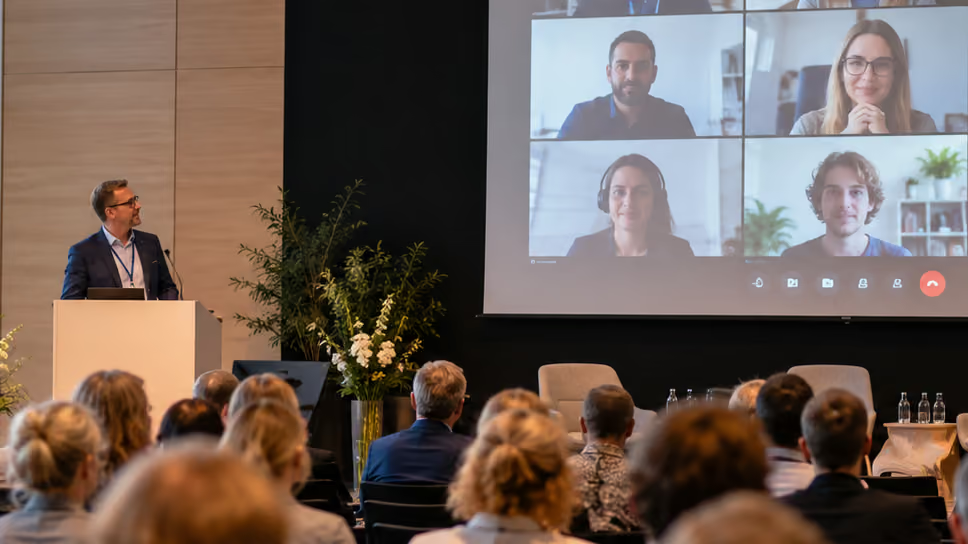
Report on what is happening right now. A tour of the venue provides you with plenty of visual material that can serve as the basis for one post or another.
Feel free to offer a different perspective on the proceedings and take a look behind the scenes. Who contributes to the success of the event? Think of the technicians who ensure that presentations run smoothly or the interpreters who make sure the speakers' messages reach everyone.
Also, keep an eye out for the most interesting talks and the most creative presentations.
Often, live-tweeting is a great option. Post who is currently speaking and what the topic is. Highlight key takeaways from the speakers. New findings from science and research are, of course, particularly suitable for this. However, be sure to check whether the statements may be shared. If someone is talking about an as-yet unpublished study, it is not advisable to quote them.
Different platforms, different content
"Double is better" is not a motto you should adopt when it comes to posting during the event. Always assume that there are participants who, like you, are active on multiple platforms and are connected to you on each of them. Especially when your own time is already limited, you don't want to see the same photos on your screen constantly.
And not all content is suitable for all accounts.
Twitter is perfect for live reporting with images and quotes from presentations, which is how the MICCAI 2015 account and the #MICCAI2015 hashtag were used. However, the log-like style is less suited to other networks. You can certainly post the occasional quote in your LinkedIn group to spark discussion.
Social media as a broadcast channel
The situation is different for important announcements, such as last-minute changes to the regular program schedule. Your participants should be able to find these everywhere. During the event, social networks therefore also serve as a kind of broadcast channel.
Do not assume that all participants are active on at least one network and keep an eye on every timeline thanks to corresponding apps. This may be true for some of your visitors, but it is by no means true for everyone.
Instead, rely on an event app with social media integration. Your updates from all networks will then be displayed to your participants immediately. This way, no one is left out or has to worry about missing anything.
Encouraging dialogue
With everything you publish during your event, don't forget one thing: your participants.
Make it clear that all visitors are welcome to reach out to the respective accounts at any time with questions or problems.
Encourage your visitors to use the official hashtag for your event.
All tweets tagged with it are best displayed centrally for all visitors on a Twitter wall, making them the ideal basis for discussion.
Reward those who get actively involved. Contests can help initiate or further encourage interaction with participants.
Whether you give your visitors a specific task as part of the contest, such as taking a photo with a participant from another country, or organize a more complex digital (photo) scavenger hunt with various tasks, is up to you. There are also no limits when it comes to choosing prizes. For example, raffling off merchandise, vouchers, or professional books is a great option.
If you would like to further specialize the discussions on LinkedIn, you can also set up groups for specific thematic focuses of the event.
This is particularly advisable for larger events that cover a very broad spectrum of topics.
What are others saying?
Your profiles should not only show your own perspective on the event but also let the visitors have their say.
Keep an eye on the chosen hashtag on Twitter and retweet posts from your participants.
Respond to feedback and thank people for any kind of input.
This also includes dealing openly with criticism. Therefore, thank people for critical remarks as well, showing your participants that you truly value their feedback.
Try to find a solution for your participants' problems. But don't think about it for too long – quick reactions are required here. If you receive a request via Twitter, 140 characters are usually not enough to find a solution or provide a detailed answer. Therefore, offer the participant the option of having the on-site team handle their request directly.
After the event
There is more to come
When an event ends, the conversation shouldn't stop there. It would be a mistake to sit back and shut down all your social media channels at this point.
Instead, aim to give those who couldn't attend the impression that they really missed out on something great.
First of all, you should thank all your attendees for participating.
Then, keep the conversation going. Ask your participants about their favorite sessions, the most interesting presentation, or simply what they took away from the event.
Collect all the photos taken during the event on Flickr. The photo community also discovered the Gründerforum auftakt. to create an album of impressions from its VC Campus 2014. You can also create a dedicated group for an event there to include photos from participants alongside your own.
Did you shoot videos or conduct video interviews with participants and experts? Then it is worth sharing them with everyone on YouTube.
The new insights and perspectives gathered throughout the event can now be evaluated and discussed within your LinkedIn group. This is also a great place to give members the opportunity to share their thoughts on the event.
In addition, there will certainly be participants who summarize their experiences on their own blogs or websites without being asked. Look for these articles and share them with your audience. You might even be able to link to press reports about your event. Those who were there will surely enjoy reading them.
After the event is before the event
If it is part of an event series, the collected photo and video material is even more useful. Use it to promote the next event. This triggers positive memories for those who were there this time, while giving everyone else a first impression of what to expect.
Even if the exact details for the next event haven't been finalized yet, it is worth mentioning where and when it will take place.
Given the countless ways to promote an event using social networks, our suggestions are by no means exhaustive. Do you have a different method or have you had positive experiences with a tool or network that wasn't mentioned here? Leave us a comment and tell us about it.