

If event organizers didn't have to worry about the budget when planning the opening speech, the majority would certainly choose a coveted celebrity keynote speaker, because a well-known name is guaranteed to bring attention to a conference. This is exactly what happened at the Princeton-Fung Forum, which even made it to the top of the German Twitter trends last spring – thanks to Vinton Cerf. The "father of the internet" was a perfect fit for the event, which was dedicated to the question of whether freedom can still exist in the digital age and, in this regard, focused primarily on the topic of data protection. In his speech, Cerf spoke out in favor of critical thinking and against fake news, and expressed his wish that all students should have written their own program at least once before graduation.
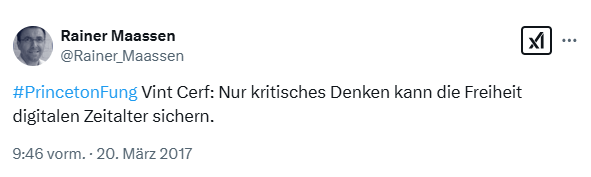
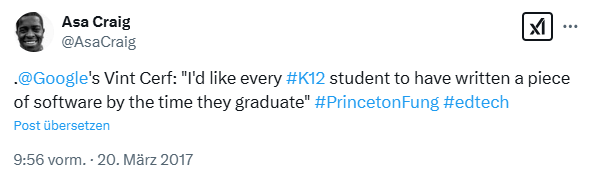
This struck the right chord online and was shared enthusiastically. For the keynote, this means: mission accomplished, as it convinced the participants of the event's concept, laid the groundwork for everything to follow in the program, and even contributed to many people engaging with the Princeton-Fung Forum for the first time or once again. The organizers seem to have shown a lucky hand in their choice of speaker – which shouldn't be too difficult for you either if you consider the following points.
1. How much time is left?
The more well-known a speaker is, the busier their schedule. If you want to secure an open slot, it is better to inquire early. However, you shouldn't approach less famous speakers just two weeks before the conference begins either; after all, the presentation needs to be prepared. Allow for approximately six months of lead time. After all, an inquiry is rarely followed by an immediate acceptance. Before the start, there will still be several conversations about the nature of the event and the content of the keynote, or fees will need to be negotiated. Such discussions are easier to manage with clear expectations.
2. How much budget is available?
To attract well-known keynote speakers to a conference, organizers usually have to dig deeper into their pockets. Five-figure sums are not unusual for very prominent individuals. Is that too much, or is it still within range? Is a fee even necessary? Shouldn't speakers actually be grateful for the opportunity when organizers of large conferences consider them for a keynote? This argument is occasionally even heard by long-standing speakers who certainly have nothing left to prove to anyone. Speaker Tarran Deane therefore makes it clear that such appearances are not a hobby for professional speakers, but rather that many make their living from it and possess expert knowledge. Treat speakers just like any other service provider. After all, no one would think of suggesting to a catering company that they provide menus for free because the event would look good as a reference on their website later. However, always put the fee in relation to other incurred costs and the number of participants at the conference. With larger events, you generate higher revenue, which is why a slightly more expensive speaker might be more within your financial means – provided this doesn't require significant cutbacks elsewhere. The joy of having a top-tier speaker will not make up for subpar catering or outdated technology. Never let the cost question be your only guide. Booking speakers solely for prestige reasons and because of their famous names rarely brings any real gain. Do not underestimate the costs. You are paying extra for flights, hotels, and transport, and potentially double if a personal assistant is included.
3. What are you looking for?
The number of potential keynote speakers is huge, yet no one is suitable for every event – even if some might claim otherwise. Never start your planning by scouring Google for a list of speakers who will appear at conferences for a fee that is hopefully not too high. Instead, first think about everything you want from the keynote – all other factors come into play later. Should the keynote be like an introduction that sets the tone for the coming hours or days, or would you prefer it to be the conclusion that summarizes the last few days before sending the visitors back home? In any case, it is something special – especially motivating, especially inspiring, or especially entertaining. In which direction should your conference go? What does the audience expect and how can a speaker meet those expectations? Only when you are clear about this can you begin the search for people who are capable of conveying exactly that.
The topic is also crucial. Should a subject-specific question be at the forefront, or should it be about something more general? Many speakers specialize in a range of topics. Speakers from outside the field usually know little about current developments in your industry or area of expertise. That is not a problem at all for a more general keynote. In that case, it is much more important that someone can win everyone over. For a technical topic, however, they would likely not be the right choice.
4. Who can do what?
To find that out, a small detour helps. As the second-largest search engine, YouTube is the perfect starting point, because in addition to names, you get video references right away, and those should be more convincing than any lists of arguments on speaker websites, which often look very similar. If your conference deals with the topic of artificial intelligence, start, for example, with a search for "Keynote Conference AI." Based on videos recorded at other events, several important questions can be answered: How does the speaker involve their audience? Is there any interaction with the listeners at all, or is a standard program being reeled off? Are the listeners asked more than just rhetorical questions? Does the speaker perhaps even let them vote on something briefly? Do they speak the language of the audience and use terms that the listeners use themselves? If you watch a few such videos, it will help you, on the one hand, to describe what the ideal keynote should be like, and on the other hand, your speaker wishlist will fill up with a few names in the process. Expand the spectrum by combining the search for suitable conferences in your field with terms like "interview" and find more videos featuring experts in this way.
By the way, the best speakers manage to find the right balance when it comes to the tone of the keynote. Between all the information, a little humor shines through now and then, never exaggerated, never forced. Furthermore, the best speakers become personal and package their message in stories about their own experiences or encounters that stick in the audience's memory – keynote mission accomplished.
Another method may seem a bit unconventional, but it can certainly help prepare a successful keynote. Why not look for someone who perhaps (not yet) belongs to the ranks of top experts and isn't present with a lecture at every major event, but whose work has at least already caused a stir? Perhaps the person has written an article that has been read and shared often in recent weeks or generally writes a lot of worth-reading content on the topic. They are then likely no longer completely unknown to the conference audience. Some tools specialize in tracking down such articles. One of the few with a free option is ContentStudio. For research purposes, a premium version is not required there. Think carefully about what you enter into the search field beforehand, as the number of queries is limited for non-paying users. For starters, the topic of the conference is sufficient. ContentStudio will then list the articles that have received the most attention on social networks. Take a little time to skim through them and then search for the authors who have written particularly interesting texts. Instead of such a tool, the same thing naturally works with any well-curated newsfeed that you may have put together in another way and use regularly to stay up to date.
If you mainly come across male speakers during your search, that doesn't have to mean there isn't a woman who could speak on the topic. It's just that female speakers are unfortunately often not as prominently placed as their male colleagues. That is why it is always worth visiting speakerinnen.org, where there is a curated list of female keynote speakers. Why not search the list for the topic of your conference? Perhaps there is an expert or two you wouldn't have thought of otherwise.
5. What do potential speakers need to know?
After the pre-selection has been made, the contact process can begin. Always keep in mind: if a keynote is to be successful, close cooperation is important. Explain in detail what is important to you and what you want from the keynote. If there are no requirements from your side, some speakers might later use the stage for self-promotion. Whether this risk exists often becomes apparent quite quickly in a conversation with the desired candidates. If someone has a serious interest in the audience and the topic of the conference, you can expect a presentation tailored to the attendees to follow. This is also the case if speakers actively help promote the event, for example with a Facebook post or a few tweets. You have definitely made the right decision if someone asks about the people who will be sitting in front of them later and wants to learn more about their challenges.
Perhaps your plan won't work out at first because your desired speaker doesn't have time. However, they might be able to recommend someone from their circle of acquaintances for the task. If your search was unsuccessful, your speaker cancels at short notice, or you really want a more prominent guest for the keynote, it is best to try through a speaker agency. Agencies usually have a large network and can quickly find someone based on your requirements. However, the collaboration is, of course, not free of charge.
Last but not least, it never hurts to show a little trust in the keynote speaker of your choice. Do not demand to see the slides in advance. Some speakers are still working on them on the way to the conference. Give them the opportunity to do so in peace. If you have followed all the other points, all doubts should have been cleared away by this point, and the perfect speaker should have been found.