


Conferences need to catch up when it comes to sustainable badges
Sustainable badges may seem like a tiny detail, but upon closer inspection, they are neither small nor insignificant. After all, every person attending the conference has one.
If a badge isn't designed sustainably, it joins all the other problematic aspects of a conference that are minor in isolation: printed programs (which still exist), single-use lanyards, disposable cups, or food waste at conferences.
🚧That meetings and conferences still have a long way to go, even in the scientific community, is shown by a study published in 2020 by RWTH Aachen University. The authors provide two startling figures: A three-day international conference produces 455 tons of CO2. That is a little more than half a ton per participant.
Given the goal of reducing per capita emissions to one or two tons of CO2 per year, attending just one conference would, strictly speaking, no longer be feasible.
Reduce, reuse, recycle works for badges too
However, the outlook for conferences isn't entirely bleak. Future attendees don't automatically have to feel guilty, because organizers can do a lot on a small scale to achieve big results.
This is working much better today than it was a few years ago. It wasn't long ago that organizing teams had to embark on a long search for more eco-friendly badge options. Now the tide has turned: the selection is huge, and almost everything is being rebranded as "sustainable."

Which versions truly deserve the label? And which badges would attendees rather not wear around their necks?
Sustainable badges: The material
Currently, conference badges do not fall under the Single-Use Plastics Prohibition Ordinance. That won't change for the time being. Nevertheless, conference organizers send a clear signal when they avoid plastic badges and look for alternatives.
Sustainable paper badges
At first glance, paper badges don't seem that exciting. On second thought, they prove to be surprisingly versatile.
Particularly sustainable badges are made from recycled paper or cardboard. Organizers can also look for the FSC label. This means the paper comes from sustainably managed forests.
At Converia, we work with tear-resistant butterfly badges, which are so durable that they don't need plastic sleeves. The manufacturers produce the badge paper using 80% renewable energy from solar panels. The paper itself is sourced from the EU and is FSC-certified.
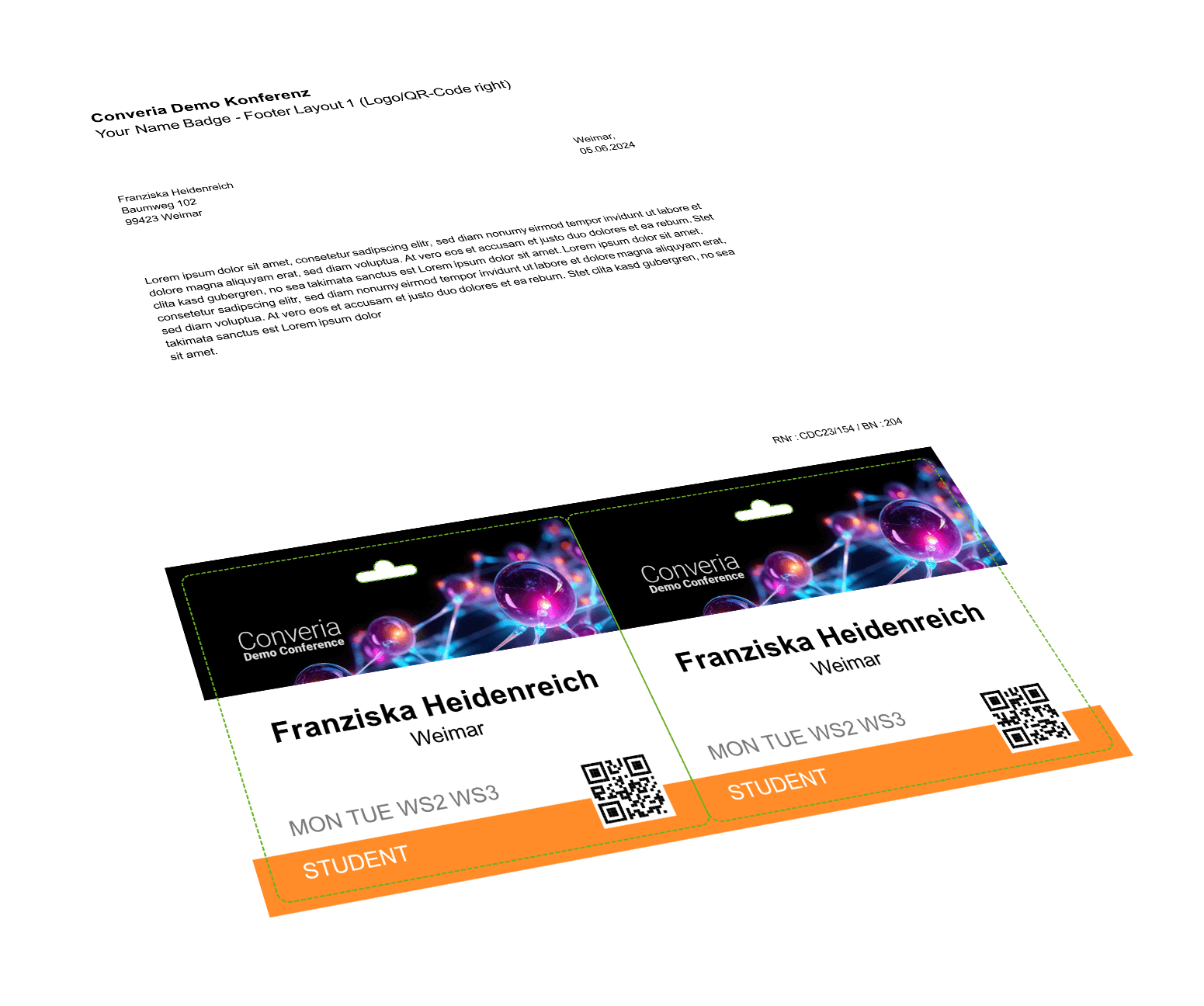
And one more characteristic of plastic badges is no longer relevant: Sturdy paper badges easily withstand multi-day conferences.
Sustainable badges made from seed paper
Seed paper badges are the greenest option. They are made from either recycled paper or recycled cotton, but in any case, they are free from the chemicals used to bleach paper. This is why the name tags aren't stark white, but rather an "off-white" shade—which is by no means a flaw. When printed with color, they look just as good as their conventional paper counterparts.
Instead of shortening the lives of trees, they actually bring new life into the world. The paper is embedded with seeds that grow into wildflowers, herbs, or even vegetables after the conference, keeping the memory of the event alive.
A word of caution: Seed paper is great. But if the badge paper travels further to reach the conference than the attendees do, something is wrong. The positive climate footprint is immediately lost. Always check where the paper comes from. If it’s not stated, ask. Printing is also a bit of a challenge. You can't print on seed paper like regular paper. It’s not good for the seeds, and standard printer ink isn't biodegradable.
🤔Are biodegradable badges sustainable?
Manufacturers frequently highlight particularly sustainable bioplastic badges in their product ranges. It sounds tempting at first—all the benefits of a sturdy PVC badge without the guilty conscience.
What isn't even mentioned in the fine print: Biodegradable name tags still take several months, sometimes even years, to decompose. Despite the long wait, the result is poor, as nothing is produced in the end except CO2 and water. No minerals, no nutrients, no humus. Consequently, they are more of a hindrance than a benefit in the recycling process.
The best solution is therefore always to avoid plastic at conferences wherever possible.
Why digital badges are often not a sustainable option
The most sustainable solution: Don't print at all.
Is that practical? Not really for conferences.
While some fully digital name tag solutions do exist, they are only eco-friendly with certain limitations. Instead of using LED or LCD, these digital badges work like e-book readers with e-paper displays. That’s quite clever at first, because they only consume power when the image changes. That isn't necessary for a badge.
However, the overall package isn't quite as smart, as the badges are made of plastic. They are also more expensive than paper versions. The investment is definitely not worth it for individual, smaller conferences.
And like any technical device, a digital badge can break down. If a repair isn't successful or isn't even an option from the start, the conference ends up producing additional electronic waste.
Sustainable badges: The design
Sustainable badges rely on eco-friendly printing inks
Sustainable choices start with the badge material, but there is more to consider.
An important aspect is the ink used on the name tag. Traditional printing inks consist of a range of chemicals, solvents, and binders. Mineral oil is also included.
Similar to paper manufacturers, sustainability has become a popular selling point for print shops and manufacturers of toner cartridges and ink. However, 100% green printing is far from being the standard—and that’s not because the players involved aren't trying.
Many have long since switched to eco-friendly printing inks based on soy or linseed oil or work with water-based inks. Both approaches are progressive, but they lead to new problems in practice. Plant-based oils require farmland, which means forests have to be cleared. To prevent crop failure, farmers often treat these plants with pesticides. Water-based inks, on the other hand, make recycling more difficult because it is hard to separate the ink from the paper fibers later on.
Farben auf Wasserbasis hingegen erschweren das Recycling, denn Farben und Papierfasern lassen sich später nur schwer wieder voneinander trennen.
Sustainable badges rely on minimalist design
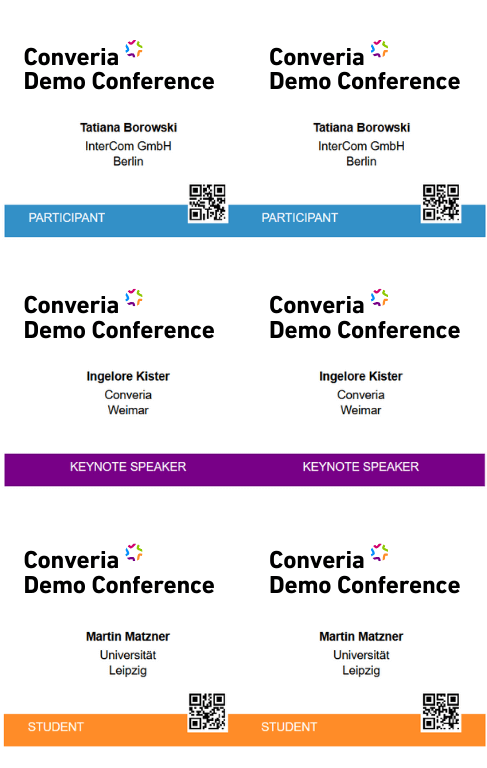
Sustainable badges follow the "less is more" principle. Lots of text and graphics mean lots of printing ink.
Consider: What information besides the name is absolutely essential for the badge? What can you leave out? For conference entry control, for example, it is often important to know if a person is a speaker or a volunteer. They can share biographical details in conversation, and an email address is equally unnecessary on a badge.
💡A printed program on the back might seem like a nice idea at first, but it’s better suited for an app – where it stays up to date.
Sustainable fonts
A lesser-known aspect is eco-friendly fonts: typefaces that require less ink when printed. Using these is another way for organizers to make a statement and create a sustainable name tag.
Fonts with very thin lines and no serifs are advantageous, for example. They use less ink and print faster.
Unfortunately, a name tag printed with ultra-thin letters is hard to read. This requires a bit of experimentation. A good compromise is using special sustainable fonts like Ryman Eco. It uses less ink because the letters, numbers, and characters are composed of multiple thin lines. This doesn't cause any readability issues, and it looks great, too.
https://www.youtube.com/watch?v=hXwv3yFlSbw
Sustainable badges: The accessories
No one needs badge holders
Conferences still frequently use plastic badge holders. These date back to a time when paper name tags were much less durable than they are today. The holders have outlived their purpose and have become a major source of waste. Nowadays, plastic-free paper alternatives are available. However, if you use a tear-resistant badge, they remain entirely unnecessary.
Consider sustainability for lanyards, too
Lanyards follow a similarly questionable path. They often feature the conference design, including the logo. Their lifespan therefore ends with the conference, as there will be a new logo next year.
Simply omitting them, as with the holders, doesn't work if you want to stick with wearable badges. Fortunately, there are several approaches to improving sustainability here:
- Sponsor the lanyards
Instead of the conference logo, the lanyards are designed with a sponsor's branding. This saves organizers money and is more timeless than the current conference logo. In return, the sponsor enjoys extra visibility. After the conference, participants return the lanyards. The sponsor can then use them for future conferences.
If you don't want to hand them over: Design them neutrally so they can be used at least one more time. No date, no conference motto. - Sustainable lanyard materials
Organizers can choose between paper, cork, and felt options. There are even some made from seed paper.
Pro tip: Sponsor logos fit on those, too 😉
Sustainable badges: Communication & organization
Set up return stations
Conference badges often meet a predictable fate after the event: they either end up straight in the trash or spend a lonely existence in a drawer or cupboard for a while.
Since no one benefits from this, and lanyards—just like badge holders—can usually be reused for other conferences without issue, return stations at the exit are becoming an increasingly common sight.
This is a sustainable idea that every conference can benefit from—provided the attendees participate. This doesn't fail because of a lack of willingness, but rather because they are often deep in conversation and simply walk right past the return station.
💡Make sure to place the station in a highly visible spot and keep reminding people about it before and during the conference. Explain what happens to the lanyards and why returning them makes a difference.
Print on-site
Some conference teams prefer not to put things off and therefore prefer to print name tags as early as possible. That isn't sustainable. It’s also risky if individual badges never find their owners because those people never show up.
For last-minute replacements and on-site registrations, organizers usually resort to blank badges and write the names by hand. Not only does this look like a second-rate name tag, but depending on the handwriting, it can sometimes be difficult to read, which hinders networking.
💡More sustainable badges are printed on-site. Even more sustainable ones are made of sturdy paper and don't require a plastic holder. This works particularly well with the butterfly badges mentioned above. Printing starts once the check-in is complete. Attendees simply peel them off the paper, fold them, and attach the lanyard.
Printing sustainable badges – thermal instead of ink
In the context of a conference, neither laser nor inkjet printers win any awards for sustainability.
While manufacturers are increasingly focusing on eco-friendly components, empty cartridges and toner still create waste. Even cartridge-free devices aren't ideal for on-site printing. It can happen that staff have to refill ink during check-in. If many people are waiting to get in, everything comes to a standstill—except for the queue, which keeps growing.
Thermal printers, on the other hand, don't need any ink at all. The coating on the paper changes color when heated. The ones used for name tags usually take up very little space, making them perfect for on-site badge printing.
💡If you are renting equipment for your conference, opt for thermal printers. Inkjet and laser printers don't handle frequent shipping well and are quite sensitive. With rental equipment, the risk that the printer or individual components won't survive the journey increases with every trip.
If you host multiple conferences per year, buying is more worthwhile. Instead of a brand-new device, you can check another box for a more eco-friendly event by choosing a refurbished badge printer.
Why sustainable badges are here to stay
Sustainability is not a trend that organizers can just sit out until it passes. For attendees, the eco-friendly orientation of a conference is playing an increasingly important role. People sometimes look for ecological aspects even before buying a ticket.
Perhaps they will voice their opinion later in a LinkedIn post if they see something that just doesn't sit right. Or, if they receive sustainable badges at check-in, they might be thrilled. That is free advertising for your conference.
By the way, just because badges are sustainable doesn't mean they cost extra. Depending on the version, you save the entire cost of plastic holders or only have to pay for lanyards once.
Conferences that avoid unnecessary waste and stop acting wastefully are definitely on the right track. Even small things like name tags can make a big difference.
A great on-site experience is a plus for any conference. Here is how you, your team, and your attendees can have a relaxed arrival and a smooth conference experience:
- You now have a plan for sustainable badges. But what information belongs on the badge? And what is the best size? Find answers here for the perfect conference name tag.
- You know what goes on the badge. Now for the next question: Which name tags are the right ones? We present several badge options and their pros and cons here.
- Check in quickly and digitally yourself and pick up your sustainable name tag? It’s quick and painless with a self-service solution for conference badges.
- How do you and your team communicate on-site at the conference? With Slack, everyone on the conference team is in the loop and can react quickly if needed.