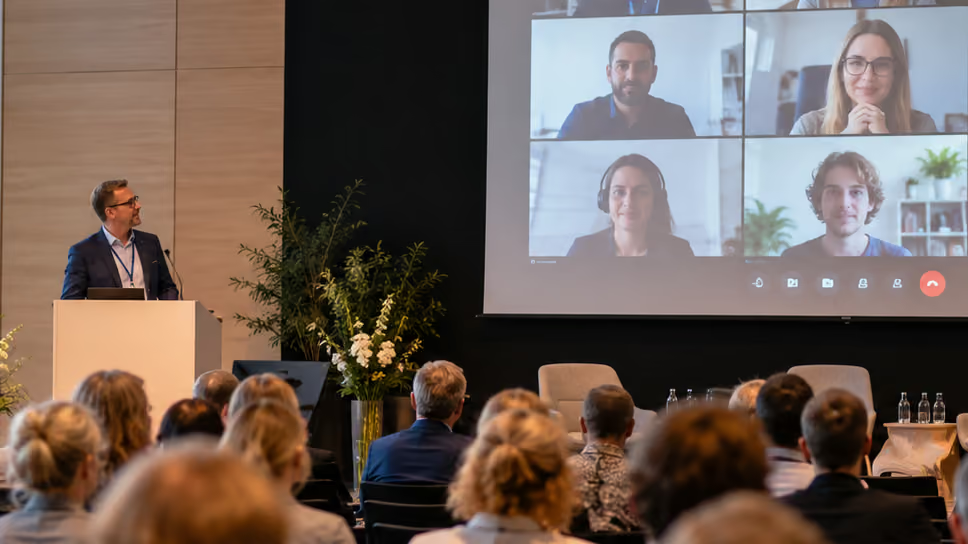


Many organizers seem to have a conflicted relationship with hybrid conferences. Both our surveys and conversations with clients show a high level of openness: hybrid events are important and are here to stay. However, when it comes to concrete planning, the feedback is much more hesitant: organizing a hybrid event themselves? They would rather not.
The reasons for this attitude are understandable and often the same: planning a hybrid conference requires a large budget, with the majority going toward technology and the staff to operate it.
Does it have to be this way for every hybrid event?
That was a question we asked ourselves, too. Especially for academic conferences, which are often not massive events with tens of thousands of attendees, surely there should be a smaller-scale way to do this?
The fact that it is indeed possible is proven by a solution we found right on our doorstep, offered by one of our partners also based in Thuringia.
That was a promising start for a potential collaboration. The only remaining question was how it would work in practice.
A compact system for a hybrid conference
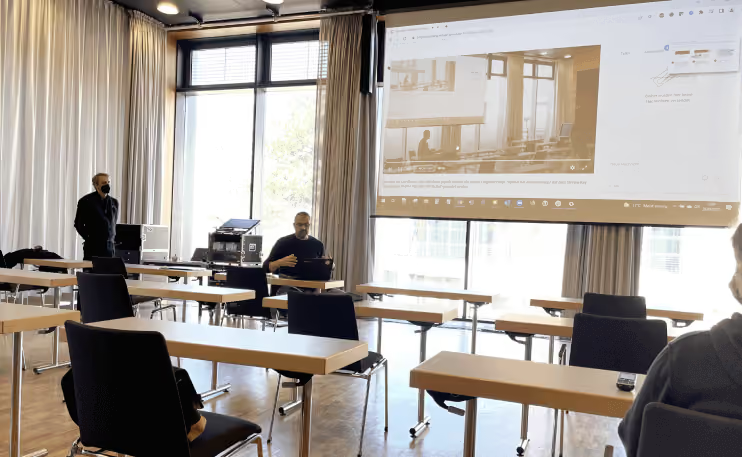
We wanted to know more, so a large part of the Converia team recently headed to the Congress Centrum Weimarhalle for a field test. Our AV partner's team arrived at the same time and was ready to demonstrate a live hybrid conference setup in about half an hour.
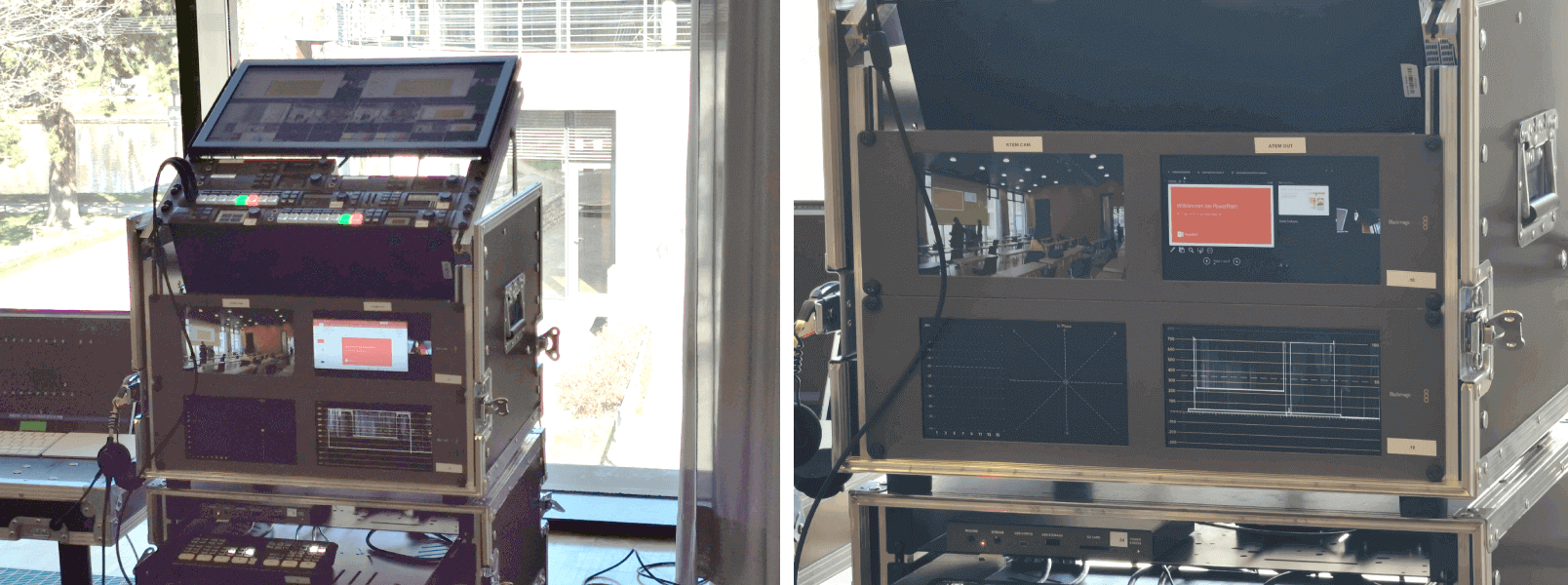
In other words: the entire system, including the live streaming technology, was fully set up in just thirty minutes and connected to the Virtual Venue, our digital conference platform, with the test run already completed by that point.
There was no need to rearrange the room to make space for the equipment, as it takes up very little room. This is useful when, as in our test scenario, there are tables and chairs in the room for an in-person audience. You also won't find any tangled cables on the floor.
Want more information? We are happy to answer your questions.
Is such a system sufficient for a hybrid event?
It might be surprising at first, but yes, it is perfectly adequate for a basic hybrid conference setup. If you want something more professional, the on-site team can set up a studio with lighting, for example, to stream presentations.
Even the basic setting offers a great deal of functionality. For instance, simultaneous streams from multiple rooms are possible. This was also part of the on-site test, as was the flexible switching between a total of four different camera angles per stream. This allows speakers and their slides to be displayed alternately or side-by-side.
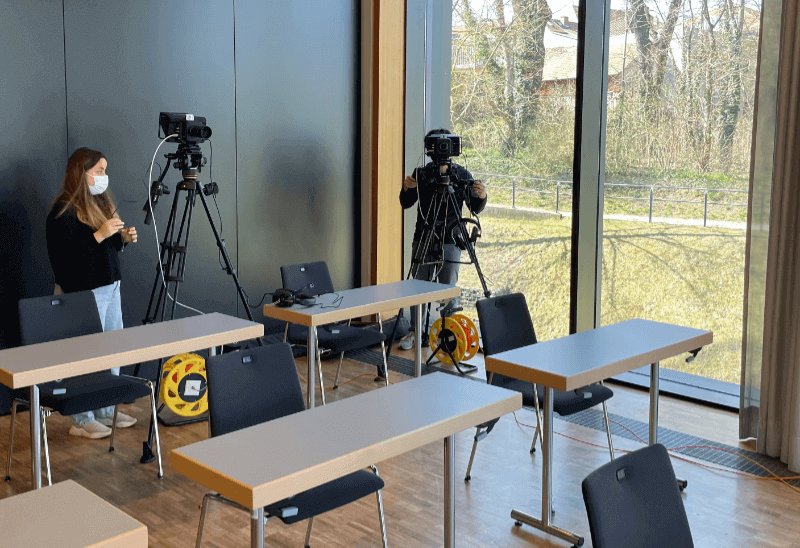
Especially with longer streams, a single camera angle can quickly become tiresome. Sometimes, there is more movement within a single shot, too. Presenters don't always stay in one place. The AV team told us about a speaker who used the entire width of the room by constantly pacing back and forth. The person behind the camera was able to react flexibly to this without needing a multi-camera setup—though that is, of course, also possible if required.
What does the hybrid conference venue need to provide?
All that is required from the venue is a power supply.
The system operates independently using its own LTE network. Your internal network remains unaffected, ensuring streams are transmitted directly to our virtual online platform in perfect audio and video quality.
The hybrid event in the Converia Virtual Venue
Connecting to the Converia Virtual Venue creates a secure, private area for conference streams, ensuring they are accessible only to registered participants.
Furthermore, all data is securely stored on our own servers. This applies to both personal data and the streams themselves.
In combination with our software, you can also easily implement restricted-access streams. The Virtual Venue tracks which individuals are authorized to access specific program items. This allows you to stream multiple workshops into the Virtual Venue simultaneously, with each one visible only to the relevant participants.
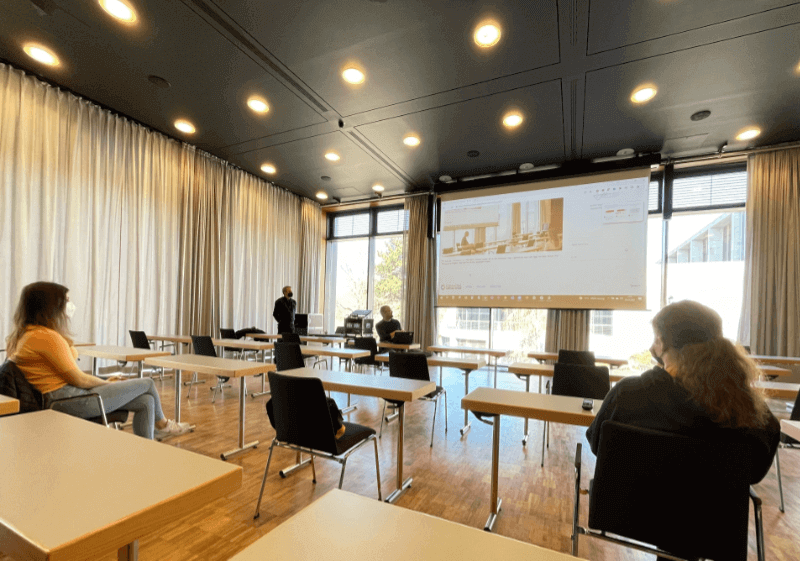
Our partner also automatically creates a professional recording of every stream. This can be edited if needed and then uploaded to the Virtual Venue, which functions as a conference media library where hybrid conference content is available on demand.
If desired, elements such as lower thirds can be added to live streams and even adapted to specific languages. Live translation and multi-language content delivery can also be implemented without additional cameras. The camera feed is synced with the corresponding audio track based on language preference, and participants can switch languages at any time during the live stream within the Virtual Venue.
What about the costs?
With hybrid conferences, it is often difficult to estimate the final number of registrations, which is why this combined solution with the Virtual Venue works so well. Billing is based, among other factors, on the number of participants, ensuring that costs do not spiral out of control.
Since our partner's streaming solution is individually scalable and requires minimal personnel, it is ideal for events with limited budgets.
Because of these advantages, this approach is perfect not only for hybrid conferences but also for events that are held entirely online.
Could this be the right fit for your hybrid event? Feel free to contact us for more information.