

It often doesn't take long for the first weaknesses of virtual conference software to reveal themselves. For example, when it is unable to cover the entire journey that participants take during a fully digital or hybrid event. Why can't registration data, including booked workshops, be transferred to the virtual platform and processed there? This posed quite a puzzle for many scientific online congress organizing teams last year—regardless of whether they were held entirely digitally or as a hybrid congress.
The problem was solved in a makeshift, cumbersome way, which sometimes simply meant that data had to be copied or re-entered manually to set the correct parameters for each person. And all this just because software from different manufacturers was used, for which no interfaces for data exchange were provided.
But because the background for the shift to virtual or hybrid formats was extraordinary and the digital congress had previously existed only as a vague concept that led a niche existence in the event industry, participants remained somewhat forgiving even after the tenth technical glitch. After all, the situation was new to everyone, certainly not easy for anyone, and in the end, it was better than a final cancellation or postponement of the event to the distant future.
What do virtual or hybrid academic online congresses need?
We also answer this question in this video:
A while has passed since the first virtual academic conferences, and much has improved. The pool from which organizers can choose the right virtual or hybrid platform is huge and feels like it is constantly growing. And yet, solutions specifically aimed at academic online congresses are rare, while software for virtual or hybrid business events is all the more common.
But the latter is exactly that: software for business events. Such a solution is not designed for functions that are more specialized, such as poster exhibitions or abstract submissions, which are rarely found outside of scientific conferences. So what should organizers look out for to avoid the multi-software solution described above, including manual data entry?
1. One solution for the entire online congress
Pieced-together scientific online congresses consisting of a multitude of applications (one software for registration, another for abstract submission, another for online meetings, and yet another for the poster exhibition) were more the rule than the exception, especially last year.
The Virtual Venue we developed, in combination with our classic Converia conference software, can handle all of this: For congress registration, organizers define different price groups, offers, and discounts and sell tickets. Because personal data is automatically transferred to the Virtual Venue and is always available in the latest version, even late registrations for the online congress are possible without any problems. There is no need for manual data reconciliation, as everything happens automatically in the background.
Whether someone is allowed to participate in the conference is checked during login. After logging in, the person receives access to exactly the sessions they have booked. The login data is the same as for registration, so there is no need for different accounts and passwords for a single congress.
Important for hybrid congresses: All participants need access to the online platform. Hybrid does not have to mean that the same program runs online and on-site, but participants on-site should still have access to the digital content. Think, for example, of a hybrid congress that places a strong focus on networking on-site, but the basis for this is the presentations that everyone watches online in advance. We have also supported events where the first few days were purely virtual and only the last day consisted of on-site program items for a limited number of people.
Furthermore, organizers manage contributions directly in Converia without extra software: Scientists submit their abstracts via the platform, from where they are evaluated by reviewers and the decision is announced by the program committee.
If you do not need abstract management for your digital or hybrid congress, you do not pay for the feature, because Converia is modular and you only use the functions that are actually used at your congress.
To see how that looks directly in the software, check out our free trial version.
2. Simple program creation
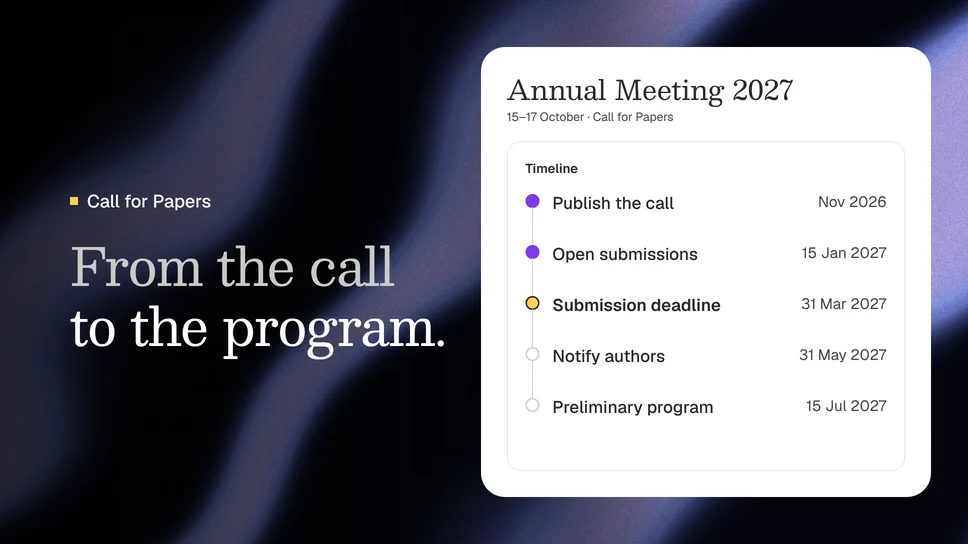
Depending on the congress, the program can be very long—for hybrid events, it is sometimes even longer if the program items differ significantly depending on the type of participation. Converia helps you keep track. The software is able to automatically transfer all accepted abstracts into the program schedule without you having to create them as new program items.
If you are inviting speakers, this is also possible with Converia. Or if you already know the speakers and their presentations, they can be imported into the system and thus into the program.
For the online congress, the program schedule is automatically transferred to the virtual conference platform.
3. Exchange, interaction & better poster sessions
With the Virtual Venue, you can implement a whole range of different online or hybrid congress formats:
- pre-recorded videos - ideal for presentation formats
- livestreams - perfect when participants are encouraged to ask questions or get involved
- breakout sessions for small groups
- discussions and other collaborative formats
Interaction with others begins right on the online congress homepage with a central chat open to all participants. Personal conversations can be held via text, audio, or video chat, and other participants can be contacted directly through these channels.
Poster sessions also prioritize discussion with the authors, eliminating the drawbacks of purely on-site events—such as having to stand by your poster for an entire hour at a fixed time waiting for questions. In the virtual space, questions are asked flexibly and discussions take place via chat. Participants decide when to view the poster gallery. Posters are available around the clock and can be commented on and rated.
Asynchronous exchange is even possible after the official end of the congress—another reason why everyone should have access to the online platform at hybrid conferences. Upon request, we can archive the content so it remains available online after the final day. This allows those who joined later enough time to engage with the congress content without being tied to fixed schedules. The ability to ask questions remains, allowing discussions to continue without participants needing to switch to another platform.
What happens to sponsors at academic online congresses?
Another question that concerns organizers and is frequently asked when people contact us: Is there a way to better integrate sponsors into the online platform of a digital or hybrid congress? This is a valid and important question, as many scientific events would be impossible without sponsors and exhibitors. If sponsors are part of your congress, we would be happy to show you our exhibitor features in more detail. To get started, this article provides a few approaches for increasing sponsor visibility at online congresses.
If you would like to see the features of our software for yourself, you can test the Virtual Venue here.
Image source: Designed by Aleksandr_Samochernyi / Freepik