

1. Content
In principle, the speaker agreement covers all rights and obligations of the conference speakers. While many of the following points will apply to most conferences, there are aspects that may be less important or require additions depending on the event. To determine which are relevant for your conference, it helps to create a list of all factors. Always think about potential issues with speakers that could arise before, during, or after a presentation. Starting with such questions often makes it easier to identify further points.
a) What is generally important?
Probably the most important question for all speakers: How long should the presentation actually last? Speakers need to prepare more intensively for longer presentations. If a Q&A session follows the presentation, the time must be divided into pure presentation time and Q&A time. A single figure for the total duration is not sufficient.
Do you expect a speaker to be on-site for all days of the conference? Given busy schedules, you should not underestimate such a detail. Perhaps you are planning a discussion round with the session speakers for the following day. It would be a shame if half of them had already left.
b) Are you offering financial support to the speakers?
Organizers of smaller events, in particular, often do not have the budget to pay a four-figure honorarium for every presentation. If the conference presentation also serves as a ticket for the entire event, this is certainly an incentive for acceptance. This works particularly well at scientific conferences, where speakers generally have a strong interest in the event's subject matter. It becomes more difficult if you plan to invite someone to speak on a more general topic. A speaker specializing in general approaches to team development or problem-solving will likely have little interest in the remaining program of a road construction congress, which is why an honorarium would be a better idea in that case. Always specify which benefits are included in detail. These could be, for example, travel expenses, catering, accommodation, or attendance at evening events. It is important to break this down in detail. If you agree to cover travel costs, note that there are train or flight tickets in different price categories. Do you also accept first-class tickets? Do you only cover flight costs if a specific airline is chosen? If you have a maximum budget of €500 per speaker, this limit should also appear as a note in the speaker agreement.
Would you like the speakers to pay all costs themselves first and then invoice you? With this option, it is important to explain that all receipts must be attached to the invoice. Set a deadline by which all invoices must have reached you.
c) Do speakers need to do preparatory work?
Good preparation is necessary for the presentation to run as planned. Work with the speakers and record what they need to provide in advance. Whether you need a short summary of the presentation or some personal details for the conference website, always specify the approximate length of the text. Other organizers want the presentation slides before the conference begins or require at least an online backup to avoid problems with the file brought on-site. And speaking of technology: precise details are missing in many agreements. Clarify whether speakers need to bring their own devices. Not everyone works with the same operating system or devices from the same manufacturer. If your technology is tailored to Windows users, either provide a Mac adapter for the projector yourself or ask the Mac users among the speakers to bring their own. Should handouts be created to accompany the presentation? If so, is it the speaker's job to print and distribute them? Make it clear whether creating handouts is mandatory for everyone or just a recommendation. For digital files, always specify if there are restrictions regarding the file size or format you accept. This is especially important if the file is to be uploaded somewhere.
d) Can anything in the room be changed?
How will the room where the presentation takes place be equipped? While some speakers prefer to speak freely, others prefer a lectern. There are similarly different preferences for microphones, with fans of stand microphones and supporters of lapel mics. Therefore, describe in the agreement which furniture and technology are available on-site. If there are extra requests regarding the setup, the speakers can communicate these. In conference software like Converia, this can be done directly in the speaker module, and no extra application is needed to collect the information. Your team will then take care of it. However, it should be clear here whose expense this is. The agreement clarifies at this point whether a speaker should discuss further requests with you and then handle everything themselves, or if you will take care of it.
e) What happens if someone does not show up?
Speakers are firmly scheduled in the program, but unfortunately, it sometimes happens that trains are canceled or someone gets sick. What happens in such a case? With the speaker agreement, speakers commit to notifying you if they are unable to attend. This leaves you a little time to react to it. However, the claim to an honorarium is, of course, void. If a speaker does not show up and does not cancel, you may invoice them for the aforementioned benefits or the costs for a replacement person you organized. Or are speakers required to arrange for a potential replacement themselves beforehand? Professional speakers who mainly earn their living from presentations usually have their own contracts that include such things. To ensure your expectations are still incorporated and to have a basis for negotiation, use the planning phase for a detailed conversation.
f) Can the organizer cancel the presentation or the entire conference (at short notice)?
The speaker agreement should also have an answer to this question. If ticket sales have been sluggish or the venue has to be closed due to an emergency, it may happen that the conference cannot take place at all or at least not as planned. In addition to canceling the entire event, there is often the option of rescheduling the conference to a different date. Therefore, always agree on how you want to proceed regarding compensation for speakers. Should speakers still receive the honorarium in the event of a new date, even if they cannot attend?
g) Should the presentation be recorded?
Here, a whole series of questions must be clarified: Are you planning audio or video recordings? What will be seen and heard? Will the speaker be visible, their slides, or both? Does the recording include the subsequent Q&A session? What should happen to the material? Will it be made accessible to others via a livestream, or should it be available on the event website or as a YouTube video after the conference? Will parts of it be used to promote the follow-up event? Will the video description contain the speaker's name so that the recording can be found later via search engines? Plus: Are speakers allowed to record the presentation themselves (as well) or use your recording for themselves later? Usually, this is not a problem, but it should be discussed with you in advance.
h) What happens to the presentation slides?
If there are slides to accompany the presentation, you should clarify whether and how you intend to use them. It is common practice to make the files available for download on the conference website for all attendees afterward. At the same time, you must commit to explicitly crediting the author whenever the presentations are used. Before speakers transfer usage rights to you, however, they should ensure they have obtained all necessary copyrights. If the presentation contains photos or diagrams from third parties, speakers must have permission to use them. If the copyright holder later complains about an infringement of their rights, it is a plagiarism issue for which you cannot be held liable, provided you included a corresponding note in the speaker agreement. Be sure to explain to the speakers how you intend to use the documents; otherwise, the transfer of usage rights might be off-putting.
i) Are there codes of conduct for speakers?
Is a speaker allowed to promote themselves or others during their presentation or at the conference in general? If you have no objections, you should still state in the agreement that such plans must be coordinated with you. This allows you to maintain control over what is being promoted. For events involving more controversial topics, it is also helpful to include a note that you will not tolerate calls for violence or hatred against individuals or groups.
2. Drafting
You do not necessarily need to hire a law firm to draft the agreement. Conversely, speakers should not have to consult a lawyer or need three attempts to decipher what they are signing up for. Overly complicated or convoluted sentence structures have no place in a speaker agreement.
Otherwise, it is up to you whether you write about the speakers in the third person or prefer to use the first person. Instead of listing everything in one long block, try to organize the agreement into subsections. This makes the result clearer. Combined with simple, clear language, you will more easily achieve the actual goal of the speaker agreement: to avoid misunderstandings between both parties. A variation that goes a step further would be to let the speakers decide for themselves on certain points. This could be useful for planned recordings of presentations. It is possible that someone might not want this but would still like to give the talk. However, you should consider in advance how you want to proceed if no one agrees to a recording.
3. Technical Implementation
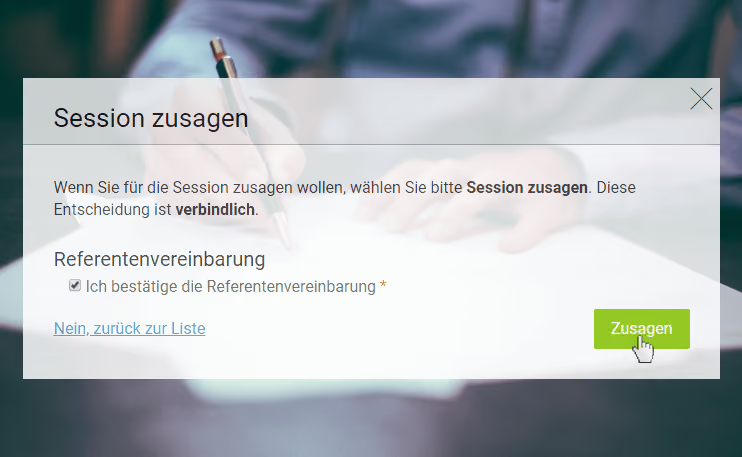
To ensure that everyone has read and accepted the speaker agreement, you could ask all speakers to send you a signed copy by mail. In 2019, this is really no longer necessary—just consider the effort involved with mail, postage, and unnecessary paper waste. These are three reasons why Converia has shortened this very analog process and moved it entirely to the digital realm: If a speaker wants to accept your invitation to give a presentation, they can only do so after they have accepted the speaker agreement in Converia. This simply requires checking a box, similar to what you are used to with terms and conditions or privacy policies. The agreement, which you uploaded once beforehand, is then immediately available to all speakers as a document with a single click, without any detours.
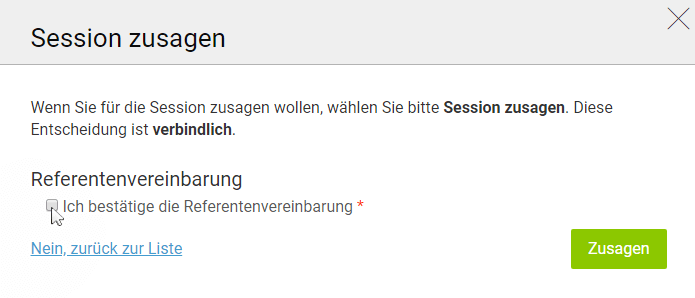
This is more practical than just placing the text on the conference website and pointing speakers to it via a link in an email. While that would be an improvement over the analog version, it does not allow you to verify whether the information actually reached everyone or if reading it was postponed and subsequently forgotten entirely.
If you are interested, we would be happy to explain in more detail how this works for your event.
If you also need help inviting your preferred speakers, it is worth taking a look at our article on invitation letters.