

Too much to do, too little time
Long queues at the check-in desk are hardly the best advertisement for an event. Unfortunately, they are a common sight that people have come to expect. It is an impression strong enough to stick in attendees' minds and significantly influence their opinion of the event. Is a conference well-organized or poorly run? Attendees get part of the answer the moment they arrive.
This becomes a problem at many conferences because there is no day more hectic than the very first one. Even the best and most thorough preparation is no guarantee that unexpected questions or situations won't suddenly arise that no one had anticipated.
It’s great if there is enough staff available to find answers and solutions. Unfortunately, as long as attendees still need to be checked in, there is rarely enough time for that.
Why self-service is a game-changer for conferences
Self-service stations make life easier for both organizers and attendees. With these stations, everyone can complete the check-in process entirely on their own upon arrival.
All you need is conference management software and the appropriate hardware capable of working with that software.
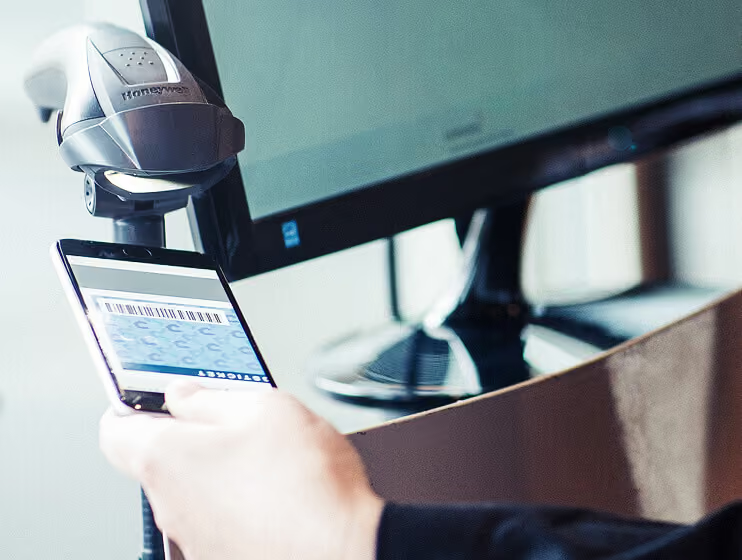
⚙️What you specifically need: scanners to capture the code on the attendees' tickets, and displays to guide them through the check-in process.
The right scanners for self-service
Not all scanners are the same: There are many different models available. The most important thing is what type of code you want to scan. Not every scanner can read every type of code. While some models only handle linear barcodes, others can scan 2D or QR codes. Handheld or stationary scanners are the most common at conferences. The latter are a bit more elegant, as attendees simply hold their ticket underneath them for a moment.
🌳If you want to make your conference check-in sustainable and save paper, advise attendees not to bring a printed ticket. Most scanner models can easily read codes from screens as well. Just don't forget to do a quick test beforehand!
The right displays for self-service
The display doesn't necessarily have to feel like an airport self-check-in kiosk. For conference check-ins, a kiosk solution is just one option, as tablets, laptops, or monitors work just as well.
🛑The only potential pitfall: The conference management software. Self-service check-in becomes much easier if you use software at all (which is a good idea for several reasons 😉). The display is a critical component of self-service stations when combined with the software. If the screen stays black, that’s bad. If the software on the tablets runs with significant lag or other errors, that’s not much better. Therefore, always check with your software provider to see which devices you can use.
From a design perspective, what appears on the screens shouldn't just follow the software manufacturer's default settings. When the self-service check-in menu matches the conference branding, it creates a much more beautiful and harmonious overall impression.
And what about the time it takes for self-service at conferences?
For once, time isn't an issue, because the primary goal is to ensure no one spends an unnecessarily long time checking in. Arrive, scan your ticket, and immediately mingle with the other visitors with your printed name badge—that’s all there is to it at the self-service station.
Ultimately, self-check-in saves valuable time that attendees can spend more meaningfully than by constantly checking their watches in a seemingly endless queue.
💡There are no special conditions for which events can benefit from on-site solutions that give people extra time to network.Self-service check-in works just as well for small meetings as it does for large congresses.
This also leaves more time for your staff. Rather than replacing your team, self-service finally gives them enough room to be available for attendee questions. At some conferences, it is all too easy for attendees to feel like they are just being "processed" upon arrival. Some people don't even dare to ask their questions because others are already waiting impatiently for their turn.
Self-service at conferences is anonymous and impersonal
A common prejudice held by opponents of self-service is that arriving at a conference becomes completely impersonal. This is incorrect.On the contrary, it finally provides the time to resolve issues calmly. Especially for less tech-savvy attendees, the thought of being left alone with a check-in station might initially set off alarm bells. In reality, no one faces an insurmountable hurdle because the operation is incredibly simple. Most of it runs automatically anyway, so people don't have to enter, select, or confirm anything. If there are still problems or hesitations, the staff is there to help.
🧪 There is also a solution for organizers who do not want to switch the entire check-in process to a self-service model immediately.Simply combine both methods, just like in some supermarkets: place stations where conference visitors can handle their own check-in right next to counters where staff check in attendees.
However, check beforehand whether your conference management software can meet your requirements. If not, it is worth considering a change of provider, because ultimately the system should fit your conference, not the other way around.
It is never too late to register
Organizers of some conferences are also happy to welcome attendees who decide to attend the event spontaneously. You can also implement this with the help of a self-service solution. People can fill out the same registration form on-site as they would for a standard online registration and see immediately if workshops or sessions are already fully booked.
💡To ensure that already registered attendees and those who still need to register do not get in each other's way, it is best to set up two separate areas.
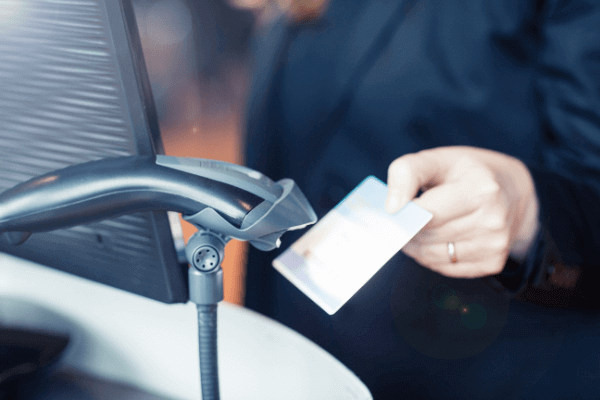
Since payment still needs to be made on-site, you should also not forgetcard readers.
One thing is still missing before moving on to the first item on the conference program: the name badge. Printing the badge is also part of the self-service solution. The second part of our series on self-service reveals which variants and devices you can choose from.
What's next?
1. If you like checking off lists, you can find one for conference check-in here.
2. Do you organize medical conferences where attendance earns continuing education credits? That is also much easier with a scan.
3. How about letting your attendees check themselves in at your next conference? We would be happy to advise you and answer all your questions about self-service stations. Contact us directly here.