

Is your conference intended for a very specific group of people and are the participants already set? Then you don't need to worry about the following tips. If that is not the case, Search Engine Optimization (SEO) is the best method to reach everyone who doesn't yet know that they will soon want to buy a ticket to attend your conference.
A website is a great way to generate interest, but it has one initial catch: no one is likely to stumble upon it by accident. Users who visit your conference website do so either because they know the address and type it directly into the browser bar, or because they click on a link that points to your site. Perhaps you are also running ads on Google or Bing, which will also bring you new visitors. In the vast majority of cases, however, it will be organic search that leads the majority of visitors to your conference website. And in all likelihood, search will continue to play an important role when it comes to discovering new content. However, being listed by a search engine is not yet a success in itself. What counts here is the position. The study by the SEO tool Sistrix mentioned at the beginning, as well as more recent research, have confirmed that it is precisely the top results that are clicked on most often. But how do you secure one of these coveted positions in the search results for your conference website?
1. Finding keywords
The first step is to find out what potential visitors to your conference are searching for. Keywords and key phrases form the foundation for all SEO measures.
Before you turn to a tool for help in identifying the crucial keywords, a very simple method is a good place to start.
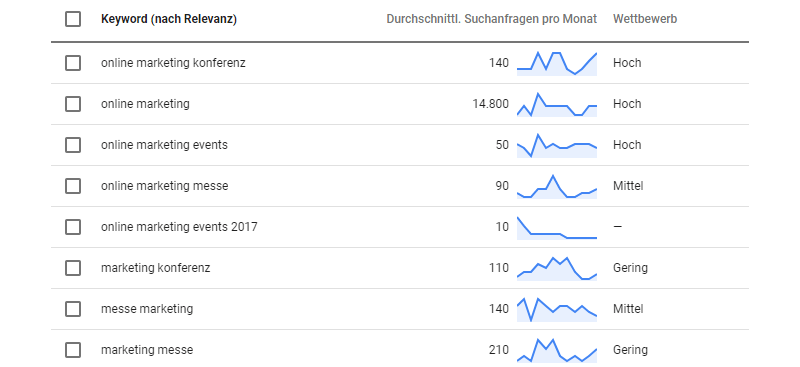
🤔Try to put yourself in the shoes of the searcher: What terms would they type into the search bar? For example, if you are hosting a conference on the topic of online marketing, the search queries could be "online marketing conferences," "online marketing conference 2026," or "online marketing conferences Germany."
Once you have gathered some initial ideas this way, you can use online tools to come up with a few more. Use tools like keywordtool.io or the free Google AdWords Keyword Planner, which you can also use even if you don't want to run any ads. The Google tool also has the advantage of providing the average number of monthly search queries as well as the level of competition for each keyword.
2. Using keywords on the conference website
Once you have identified the terms for which you want your conference website to rank highly, another important part of the SEO work begins.
The search engine should recognize that the website for your conference is a perfect match for the entered search term. Of course, this only works if the term appears frequently enough on the website. If you are organizing a conference on the topic of digitalization and the word only appears once on the site, the search engine will assume that users won't find much on the topic on your site, which is why the coveted positions on page one will likely go to others.
🔎If, on the other hand, the individual keywords appear frequently and in headings, this is a fairly clear signal to a search engine that the website is dedicated to the topic in detail and that anyone searching for it will find valuable information there.
Does this mean that a keyword just needs to appear often enough to help the page rank higher?
3. Better to avoid keyword stuffing
A few years ago, if you wanted to secure the top position in the search results, you really only had to use one SEO trick: include the keyword as often as possible within the text. Done.
Unfortunately—or fortunately—search engine algorithms are now intelligent enough to recognize the intent behind this. As practical as that may have been for the website operator, it was annoying for many users. A text in which the same word is constantly repeated is certainly not easy to read. As soon as Google decides that someone has overdone it with the use of keywords, the website can be penalized. As a result, it will either rank significantly worse than before or be removed from the index entirely—the ultimate SEO penalty.
So, instead of constantly cramming the same keyword into every conceivable place in the text, it is better to use synonyms.
🚀Synonyms are practical, do not compromise readability, and are rewarded by search engines. They are increasingly able to recognize synonyms as such and take this into account in their rankings.
4. ...and no automated link building either
There are also SEO factors outside of your own website that affect your visibility in search results.
This primarily concerns links from others pointing to the conference website. The "logic" search engines use for such backlinks is easy to understand: those who receive many are significantly more relevant than a page that no one links to.
However, the source of the link is always crucial. Are they websites that have a good reputation themselves and appear credible to a search engine? If so, the backlink is classified as high quality.
👨🎓For example, if a university or a professional society has linked to your conference website, it is highly valuable from an SEO perspective.
You can even create some of these links yourself. Give your backlink profile a boost by registering the conference in various congress calendars. For medical events, good places to start would be the Medical Tribune event calendar, the ZB MED congress calendar, or the Laborjournal.
✅Always check in advance whether the backlinks are so-called no-follow links. This means that while another website is pointing to your conference (good), the site operator has specified that the links should not be indexed (not good).
The search engine therefore does not "see" the links, which is why they have no influence on your ranking. For this purpose, there are browser extensions that detect all no-follow links and display them, for example, with a strikethrough. There is nothing wrong with link building—that is, actively building such backlinks—as long as you don't overdo it. Links on websites with no thematic relevance are of little help, and the more of them there are, the more it creates the impression that they are paid links. You should also avoid offers to buy backlinks.
Search engines penalize such practices accordingly. While it is possible for Google to reverse a drastic measure, the conference website operator has to put in a lot of work to invalidate those backlinks and distance themselves from them. You need to set aside some time for this; the task should not be underestimated.
Partners can sometimes help you get more links, too. Who have you successfully collaborated with for your conference? Have you had good experiences with service providers for technology or catering? Perhaps they would appreciate a testimonial from you that they could post on their website. This helps both sides: the provider receives positive feedback that convinces future customers, and in return, you get a link that improves your website's visibility. Or perhaps one of your speakers runs a blog and writes about the upcoming conference there.
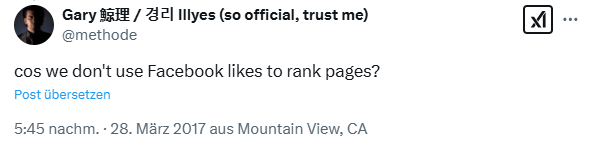
It also doesn't hurt to be active on social networks and link to your website from there, or have others do so. While metrics like Facebook likes most likely do not have a direct impact on the conference website's position in search results, these channels naturally ensure that others become aware of your conference through this path.
5. Pay attention to good descriptions
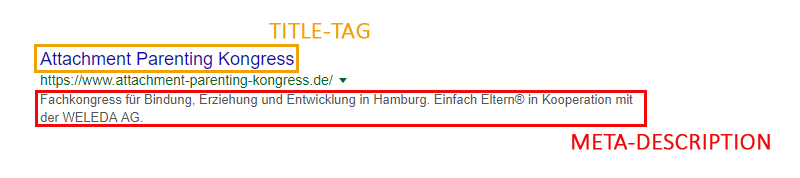
A good ranking alone isn't everything. Ultimately, what counts is that users click on the search result. If the title and description aren't appealing, that won't happen. Both hold great potential for SEO: if you don't define a title and a description text, the search engine will simply take whatever it can find, which is often not ideal.
⚠️Wichtig ist, dass jede Unterseite der Konferenz-Website einen Titel hat, den Sie entweder als Title-Tag in den Quellcode der Seite einfügen oder in die entsprechende Titelzeile Ihres Content Management Systems. Anderenfalls tauchen später in den Suchergebnissen Überschriften wie etwa "Seite 2" auf und das animiert nicht unbedingt zum Klicken. Auf aussagekräftig formulierte Titel, die zusätzlich noch Keywords enthalten, klicken Nutzer dagegen besonders gerne.
The description, or meta description, works in a very similar way. This is the text displayed in the search results below the title.
Search engines usually just take the first text they find on the page, which often leads to the description being cut off mid-sentence once the maximum length of 155 characters is reached. The description itself has no influence on the position in the results list, but the text should encourage users to click.
For the description, it is therefore a good idea to provide a short summary of the entire text that answers some of the key questions: What is the conference about? Who is organizing the event? When and where is it taking place?
👉In addition, there are a few other factors that affect the position of your conference website in search results. In the second part, we will show you how to structure content in a search-engine-friendly way and what things like loading speed and website design have to do with it.