


You are planning an event, and at the end of the day, you need to cover your costs and balance your income and expenses. This requires careful planning and consideration, as the venue, event technology, and social events all need to be paid for. Along with sponsorships and grants, registration fees are a key component in plugging the gap on the expenditure side.
But how should you calculate the fees, and more importantly, how many of the registered attendees will actually attend the conference? How many cancellations should you expect?
It certainly depends on the type of event and the number of attendees you expect. A cancellation of 10 people will be less painful for the budget of a 1,000-person conference than for a meeting with 100. Yet, one to two months before the event, the question arises: how many conference materials do we need, and how many people will attend the gala dinner?
A Converia study of 26 scientific events from various disciplines between 2007 and 2010 provided us with answers regarding cancellations. On average, 253 people attended these events, which ranged in size from 50 to 1,200 participants.
Every 50th booking is cancelled
The most intriguing question is likely the number of cancellations:
More than a third of all organizers were fortunate enough to have no cancellations (10 out of 26 events). The other 16 events saw cancellation rates ranging from 0.34 to 9.09 percent, with an average of 1.9 percent. On average, every 50th booking is cancelled. For an event with 300 attendees and a conference fee of €500, you would need to account for a loss of €3,000.
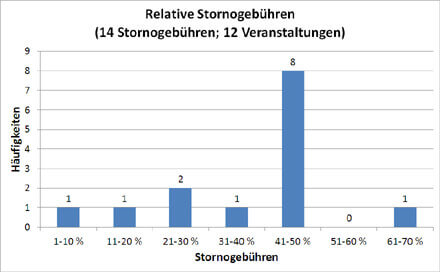
Cancellation fees average 41%

Average registration period is 4 months
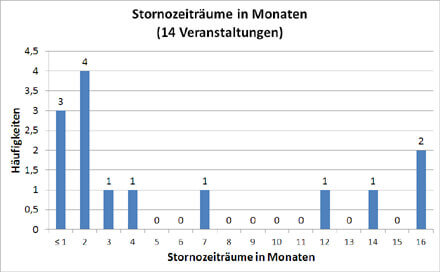
It is also interesting to see how long attendees should be allowed to cancel. Approaches varied significantly, regardless of the expected number of attendees: the 13 organizers allowed their participants anywhere from 1 to 16 weeks to cancel. This resulted in an average cancellation window of 6 weeks. The registration period for the events averaged 4 months, ranging from 2 to 8 months.
To assess these figures, it is helpful to know the level of the registration fees. The analysis used only the fees for full-conference attendance without discounts, resulting in an average participant fee of approximately €300.
Our study shows that just under 2% of registered individuals cancelled their attendance and had to pay an average fee of 41% of the registration cost. Cancellation fees were typically applied about 6 weeks before the conference.
Interestingly, the frequency of cancellations is not linked to the cancellation fees. Your attendees are not deterred from cancelling by potential fees. Consequently, in the event of a cancellation, the only consolation is that you are not left entirely to cover the costs yourself.
What has been your general experience with cancellations?
How high are your cancellation fees? What do you base your registration periods on, with or without cancellation fees?