


There is no way around calculating ticket prices, even if event planners rarely jump at the task with enthusiasm. Yet, it could hardly be formulated more clearly: in the end, costs should be covered by revenue, the majority of which comes from ticket sales. Rather than being a loss-making venture, conferences organized by companies should ideally turn a profit, leaving a surplus at the end of the day. Scientific conferences work a little differently, as profits are secondary there. However, no one wants to run at a loss either. Therefore, expenses should not exceed the revenue generated by too much. Miscalculating is never good, which is why you should ask yourself these questions beforehand:
How much does the conference cost?
Very important and always the first step: what costs are you actually facing? These can be roughly divided into fixed costs, which remain the same regardless of the number of visitors, and their variable counterparts. While venue rentals, speaker fees, insurance, and expenses for technology and decoration fall into the first category and can therefore be determined quite accurately, it is more difficult with variable costs. Name tags, catering, and personnel costs are hard to estimate when it is not yet clear how many visitors will register. However, approximate values can be determined by asking what is realistic. Every venue, for example, has a certain capacity. Does it make sense to book a specific location? How many people were similar events able to attract as visitors in the past?
Would you like to create a registration form and sell tickets right away? Our free demo shows you how it works with Converia.
When in doubt, round up your costs. The calculation does not have to be accurate to the cent. For ticket costs, all you need initially is a rough starting value. However, cutting costs in the wrong place can have fatal consequences: be sure to include marketing costs. Without advertising, participants will stay away and you will be left with unsold tickets. The money you spend should at least return to your account in the end to avoid generating a loss. That leaves the question of what other expectations you have—do you want to make a profit with the conference, or is it enough for costs and revenue to break even? In the former case, ticket prices would have to be set accordingly higher—or you would need to cut expenses.
How do you set a starting price?
Option 1: The price you initially calculate can be varied later—the amount does not necessarily have to be the same on everyone's invoice, especially since ticket discounts are not synonymous with losses for the organizer. When determining the starting price, the simplest method would be to add up all incurred costs, estimate a profit margin (if you want to plan for a profit), and then divide the total by the minimum number of participants.
However, you will only get reliable values if you are able to realistically estimate the variable costs—if you are unsure about the accuracy of your own forecasts, you might prefer to try the reverse approach.

Option 2: In this case, you first set a ticket price (how much is the target group willing to spend?) and plan all costs based on that. Such a strategy has its pros and cons. It can encourage organizers to focus on the essential aspects of the conference and may put a stop to one or two expensive extras; on the other hand, while this is a cost-efficient way to plan, the event might lack that special something.
A good starting point is also the framework conditions of the conference, or more precisely: how do potential ticket buyers feel about the offer? The decisive factors here are: where is the conference taking place? Is the venue easily accessible? Such factors always influence the decision when someone considers buying a ticket. If a long journey is involved, some find it too strenuous, while others would take it on but have to factor in additional travel costs.
How much money does the target group have?
Participants and ticket buyers are not always the same people. Sometimes employers provide a professional development budget, meaning the costs are covered in full or at least in part, and participants do not have to pay out of their own pockets. In such a situation, many are more willing to register for a conference that is a bit more expensive. If your event is aimed primarily at participants who do not have to pay for the costs themselves because the conference qualifies as professional development, the price can certainly be a little higher.
Should everyone pay the same?
Despite good content, 800 euros for a conference ticket is simply too much money for some interested parties. Such a price acts as a deterrent to students or young scientists who do not have a particularly high income. Expensive conferences are clearly above their budget and run the risk of becoming an exclusive event. The event itself also loses out: fresh ideas and perspectives from those who cannot afford to attend are unfortunately missing.
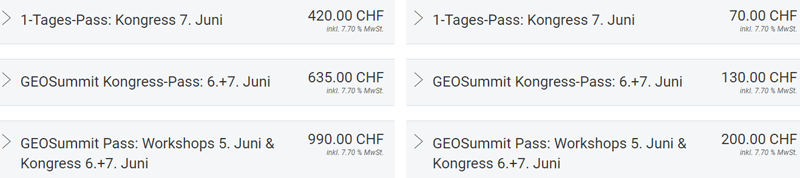
Also, keep in mind that the interest of some visitors might be limited to very specific program items, and they are not willing to pay for the entire package. Instead of offering only one package, multiple price groups are recommended here. This allows everyone to put together offers and packages according to their personal preferences, with different prices applying depending on the content. Or you can divide visitors into specific groups (students, association members, etc.) and set different prices based on this classification. The GEOSummit in Switzerland, which we support, combined both: during registration, interested parties are first asked whether they are visitors, association members, or are currently in training or studying. In the next step, they choose from various all-inclusive passes and individual offers. The prices for trainees are set significantly lower, which makes the event much more affordable.
When do discounts make sense?
Another strategy to create an incentive for ticket purchases right from the start and to put the conference on a solid financial foundation early on is early bird pricing. These create a certain level of planning security, which is much better than having to hope later on that you will sell enough tickets to cover all costs. If many participants register very late, it is ultimately unfavorable for calculating variable costs. Think, for example, of caterers who need to know how many visitors to expect. However, there is a small catch: the early bird rate must offer a real incentive and therefore be significantly lower than the price that follows the discount. A 30€ difference is unlikely to spur anyone to register as early as possible. And please don't overdo it: set a single early bird deadline.
Always offer tickets at a cost-covering price, even after deducting discounts. Discounts should only ever be used to vary the profit margin per ticket and increase the number of tickets sold, thereby reducing the share of fixed overhead costs per ticket.
Early bird rates and other discounts can also be implemented when creating the registration form in Converia. Our demo shows you more.
Instead of early bird periods, you can also work with scarcity. The first 200 attendees get their ticket at a lower price, while you provide ongoing updates on how many tickets are still available. The more that are gone, the more likely interested parties are to make a purchase. This is quite helpful for your calculations, because unlike early bird prices, you know in advance exactly how many discounted tickets you will sell at most.
What premium features does your conference have to offer?
The principle behind extra features: Those who pay more, get more. Features not available to standard ticket holders could include video recordings of sessions or access to exclusive events like workshops, networking meetups, or a meet & greet with a well-known keynote speaker. This also includes livestreams. Attendees who prefer (or need) to stay home still have the opportunity to follow everything, and such a service brings you additional revenue. To be successful with such premium features, two things must always come together: a) the content offers exclusive added value and b) it strikes a chord with the audience. Younger people in particular are generally more willing to invest money in unique experiences than in material goods.
How much do others charge?
Setting prices without any orientation is sometimes a bit too speculative. Are there similar conferences that target the same audience? Feel free to take a look around and then check their prices. By doing so, you are doing exactly what your visitors do. They, too, will consider beforehand which conference(s) they want to invest their money and time in. However, what you ultimately charge for your tickets should not deviate too much from the prices of others. If your tickets are significantly lower in direct comparison, it does not automatically mean you will sell the most. It may lower expectations for your conference, while prices that are too high tend to reduce the willingness to pay.
Insights from price psychology are also interesting in this context. If you omit the cents, the price appears slightly lower than others.
Sponsors help
A sponsor won't solve every problem on its own, but it makes them much easier to tackle. Sponsorships can save a lot of money if you find a partner who finds their target audience at your conference. And it is sometimes easier to convince a sponsor of your conference concept than to persuade a large number of potential attendees to buy a ticket. In concrete numbers: A sponsor supporting a conference with 6,000 euros brings in as much revenue as 75 attendees at a ticket price of 80€.
Pro tip: Ask around
Who knows best whether tickets were too expensive? Those who didn't buy them for that reason. Since you cannot survey those individuals, pass the question on to everyone who is there instead. A short survey is perfect for this, allowing you to reach all attendees at once and ask if the ticket price level was appropriate. The best time for such a question would be after the conference. Only then are visitors able to judge whether the prices were reasonable, because by that point they know what they received in return.
What's next?
Once your prices are set, you have cleared an important hurdle. However, you are immediately faced with the next one, because now you need to find buyers. Even if the conference program and pricing strategy seem to have little to do with each other, they are actually closely linked: If the offering manages to impress potential attendees, they are more likely to decide to register. It is a different story for events that are interesting in terms of topic but offer no other added value – in that case, the decision will likely favor another conference, for example because CME points can be earned there or visitors can participate in hands-on workshops or hackathons instead of being subjected to a constant stream of lectures. Of course, this does not mean there should be no lectures in the program. But it is important to think about what else you can come up with to stand out from other events. With an interesting offering, a slightly higher price is often acceptable for most people.