


Beyond the many benefits virtual conferences offer everyone involved—such as participants saving on long travel times and organizers being able to sell far more tickets—such organizational hurdles can easily fade into the background. However, almost everyone needs to keep the time zone issue on their radar. The only exceptions are conferences where all participants are in the same time zone or where there are only one or two-hour differences. But who can predict that accurately for virtual conferences? The line between national and international events is no longer clearly defined. Even for purely German-language conferences, it is now possible for participants in New Zealand to register.
When the most pressing problem last year was simply making the conference happen at all, organizers largely opted for the simplest and most obvious solution: they chose the time zone of the location where the conference would have taken place under normal circumstances—much like a sports world championship, which can only be broadcast live once. While participants in other time zones were at a disadvantage, they were initially able to cope with it because their daily lives had suddenly changed as well. But now that the range of virtual conferences has become larger and more diverse, and organizers are moving away from a pragmatic, experimental approach to planning, considerations regarding conference timing should be given more weight.
It can be done without exact times
It is still often the case that organizing a conference means relying heavily on estimates and past experience. Especially with a series of conferences, organizers draw on data and insights from previous years because it provides a rough idea of which parts of the world most registrations usually come from. However, as previously mentioned, this is currently shifting.
How about just announcing a date for the conference first and only introducing specific times once it’s clear who will be attending? Most people will reserve the entire day for the conference anyway, and travel logistics don't need to be considered. For better planning, however, it is helpful to tell (potential) participants right away whether a conference day will last five or ten hours. Explain that you are holding off on exact start times for a while to make participating in the conference as convenient as possible for everyone.
Which time zone wins?
Should you then set the conference times to the time zone where most participants are located—or not?
That would indeed be the simplest solution, but it is only fair if there are just a handful of participants from other parts of the world. Time zone-specific adjustments always involve extra thought and considerable effort for organizers. To find a compromise, try to ensure that the conference doesn't start at 3 a.m. for anyone. Usually, you can find better times that might not be ideal for some, but still don't clash so severely with a regular daily routine that night shifts in front of the screen become necessary.
Time zone converters help in setting suitable times. Select the participants' time zones to get an overview of the individual times and better identify what the time differences look like in detail.
Working with recordings
A conference with a live program is great, but one with pre-recorded presentations is not necessarily worse. You don't have to broadcast every session live—especially if there are other ways to involve participants. If you use a comprehensive platform for your virtual conference, a whole range of such options is immediately available to the audience. For example, questions can be posted under a video for speakers to answer, speakers can be contacted directly via the platform to arrange a personal meeting, or participants can discuss the content with each other via a chat function. At virtual conferences, it happens easily that someone misses a session or two. In that case, the person should always have the opportunity to quickly jump back into the conference proceedings and get in touch with other participants.
Organizers can also solve the time zone problem with a combination of synchronous and asynchronous program elements. This was implemented, for example, by the 3rd Swiss Congress on Giftedness and Talent Development (IBBF) at the University of Applied Sciences and Arts Northwestern Switzerland, which took place in mid-January. The participants included teachers who are not constantly available during the week, as well as experts from the USA. Although there was a fixed program schedule with live presentations and some pre-recorded workshops, the majority of the program was available as a recording in the Virtual Venue for several days afterward, giving everyone enough time to follow the congress in several segments. All presentation slides were also available for download on the conference platform.
The German Society of Periodontology (DG PARO) followed a similar approach during its 2020 hybrid annual meeting. At the beginning of the meeting, all pre-recorded presentations could be viewed and discussed in the Virtual Venue over several days. This was followed by the second part of the program, the Live Day. A limited number of participants had the rare pleasure of attending the conference in person, where they could take part in an exclusive hands-on course or follow presentations live, which were streamed in parallel to the Virtual Venue and made accessible to those staying at home.
Alternatively, the conference could take place entirely as a live event—and then be made available in its entirety as a recording. There is a small risk involved in that perhaps significantly fewer people will register for the livestream or it will run with little international participation, which might result in less extensive accompanying discussions.
Holding sessions in multiple segments
The software conference RecSys developed an interesting system for the virtual version of its 2020 event: the conference program took place live at a set time—and was repeated in its entirety eleven hours later.
The graphical representation is particularly well-suited for personal scheduling: the program items highlighted in red are better for night owls and simultaneously serve as a signal for the more day-active participants to switch to the alternative, green-highlighted time in the other round.
A participant in London could thus finish at 10 p.m. and log back in at 9 a.m. the next day instead of pushing through until 2:30 a.m. to avoid missing anything. The latter would have been theoretically possible, as everyone has the choice and decides for themselves—the great advantage of this option.
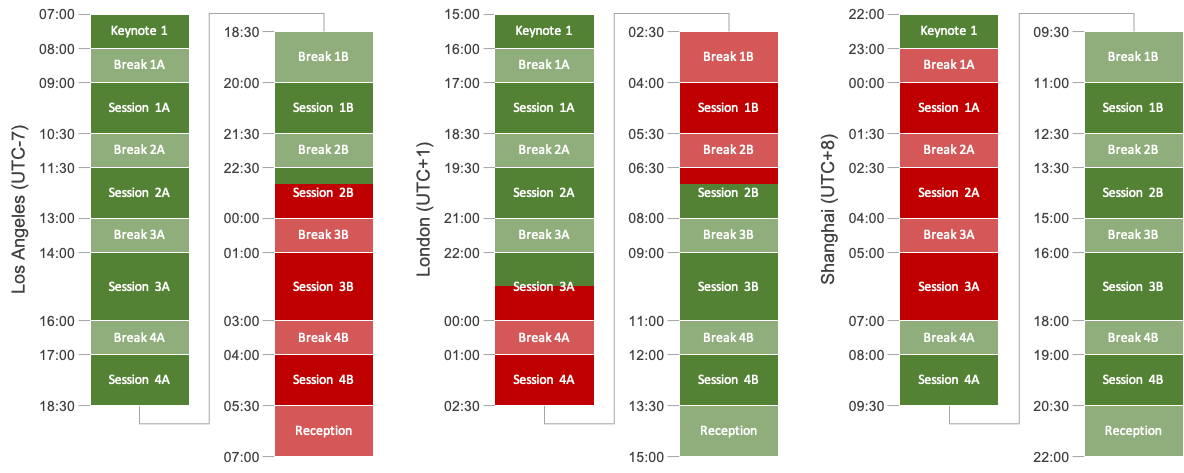
Whenever there are multiple times for a program item, all of them should be listed in the schedule. It is not enough to provide just one time and note that the entire program will repeat later. This forces participants to look up the times themselves and convert them to their respective time zones, which is tedious and error-prone when dealing with an extensive program.
In general, there is currently a lot of experimentation with this model. For example, at ECML-PKDD 2020, a conference on machine learning and data mining, every presentation was held twice, with a twelve-hour gap between the two sessions.
Regional focus
You don't have to be on the organizing team of a software conference to find ways to bring geographically dispersed participants together virtually. A noteworthy idea came from the U.S. Grains Council. For two international meetings, they grouped individuals from the same or nearby time zones for some of the sessions.
In the morning (based on EST, the local time of the Grains Council in Washington, D.C.), participants from Central and South America, Canada, Africa, the Middle East, and Europe exchanged ideas. In the evening, sessions were held for everyone in the Asian region.
Shortened conference days
Despite different time zones, the conference can maintain its usual or originally planned scope. However, it is advisable to divide the program into several sections that span multiple days. This makes it easier to coordinate the program across different time zones. If a nine-hour conference program runs in one go, some participants will likely drop out before the end. Keep in mind that in most cases, they are sitting alone in front of a screen and moving from one session to the next only virtually. Even with the most varied program, this becomes exhausting and tiring after a few hours.
Such an unwanted effect is avoided if the nine hours are spread over two or three days. Even if someone cannot stay for the entire duration on one day, it is much easier to catch up on missed time or, as an organizer, to coordinate the different time zones in the first place. With a nine-hour conference day, there are always disadvantages for some people, as some program items fall into the "red zone" of conference-unfriendly hours, which you should avoid if possible.
Do you have any other ideas for planning conferences across multiple time zones? Which approaches do you think are suitable and which are not?
Our conference platform makes it even easier to create schedules for events. Test the feature here or the virtual platform here.