

To ensure Q&A sessions are a success, even at academic conferences, pay attention to these five factors:
- Room layout: Visibility and proximity instead of distance between the panel and the audience.
- Moderation: Stay attentive and be prepared for critical questions.
- Technology: Incorporate multiple microphones, translation tools, or digital Q&A platforms.
- Audience: Collect questions in advance, use digital channels, and lower the barrier to participation.
- Experts: Provide clear information on procedures and roles beforehand to build confidence.
A Q&A session acts like a magnifying glass: it deepens, clarifies, and gets to the heart of what remained open. It is all the more frustrating when it misses the mark because no one asks questions or the conversation fails to get off the ground.
To avoid this, you need more than just good content.
Tip #1: Optimize the room layout
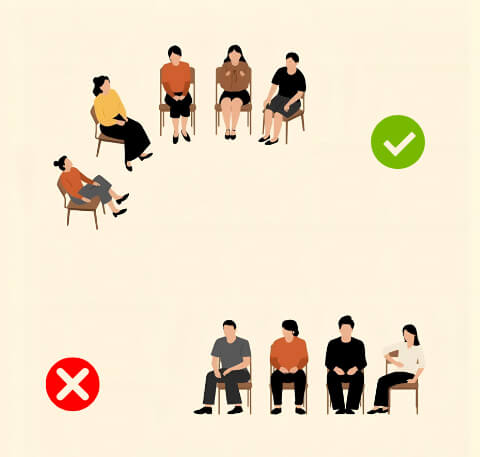
Place the experts in a semicircle instead of a rigid row. This keeps the exchange lively.
Q&A sessions often fail because of the seating arrangement. A few chairs on stage—done? That’s not enough. If the panel and the audience cannot see each other, interaction falls by the wayside.
The setting helps determine how much interaction is even possible. A small detail that is often overlooked: the seating arrangement of the experts.
Here is how to do it better:
- Semicircle instead of a row: This encourages eye contact and creates more dynamic interaction.
- Fewer panelists: Everyone gets enough speaking time, leaving more room for discussion. Conversations remain lively and balanced.
- Tables only in exceptional cases: Tables create a barrier between speakers and the audience. The conversation feels more formal, and the barrier to asking spontaneous questions increases. If possible, use low tables.
At the 2016 ReactNext conference, the organizers showed how it’s done: the speakers sat in a semicircle rather than in a neat line. This had several advantages: everyone could see each other, speak more directly to one another, and react better to each other.
💡Pro tip for your Q&A session:
With more than three people, it quickly gets crowded on stage. The most thankless spots are on the far ends, as people there are easily overlooked. It is better to opt for a semicircle.
Another option: a long table for the expert panel.
The organizers of the Zabbix Conference chose this. It can be quite useful as a place to set down water bottles, laptops, or notes.
👍Where tables work for Q&A sessions:
As at the Zabbix Conference, the table should be close to the audience. Also, the attendees were seated at tables here as well. This is typical for many software conferences where laptops and tablets are standard equipment. This creates at least a visual sense of balance.
Less well-executed at Zabbix: The table was not centered in front of the audience. Instead, an unused lectern stood in the middle. This likely blocked the direct view of the stage for some participants.
Schedule a brief technical and stage check. Also, test a few seats in the audience before the session. Is the view clear or obstructed?
Remove unused items like lecterns or flipcharts that are in the way. A clear view of the stage makes it easier for the audience to stay engaged and participate.
Sidebar: Campfire Q&A
The University of Birmingham recommends breaking away from traditional conference formats. In a strict sense, this refers to the Q&A portion following a keynote, but it works just as well for a panel of several experts:
In the campfire version, several round tables are placed around the room. Attendees sit at these tables, leaving one chair empty. For a set amount of time, an expert from the panel joins each table to answer questions.
Benefits of the campfire approach:
- Conversation over stage: less distance, more personal interaction
- Ideal for smaller groups: works especially well with fewer than 100 people
- More confidence to ask questions: lower barrier to entry, more direct exchange
✅Bottom line: Successful Q&A sessions rely on proximity rather than distance between experts and the audience.
Tip #2: Use a moderator strategically
A Q&A session is unpredictable. Without a moderator, it can quickly lose its focus.
The main risk of a Q&A session is that organizers are, to some extent, handing over control of the proceedings.
How many questions will come from the audience? Will there be any at all? And how will the experts handle critical comments?
The moderator must be prepared for anything. The success of the entire session hinges on this role.
Choose a moderator who is knowledgeable about the subject matter. They should guide the conversation without making themselves the center of attention.
How it works:
- The moderator should already be familiar with the topic or the conference to guide the conversation confidently.
- The panel and the moderator should meet beforehand; it makes everything run much more smoothly on stage later.
- Good moderation also means internalizing the schedule in advance and keeping an eye on the time during the live session.
🎤 Good choice, good result:
At Zabbix, Rihards Olups, an experienced consultant from their own team, took on the moderation. At ReactNext, it was Boris Dinkevich—not only a co-organizer of the conference but also a long-time developer.
A few common pitfalls in Q&A sessions:
- Questioners who ramble on
- Answers that lose their way
- Experts who interrupt each other
An attentive moderator recognizes these moments and intervenes discreetly without breaking the flow. A good sense of timing and an instinct for when to delve deeper into a topic or when to wrap it up are essential here.
What if opinions on the panel diverge?
Then the moderator should give each position sufficient space. Discussions shouldn't spiral out of control, but the moderator shouldn't nip them in the bud either. The audience gets more out of the session when they hear different opinions and can reflect on them afterward.
Another important point: Where is the moderator positioned?
Literally. At ReactNext, they were placed slightly to the side at a lectern. While this didn't block the view, it always made them feel a bit sidelined.
One final point: Please skip the PowerPoint.
A Q&A session thrives on interaction, not prepared slides. If you want to show something, incorporate live examples or demos instead. Especially with technical topics, this creates a welcoming entry point.
✅ Bottom line: Good moderation is indispensable. It structures the conversation without dominating it.
Tip No. 3: Prepare your technology well
Many Q&A sessions fail not because of a lack of interest, but because of technology that slows down the conversation.
During the Zabbix and ReactNext sessions, microphones were passed back and forth very often. A few more would have benefited both conferences. This is poison for dynamic discussions, as every hand-off wastes unnecessary time.
Therefore, use multiple microphones or throwable mics that can quickly reach anyone with a spontaneous question.
🎲Throwable microphones are especially practical in larger rooms. Participants toss the foam cubes with integrated microphones to one another. This makes discussions much easier, as the mic quickly reaches the person who wants to speak.
Some universities already have throwable microphones in their inventory: For example, organizers can borrow them from the University of Leipzig, the University of Zurich, or the Merseburg University of Applied Sciences. Check with your tech team in advance to see if any are available.
Also important before starting the Q&A session:
- Use lapel mics for all speakers
- Use multiple room mics
- Pre-session tech check: Are all mics working?
However: The more microphones, the more coordination is required. Without clear rules, three people will suddenly start speaking at once.
If you're looking for something a bit more unconventional, you could experiment with a throwable microphone instead. It looks like a cube, is easy to spot, and adds some movement to your Q&A session. Where appropriate, it encourages more interaction and can even lighten the mood.
✅Bottom line: Having sufficient and functional technology in place ensures dynamic Q&A sessions.
Tip #4: Actively involve the audience
Q&A sessions thrive on the courage of the participants and how easy you make it for them to speak up.
The first question is often the biggest hurdle. Without it, the room stays silent.
The setup at the Zabbix session might have been a bit daunting: anyone with a question for the experts had to walk up to a microphone at the front. It felt a bit like an oral exam. It’s no wonder that kept some people from asking their questions.
Nevertheless, it didn't stay quiet.
Perhaps because the participants accepted the hurdle as normal. Or because they came to the session well-prepared. Or maybe it was just because the format was clear and everyone knew how it worked.
But: The start is almost always bumpy. At first, it seems like no one wants to contribute, and then suddenly, hands start going up one after another. This tipping point determines the flow of the entire session.
Here is how to lower the barrier to asking questions:
- Mention that there will be a Q&A session in your advance emails.
- Feel free to keep reminding them.
- "Questions are welcome" – if people know this in advance, they can prepare one.
- Make it clear: There are no stupid questions.
- Offer the option to submit questions in advance – anonymously, if desired.
This helps anyone who doesn't feel confident in the language (international conferences!) or prefers to formulate their thoughts in peace.
Participants can also submit questions in writing during the session. This can be done either via the official conference app or, on a larger scale, via a social wall. The moderators then pick up these questions and bring them into the discussion.
And the experts benefit from this, too:
If you share a selection of the pre-submitted questions, they will know better what to expect. Sometimes, the experts are just as nervous as the audience.
Official conference guidelines also emphasize the importance of actively involving the audience in the discussion. For example, the Q&A guide from the ISPOR health economics conference recommends: Don't just wait for questions from the audience; as a panelist, ask some yourself. "What challenges have you encountered?" encourages the audience to share their own experiences and start a conversation.
✅Bottom line: If you get the audience to start asking questions early on, you will be rewarded with lively discussions.
Tip #5: Prepare your experts
Anyone standing on stage should know what they are getting into. A Q&A session thrives when everyone involved feels secure. This applies not only to those asking questions but also to the experts.
Inform your panel experts in good time about the schedule, moderation, and potential topics so they can react confidently during the session.
As soon as the date, time, and location of the conference (and especially the Q&A session!) are set, send out an initial update. This allows everyone to prepare in time.
If you are publishing short profiles of the experts on the conference website, specifically ask for a short biography and a current photo.
One to two weeks before the conference is a good time for a second, slightly more detailed message.
This should answer questions about the exact flow of the Q&A session:
- Who is moderating the session?
- How exactly will it work? Will there be an introduction round? Thematic blocks?
- How will questions from the audience be collected?
- Do the experts need to prepare anything?
This is also the moment to remind the experts (once again) that they do not need to bring a PowerPoint presentation. Remind them that the focus is on dialogue.
In their guide to Q&A sessions, Streeter and Miller (2011) recommend that moderators and panelists always take questions seriously, listen actively, and ask follow-up questions if necessary to better grasp the core of the inquiry:
- Respond honestly: If no one has an answer, admit it openly or pass the question back to the audience.
- Remain respectful: Do not ridicule any question or respond with "You really should know that..."
- Recognize opinions: Sometimes questions are disguised comments. Thank them for the input without shutting down the discussion.
✅Bottom line: Good preparation brings more composure to the stage.
Bonus tip: After the Q&A session
Once the session is over, there is one final step: Say thank you.
This is also part of good communication and leaves a lasting impression.
You may have conducted a survey among attendees in the meantime, in which the session was praised. That would definitely be worth mentioning in the thank-you email. A brief note of thanks with genuine praise is always well-received and motivates people to attend again next time.
Special features of Q&A sessions at scientific conferences
In an academic setting, Q&A sessions are particularly important. They allow for follow-up questions to researchers, open up dialogue, and provide insight into new research perspectives.
At the same time, they present organizers with unique challenges that can quickly become stumbling blocks in the daily routine of a conference.
Typical pitfalls of conference Q&As and how to handle them:
- Overcoming language barriers: At international conferences, participants whose native language is not the conference language often ask questions. Formulating such a question (and then asking it in front of everyone!) is challenging. The question might not be phrased correctly or might be difficult to understand due to an accent.
- Solution: Moderators should repeat the question in their own words. Ask the person to rephrase the question. If that doesn't work, offer to clarify the question with them directly after the session.
- Managing highly specific technical questions: Sometimes participants ask extremely detailed questions. There is a risk of losing the majority of the audience here.
- Solution: The moderator summarizes the question in a generally understandable way or moves detailed discussions to a follow-up conversation.
- Interdisciplinary panels: In many scientific sessions, experts from different disciplines sit together. Questions are often only relevant to a portion of the panel.
- Solution: The moderator directs questions specifically and asks for different perspectives. This allows the entire panel to participate.
- Hierarchies and power imbalances: Early-career researchers sometimes hesitate to ask critical questions of established researchers.
- Solution: Allow questions to be submitted anonymously via a conference app or actively encourage the audience: "Controversial questions are also welcome."
FAQ on conference Q&A sessions
What is the best way to introduce a Q&A session at a conference?
The best way is with a clear invitation, e.g., "Questions are explicitly encouraged." It is also helpful to ask the first question yourself or use a prepared question to break the ice.
What mistakes should definitely be avoided during a Q&A session?
Mistakes include: planning too little time, ridiculing questions from the audience, shutting down discussions, or failing to actively involve the audience.
How long should a Q&A session be?
For panels, 45-60 minutes is ideal. It is important to allow enough time for several questions without running over the allotted time.
How should experts handle critical or uncomfortable questions?
Listen respectfully. Respond calmly and answer the question factually. If you don't have a suitable answer, be honest about it. Alternatively, pass the question to other panel members or to the audience.
How can you encourage participants to submit questions in advance?
Encourage participants to submit questions beforehand online or via a conference app. This gives you a selection of questions to start with. Experience shows that once the first few questions are asked, others will naturally follow during the session.
A Q&A session is only a small part of a scientific conference program. Find more tips for the rest of the event here:
❌Please, no more lectures! Why not design the rest of the program like a Q&A session and involve the audience more?Discover other mistakes you should avoid as a conference organizer.
💡Asking the right questions can lead to clever ideas that enhance any conference program.Read here to find out which questions will get you there.
Conference training for academics: Take your conference organization skills to the next level!
Use this Converia voucher code to get a 10% discount: Converia_Earlybird_10
👉 DESIGN successful events: Creativity meets strategy!
Do you want to design events that exceed your participants' expectations?
This training will ensure your events are inspiring and memorable!
👉 PLAN conferences stress-free
Would you like to start planning conferences with seasoned confidence?
Get the methodological know-how you need for a successful project launch here!
👉 EXECUTE conferences successfully
Would you like to start running conferences with seasoned confidence?
Get the methodological know-how you need to guide your event day with confidence and ease.