


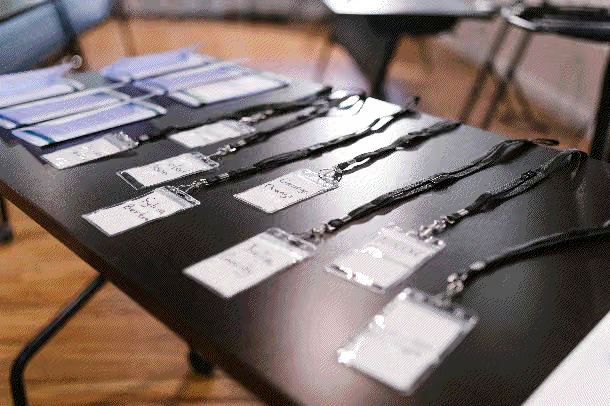
What makes a good conference badge?
There are many factors to consider when designing a badge. Size is fundamental: a larger badge is easier to read from a distance, but it can also be cumbersome for the wearer.
The information included can also vary. The name is, of course, the most important element. You can also include qualifications, the attendee's role, and, naturally, the name of the conference.
Find out here how Converia supports you with automated badge production using attendee data.
Never underestimate the visual design of a badge. A name tag should look impressive, but too much of a good thing can backfire. Try to strike an elegant balance between artistic appeal and functionality.
It is also worth thinking about accessories in advance: clips, pins, or magnets are all valid options, but are they really better than a simple lanyard?
What types of conference name badges are there?
Everyone is familiar with traditional paper and plastic badges, and there is nothing wrong with them. Plastic badges, for example, are extremely durable compared to other types. Paper badges, on the other hand, are sustainable and inexpensive.
If you want to make a lasting impression, you can get more creative. With an integrated RFID chip, you can turn a simple badge into a multifunctional tool. Or, if you have the time and resources, electronic name tags are a great option. They make for a stylish souvenir and an unforgettable conference experience.
All of these types have more pros and cons than can be listed here. You can find more details here.
Eco-friendly alternatives to traditional badges
Sustainability is not just a trend! It is clear that conferences generate a lot of waste. To reduce these amounts, eco-friendly badges are a great option. However, like standard badges, there is no one-size-fits-all solution that you can simply select as an organizer. If you want to act sustainably and eco-friendly, you need to pay attention to many things, such as materials, origin, printing, and accessories. This also includes the realization that even if sustainable badges are not an option for you, there are still ways to make your conference environmentally friendly.
Protecting the planet is something we all care about. Click here for an in-depth look at the topic of sustainability in conference badges.
On-site badge printing in detail
Your badges do not necessarily have to be produced in advance. Printing on-site can be much more efficient because only as many badges as needed are printed. The printing process itself is fast and attendees can easily do it themselves. You have a choice: the inexpensive but technically limited thermal printing, or the high-performance printer. The latter prints the entire content of the badge rather than just the name in black.

By the way, Converia offers organizers help with self-check-in to ensure a quick start.
Badge distribution
However, we don't want to convince you that printing on-site is the only sensible solution. With Converia, you can generate a sorted list of all badges for pre-printing in a convenient butterfly format.
Sending them by post or email can also be worthwhile. If the conference ticket includes a public transport pass, it is important that attendees can use it on their way to the conference.
Nevertheless: blank badges or a printer are a must, as some attendees may forget their name tags or register only at the start of the conference.
Print-at-home badges
Recently, event organizers have increasingly been using so-called print-at-home badges. In this case, the ticketing software provides a badge along with the ticket that can be printed at home. This saves attendees time on-site and saves organizers from intensive staffing requirements. Converia offers standard solutions for this as well.