

Since our article in February, it has become clear that the comparison to the seasonal flu is quite flawed. While it is not yet possible to say anything reliable about the coronavirus death rate because the pandemic is still ongoing, we now know that the coronavirus is significantly more contagious than the flu and spreads much faster—which is dangerous because it remains unnoticed for so long. As a rule, it takes several days, sometimes even up to two weeks, for the first symptoms to appear in an infected person. And occasionally, they do not appear at all or are so mild that they are ignored.
However, the person is already contagious during this time, and the consequences are devastating if they have contact with many others, as is the case at a conference, for example. In fact, it was likely a conference in January that opened the door for the virus to enter several countries at once.
Conferences are—these days—risky
At a relatively small conference organized by a company, just over 100 participants from various countries gathered at a hotel in Singapore. Among them was a man from Great Britain who likely became infected there and subsequently infected at least eleven other people of different nationalities after the conference, who then, in turn, spread the virus further in their home countries.
While it is true—as we wrote in our earlier article—that every conference should take precautions to protect participants and organizers should actively encourage them to help out, it is unfortunately also true that conferences contribute significantly to the spread of the coronavirus. Therefore, it is more than right to cancel all upcoming events for the time being and to consistently maintain social distancing.
If this does not happen, the infection curve will continue to rise rapidly, exceed the capacity of the healthcare system, and inevitably lead to more deaths—as has already happened in Italy. Because there is currently neither a cure nor a vaccine, the only option is consistent behavioral measures to slow the spread.
This has been very successful in places like Singapore, where the government quickly banned all events and initiated further measures, so that the number of infections has remained far behind that of other countries.
Not (going) as planned
The now widespread ban on events is an important and logical step, but it presents organizational teams with challenges that, in this form at least, no one could have been prepared for.
In addition to legal and insurance matters, there is organizational chaos and the question of whether postponing or canceling the conference entirely is the wiser decision. As if that weren't difficult enough, this often has to be managed from a home office, as offices remain closed in many places for the time being—also a sensible measure.
The Converia team is also currently adjusting to a situation that feels a bit unusual. While everyone on our team who wanted to work from home occasionally has been able to do so without any problems for several years, it is a completely different matter when it suddenly affects everyone, and some also have to take care of their children at the same time.
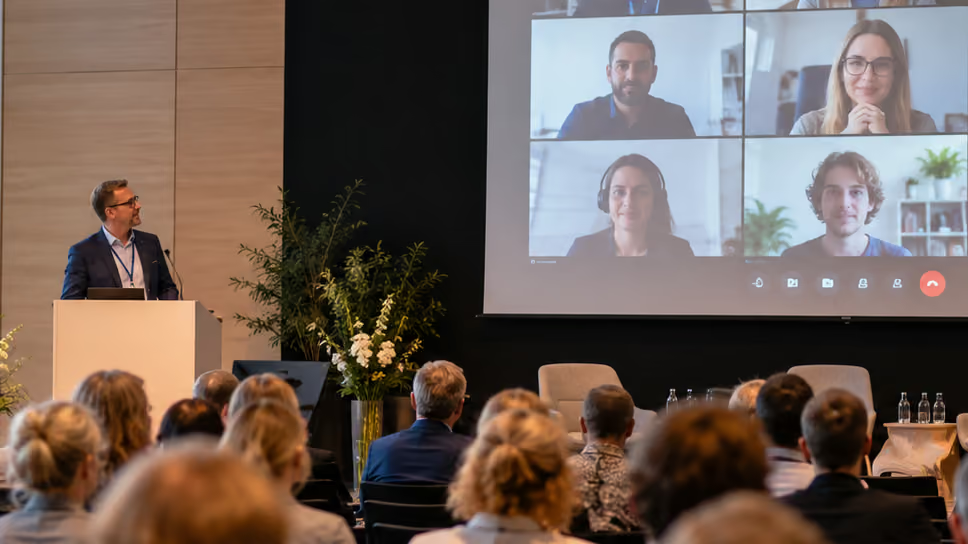
Whereas previously there might have been one or two people joining remotely via video, now all meetings have to be conducted this way. With the entire team, this is much more demanding than on a small scale, so we had to run a few test runs before we could solve this problem (since last week, Zoom has proven to be an intuitive and stable tool for us, especially for larger meetings).
We are therefore aware of some of the problems that arise from the new situation, especially because our clients have had to either find new dates for their conferences or, with a heavy heart, cancel them entirely over the last few weeks.
For this reason, it is very important to us at the moment to actively help conference organizers and to be there with our conference management software and our service, as reliably as ever, during these unusual times for all of us.
The last few weeks have shown us how much we rely on scientific findings. We therefore want to minimize the financial damage that can result from the cancellation of scientific conferences, which is why our minimum order value for scientific conferences is completely waived for all organizers who choose Converia by April 30, 2020, and have to cancel the conference later after all.
Because this can of course also happen with all non-scientific events, we are also reducing the minimum order value for these by a full €500 in the event of a future cancellation, provided Converia is commissioned by April 30.
If the conference is postponed instead, we will not charge you any additional costs for this. The same applies if you decide to hold the conference virtually. The latter is currently an attractive option for many organizational teams. However, very few have dealt with the topic before and are not sure whether this is a realistic alternative for their conference or how exactly it should be implemented. We are happy to help you with these questions and advise you. Simply contact us via our form or call us directly at +49 3643/811 807 60.
Things are looking up for organizers
The measures currently being taken are temporary. The effects are being monitored and analyzed daily, and there is a constant reassessment of which steps are necessary and in which areas strict measures are no longer required. All the regulations we are currently dealing with are therefore temporary in nature.
There will be a time after the pandemic. Of course, it is unlikely that we will all immediately return to business as usual and that massive international conferences and congresses will take place right away. It will likely take some time before organizers return to normal.
But it is also clear that conferences will return in a post-pandemic world. And perhaps we will enjoy them even more after this period of limited contact.