

And because progress always requires exchange, the Annual Scientific Meeting, formerly the GBG Annual Meeting, is a key date in the calendar for many people working in gynecology, cancer therapy, nursing, and pharmacy, as well as for those who have been diagnosed with breast cancer themselves.
The COVID-19 pandemic also required the GBG to act quickly in the face of a new situation that had to be managed virtually. The organizing team adapted the conference format and created a temporary home for the event in a digital environment. Participants joined virtually, welcomed the new format, and conducted what were previously in-person conversations via their screens. However, this purely digital solution was intended to be only an interim measure.
Major challenges in the anniversary year
With the planning of the 20th Annual Scientific Meeting and the desire for direct, personal, on-site interaction, the organizing team opted for a hybrid conference format. Participants were free to choose whether to follow the latest developments in breast cancer research from home or to discuss them in person on-site.
This choice between physical, hybrid, or purely virtual participation required several adjustments:
The conference software no longer fit the conference
For the purely digital format, the GBG had relied on an application that worked well in the virtual space but could not support hybrid conference formats in the way the team had hoped.
Distributed processes, distributed data
The software challenge led directly to the next difficulty: How and where should all the data from the digital and non-digital parts of the event converge? Is that even possible without participants having to register twice? Furthermore, there were processes that still had to be managed entirely manually by the team, which continued to cause a significant workload even after the event had ended—such as certificates of attendance.
Conclusion: New conference software?
All these factors pointed to the need for new event software, which had to be found and implemented as quickly as possible due to time constraints. During this software search, the organizing team discovered Converia.
A single software for the entire hybrid conference
Converia was particularly appealing because, in addition to features for in-person events, the software also includes its own digital conference platform, the Virtual Venue.
For the hybrid Annual Scientific Meeting, this meant one thing: the extra workload was eliminated. People who wanted to attend the conference registered exactly once. The login provided participants with access to documents such as invoices or booking confirmations. If they were attending remotely, it also opened the door to the digital conference hall.
From the organizers' perspective, the great advantage was that all personal data remained in one system and was therefore synchronized. If the team had decided to use tools from different providers instead, this would not have been so easy. Often, there are no interfaces, meaning organizers have to laboriously update data manually whenever addresses or bookings change.
Setup service and premium support
In Converia, organizers have two options when setting up their conference: either they configure the event entirely themselves, or Converia handles it. The latter proved particularly practical for the GBG, saving them valuable time. Furthermore, all questions regarding the conference were answered by a contact person from the Converia team who was intimately familiar with the project.
Live streaming by our technical partner
On-site at the Steigenberger Airport Hotel in Frankfurt am Main, the GBG had a technical service provider, but they were responsible exclusively for the on-site conference technology.
The 16-hour program was broadcast by our technical partner, who used a complete system and three cameras on both days of the event to ensure that the high-quality streams reached the Virtual Venue.
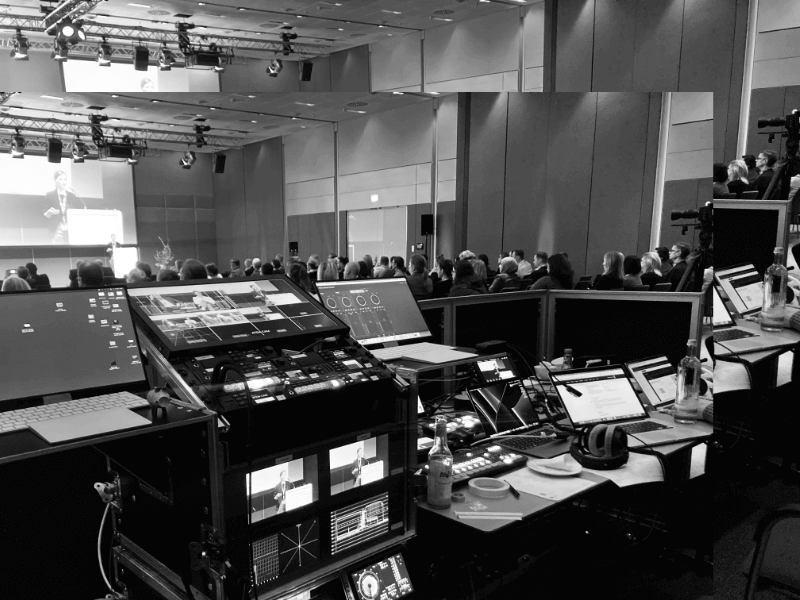
Our partner's system operates on its own LTE network. As a result, on-site participants did not have to deal with slower internet speeds during the streams.
In parallel with the streaming, our technical partner recorded the presentations so they would be available for on-demand viewing in the Virtual Venue afterward.

Even more convenience for the team
The GBG organizing team was pleasantly surprised by the many additional Converia features that further reduced their workload. For example, Converia managed the registration fees for the Annual Scientific Meeting, processed participant payments, generated invoices, and disbursed the revenue to the GBG.
The GBG team, led by Scientific Advisor Alena Gribko, found it easy to get started:
The software is user-friendly, making it very easy to find your way around. With the support of our Converia contacts, we were able to set up the event page, including ticket sales and the conference manager, quickly and exactly according to our requirements.
The team also used Converia to manage the scientific contributions that made up the program, as well as the speakers and sponsors. In addition to a general listing, each sponsor was given space on their own microsite to present themselves and their services in detail.
Since the Annual Scientific Meeting is a certified training event recognized by the Hessian State Medical Association, participants were able to earn continuing education credits during the conference. Converia tracked these directly. To do so, participants entered their personal training ID during registration. Following the event, they received their certificate of attendance with the CME points earned.
Fast check-in without long waits
Before receiving their name badges, on-site attendees simply had their tickets scanned. For this, Converia provided the GBG team with scanners that can also read digital tickets. This allowed participants to save paper and meant they didn't need to bring a printed version of their conference ticket. After the scan, the team could immediately see whether the person had paid their registration fee. If everything was in order, the next step was to issue the name badge.
The templates for the name badges had already been created by Converia in advance. The badges were color-coded for different groups, such as standard participants, speakers, or sponsors.

Analysis of digital conference platform usage
The GBG was naturally interested in how participants used the Virtual Venue. The high level of interest in the online version of the annual meeting was evident from the attendance figures: on both days of the event, about 200 of the 450 total participants were active in the Virtual Venue at any given time.
Furthermore, Converia was able to provide the team with in-depth usage statistics. The analysis showed, for example, which program items were the most popular or which sponsor profiles were viewed most frequently.
Outlook: What’s next for the GBG Annual Scientific Meeting?
Given these figures, the GBG can consider its first hybrid conference a clear success. While some participants were happy to meet in person again, others were grateful for the online option. Since interest in the digital format was not limited to just a small group, it is no surprise that the GBG opted for a hybrid format again in 2024—and remained loyal to Converia.
With the highly successful premiere of the hybrid format during the conference's anniversary year, the stage is set for a successful future.