
Back in 2019, we explored the question of how to reconcile gender-neutral language with usability in conference software in an article. This topic has been on our minds for several years, but for a long time, we lacked a truly satisfactory solution.
However, our support team regularly received inquiries regarding this exact issue. Many conferences required adjustments to the software's wording to incorporate gender-neutral phrasing. While Converia has always used neutral terms like "persons" in many places by default, we relied on the generic masculine for more specific terms, such as "attendee" or "author."
Since our software is highly tailored to the needs of academic conferences, we increasingly noticed that organizers in the higher education sector place great value on gender-sensitive language. We want to support this, because conferences should be inclusive spaces that are open to everyone. Language plays a significant role in this, and conference software also "speaks" to attendees in a sense. If organizers consistently prioritize non-discriminatory language, but attendees are then addressed using the generic masculine during registration, it creates a disconnect.
Although we were able to largely avoid such contradictions by manually adjusting the wording, it always required significant effort from our support team. We wanted to make a fundamental improvement, even though there are currently no uniform standards we could adopt as a foundation.
This was also why we were initially hesitant about how to proceed: any approach we chose might not align with the specific requirements of our organizers. This would mean our support team would still have to make extensive wording changes, meaning no one would truly benefit.
Which special character?
This was the core question that occupied us for a long time. Again, there are no current standards. We wanted to consider factors like usability, inclusivity, and accessibility in every case, which ultimately led us to choose the colon.
Compared to other special characters, the colon interferes the least with readability. It sits right in the middle of the letter height, blending much better into the typeface than the frequently used gender star (e.g., "attendee*s"), and therefore works very well on buttons, too.
Unlike the internal "I" (e.g., "attendeeIs"), the colon also encompasses the entire spectrum of identity rather than just representing two genders.
Not least, Apple has demonstrated that gender-sensitive language can work well and be user-friendly in widely used computer and smartphone operating systems by using the colon.
Software should be as accessible as possible
This should also apply to Converia. We are currently working in parallel on solutions to meet established accessibility standards (e.g., WCAG 2.1). Strictly speaking, special characters don't fit perfectly into this picture, as they can cause issues with screen readers—due to the lack of standards.
Our approach was also somewhat influenced by Apple, which has consistently used the colon for gender-sensitive language since iOS 15. Perhaps this will evolve into a uniform standard that screen readers will also account for in the future.
For our concrete approach, we agreed on the following: We only use the colon when we cannot find a neutral term or when the text cannot be rephrased to be gender-neutral. The implementation effort was therefore immense and spanned several months, as a simple "search and replace" approach obviously did not work here.
What is the result?
One initial fear was that we would end up with conference software that is gender-sensitive, but with texts that have become longer and more complex.
We were able to avoid that. For example, by being very careful to ensure that the meaning is not lost and terms do not become too vague due to gender-neutral phrasing. An "author," for instance, could be rewritten as a "person," but it would no longer be clear which person is meant. An author? An attendee? A speaker? These are all people whose data is stored in Converia. Therefore, "Add person" would not have been a suitable label for a button.
We also wanted to avoid introducing entirely new terms. For long-time Converia users, that would have been too big a change, which would certainly have made working in many areas more difficult.
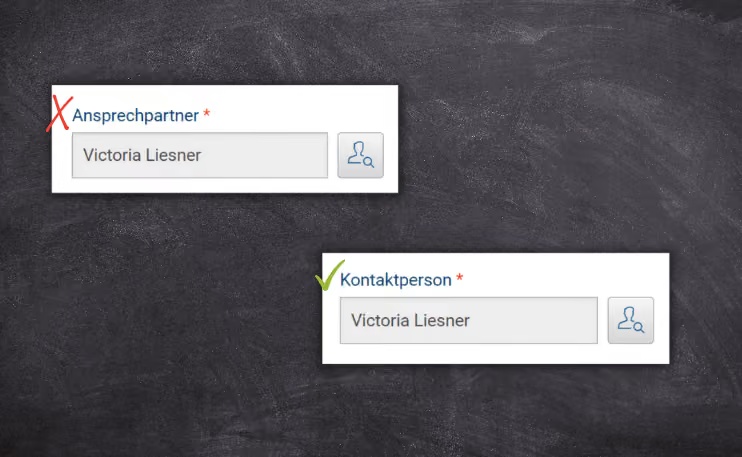
However, this was easily implemented in other areas where there is no issue with clarity. For example, we changed "contact person" (Ansprechpartner) to a gender-neutral equivalent, and instead of "user account" (Benutzerkonto), Converia now uses the term "account."
Improved usability
This also allowed us to fundamentally improve the handling of our conference software. Terms introduced in various Converia releases over the years were not always consistently aligned, leading to a mix of terms like "user account" and "account." We now use consistent terminology throughout.
Furthermore, we were able to replace some text passages with simpler phrasing, which reduces misunderstandings and makes working in Converia even more pleasant.
Overall, these language adjustments have created significant added value in terms of usability—something gender-sensitive language can also contribute to. We are pleased that our conference software can play a part in this.