


The "Room Block of the Future" study, published a few weeks ago, analyzed online booking data and surveyed 750 people who had attended at least one business conference in the past twelve months. The study revealed some very interesting details for event planners, starting with the fact that only about half of those booking actually make use of the provided room blocks. The rest prefer a hotel of their own choosing, look for alternative accommodation on Airbnb, or book at one of the hotels suggested by the organizer while deliberately choosing not to use the block.
Why is that? The study asked participants about this as well: frequent travelers in particular participate in hotel chain loyalty programs. Booking outside the block allows them to continue earning points because they can identify themselves to the hotel as loyalty program members, which is often not possible during the conference registration process. Secondly, some are convinced that the room rates within the conference block are not the cheapest available, which is why these individuals also tend to book directly with the hotel rather than through the organizer.
The data contradicts the latter point, at least: 72% of the respondents who booked independently outside the block ultimately paid the exact same price or—as was the case for the vast majority—even a little more for their room. Naturally, this situation is far from ideal: independent booking ends up costing attendees more, and negotiating room blocks is not worthwhile for the organizer if they are only used hesitantly. Can this be improved?
What is the benefit of a room block?
The study shows that it still hasn't gotten around everywhere that this is a useful and affordable service provided by the organizer, rather than a means for them and the hotel to rip everyone off. At the same time, this reveals a clear deficit in communication policy regarding the conference. Do not be secretive about prices; publish them on the conference website. This is the best way to dispel the prejudice that prices were increased specifically for the conference. However, you should negotiate lower or at least consistent room rates in advance, otherwise there is an increased risk that not only will a participant find cheaper rates outside the block, but they will also prefer not to identify themselves as a conference attendee to the hotel.
During negotiations with the hotel, agree that an attendee will still receive their loyalty points when booking within the block, and ensure that this is clearly visible to everyone so they don't have to ask about it—they might not even bother to check with you otherwise.
Registration (+ room booking)
Another, and likely the best, incentive to book the hotel room at the same time is to include the choice of room as an additional step in the registration process—as an option, of course, since no one should be forced to book a room to complete their registration. It is still common for organizers to post general details about room blocks on their website, while attendees then have to contact the hotel themselves to make a booking.
It would be more convenient to handle everything in one step without having to dial the hotel's number or print out a PDF form, fill it out, and send it by fax (some organizers still require this in 2019). It is hardly surprising that, given this, a participant would rather book on their own with a few clicks, even if it means paying a little more. The phone and fax options also leave those wanting to book in the dark, as they don't know if there are any rooms left at the hotel or if they have to call everyone else on the list as well. In contrast, when registration includes a booking option, the software displays how many rooms are still available in advance. This is managed by a counter in the background. If the block for a hotel is sold out, a notice appears stating that no more rooms are available there.
For those still not entirely convinced that this strategy works, offer special discounts on the conference ticket if accommodation is booked during registration. Be careful with this and other additional incentives, such as exclusive access to a networking evening. Only offer such things if you are sure that few to no people will be attending who do not require local accommodation. Rewarding only a few out-of-towners would be quite unfair.
Provide a choice
The study results show that many attendees want to choose their own hotel room. If they cannot select the room type, it is a major annoyance for most and reason enough to take the room search into their own hands. Choice is therefore a big plus for the acceptance of room blocks.
This can be extended to the entire hotel offering. While there will be attendees whose stay is paid for by their employer anyway, or who prefer to stay in a 4-star hotel, others may not have the budget for luxury accommodation. Often, participants are simply not willing to spend a lot of money on a hotel room where they will only be staying for a few hours. Since it is difficult to find a common denominator for such diverse needs, you should negotiate room blocks with accommodations in various price ranges. In addition to star-rated hotels, conference organizers sometimes even include hostels and guesthouses, which is particularly common for events aimed at younger researchers.
Organizers who know their audience have an easier time putting together the individual options. If you are not sure how well you know them, ask. Of course, this works best for recurring conferences, but it is also a great way to identify problems you might not have noticed yourself, while getting to know the people you are planning the conference for better.
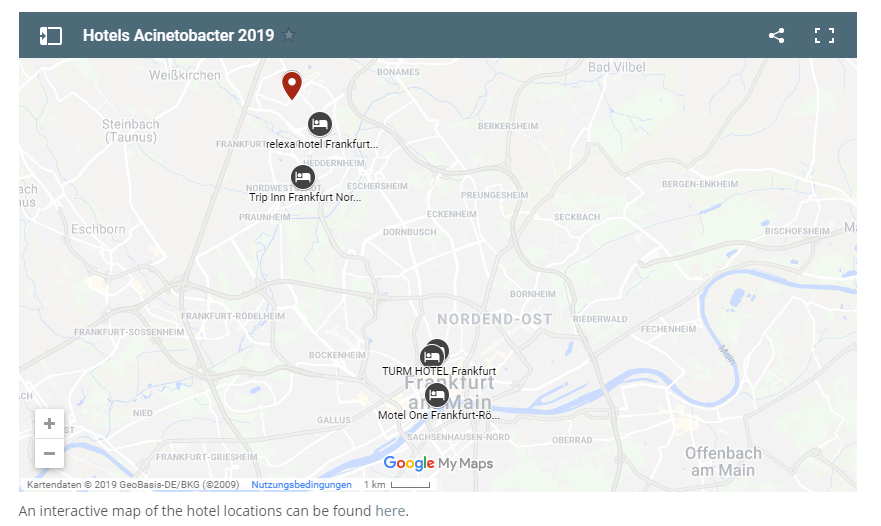
Use the conference website to briefly introduce the individual accommodations and list others nearby for which there is no room block. Visitors can find the relevant information under a dedicated menu item. The majority of respondents in the study named the event website as their most important source of information when searching for a room, even ahead of Google searches. Therefore, keep the content up to date. This is easiest if you can make changes yourself and don't have to go through an external agency that built and manages the website for you. If rooms can be selected during attendee registration, add a note to the subpage.
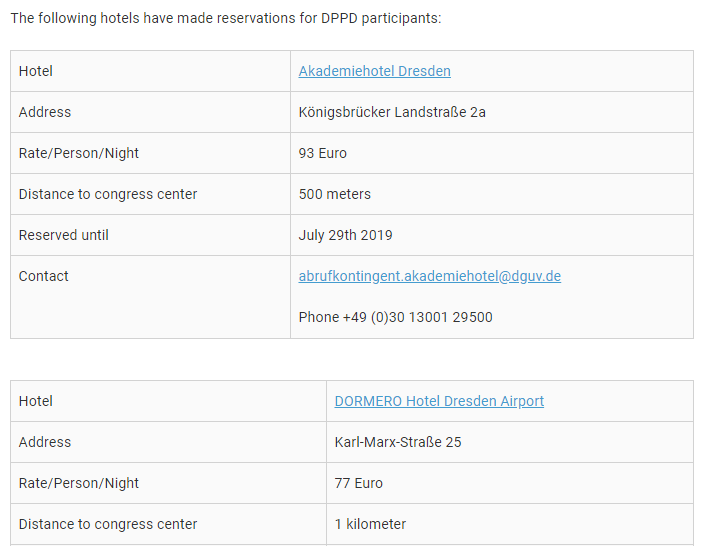
How detailed you want to be with hotel information is up to you. In the case of our clients, this is implemented practically as follows:
According to the study, those who prefer not to book their hotel room through the event organizer fear they will be at a disadvantage in the event of a cancellation because they will receive less or no refund. Negotiating room blocks is indeed a risk for hotels—if the conference is cancelled shortly before it begins, the hotel is left with empty rooms. Regardless of how favorable the cancellation terms are, no one should have to hunt for this information themselves. Make sure to post these details directly on the conference website. This will certainly help those who are still undecided.
Group-friendly booking
Another revealing finding from the study: 80% of respondents who booked their hotel room separately and opted out of the accommodation block coordinated beforehand with acquaintances who were also attending the conference. This suggests that their primary goal was to secure a room in the immediate vicinity of their peers. This can be addressed with a group booking option with integrated room selection, which allows attendees to book in the same hotel, provided there is still sufficient availability.
Alternatives with room for improvement
In the survey, people under 40 in particular stated that they had booked outside the room block. They explained this by saying they did not want to sacrifice individual experiences, even as business travelers, which is why they moved away from the organizer's suggestions and specifically looked for accommodations that better suited their personal tastes.
This, combined with the fact that there eventually comes a point when all room blocks are exhausted, could actually prove to be an opportunity for alternative providers. However, their services for conference organizers are currently sparse. Airbnb briefly offered an exception with a free extra service: the platform curated accommodations from its own listings near the conference venue, which organizers could then embed on the conference website. While the specific impact on bookings with and without room blocks is unknown, this would be a useful addition, especially once room blocks are exhausted but registrations continue to climb. If it is a large conference or if other events are taking place in the city at the same time, space will likely become an issue. Platforms for individual accommodations could help here without directly competing with room blocks. Unfortunately, unlike the website where it is still advertised, the tool is no longer available to organizers.
Airbnb is currently focusing on business travelers and providing specially selected accommodations for them. However, a major issue with private hosts is the question of liability if the accommodation does not meet expectations. This has nothing to do with the organizer, but what if they officially recommend these listings? Airbnb's "Plus" option promises apartments and rooms that have been quality-checked, but these currently do not exist in Germany outside of Berlin.
Anyone who goes to the trouble of providing hotel blocks for attendees should never fail to provide detailed information about them and everything else worth knowing. If organizers dispel prejudices from the start and establish a process that makes booking particularly convenient, guests, hotels, and the conference organization team will all be equally satisfied.