


The history of the conference is likely as long as that of humanity itself.
Even in ancient Greece, Athenian citizens would gather for social wine rounds to listen to the speeches of Socrates or Plato and exchange ideas on specific topics.
The scientific conference as we know it today is not so far removed from antiquity after all.
Of course, wine no longer plays such a major role. Communication and the social aspect, however, have remained at the forefront: in addition to sharing information and personal conversations, conferences are always used to continuously expand one's network.
Compared to virtual meetings, however, multi-day conferences do initially seem a bit outdated. The effort involved in organizing and attending a scientific conference is particularly enormous. For example, you have to plan travel that is often quite lengthy, compile your personal program from a multitude of offerings, and keep an eye on the costs involved at the same time.
Nevertheless, there are numerous arguments for conferences outside the internet. We would like to introduce some of them to you below.
1. Knowledge and innovation
Conferences offer you the opportunity to provide a mostly international audience with insights into your findings and work. Everyone present is thus able to learn about new research topics and results. Scientists often present findings in lectures that are not yet accessible to you in any other way. Extensive publication sometimes only happens much later. Accordingly, attending conferences not only brings your own knowledge up to date but also saves time: presenting findings via a lecture helps with orientation and reduces the effort required for your next literature search.
2. Networking made easy
Conferences are ideal for making new (international) contacts. During breaks and evening events, you can easily strike up conversations with other participants and get to know colleagues and their research interests better.
A young scientist's network can find its starting point at conferences. Presenting your own results promotes visibility within the scientific community. It is not uncommon for conversations with experts and decision-makers to follow.
Especially if your personal contacts in your own field are still quite limited, conferences are the right place to change that.
Online, however, making new contacts is not quite as easy. The barrier to writing to established luminaries for the first time is at least as great as the risk that your message will get lost among countless others and receive no response.
3. Successful collaborations
Conversations, in turn, can provide approaches for joint research projects. Many a conference has laid the foundation for successful scientific collaboration.
For example, media scientist Dr. Maya Götz describes how the idea for a research project on children's and youth television emerged from a discussion at the ICA conference in Washington.
Discussions are also worthwhile if you already have a more complex project in mind. Through conversations, you may encounter interested supporters or collaborators whom you would have found difficult to locate otherwise.
4. Publishing = visibility
A conference volume is often published as part of a conference, in which the individual contributions are featured. If your name can be found in these proceedings, it ensures that you and your research results are noticed.
If your articles are published in conference volumes, the probability that others will cite you also increases. This, in turn, speaks for the quality of your scientific work. And this is a decisive criterion when it comes to awarding funding or filling positions.
5. Motivating discussions
Furthermore, a scientific conference can open up a new perspective on your own research. Exchanging ideas with other scientists helps you discuss your own results and get an impression of how they are evaluated. Colleagues can support you with useful impulses and advice and positively influence your research.
That leaves the organizational effort.
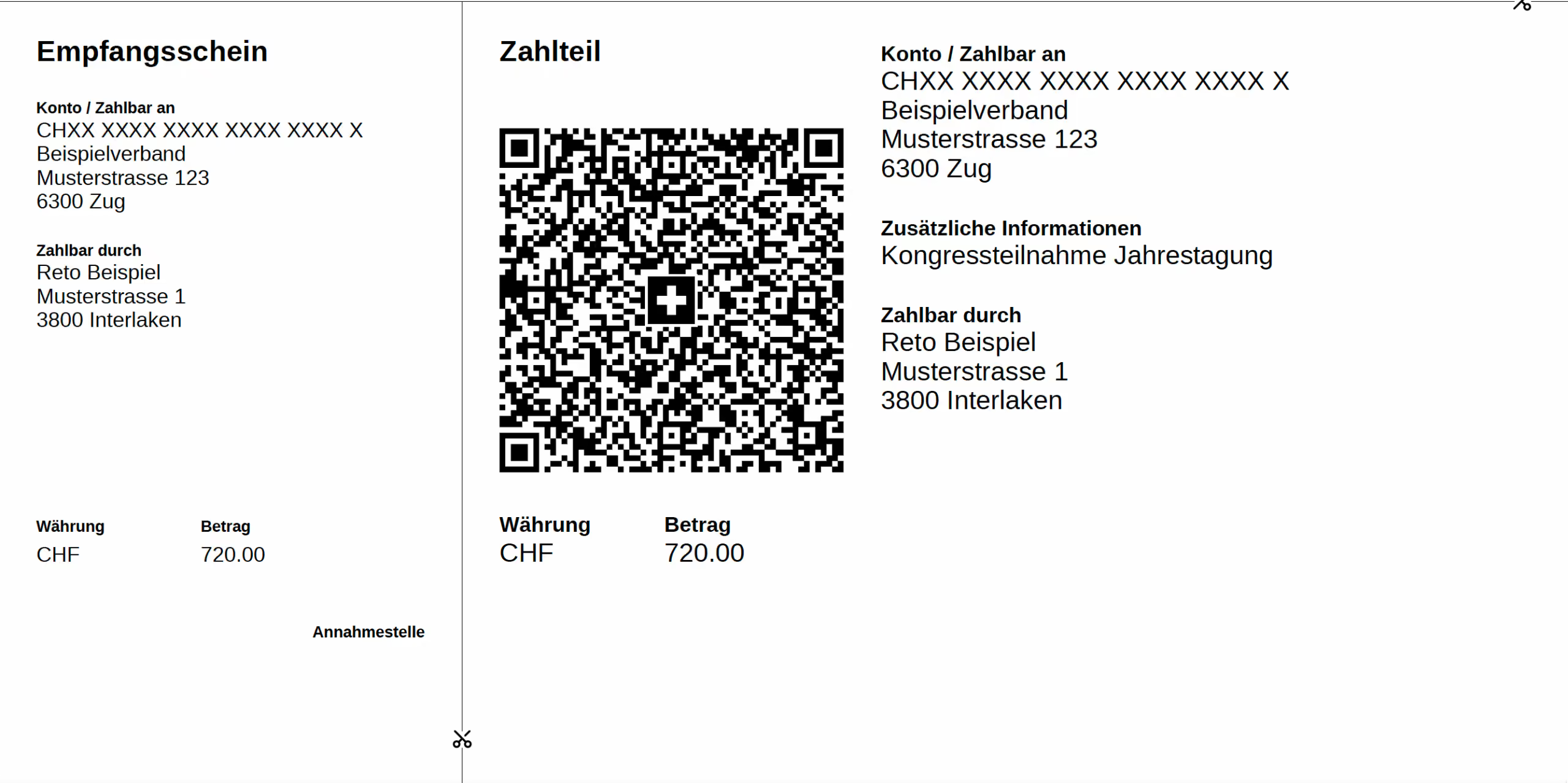
Unfortunately, this cannot be completely eliminated. But if you are lucky, the organizer uses software such as Converia. Preparing for your attendance becomes particularly easy: you can conveniently register and pay online. And if you would like to give a lecture, you can simply upload your paper yourself.
With the app, you can also keep track of the entire conference program and access up-to-date information on sessions, authors, and abstracts at any time.
Nothing stands in the way of a relaxed event.