



Important: New VAT regulations effective January 1, 2026
As of January 1, 2026, different VAT rates apply to food and beverages at conferences.
- Food is subject to a permanent 7% VAT rate. Beverages
- continue to be subject to the standard 19% VAT rate.
If you offer a combined catering package for your conference attendees, you must separate the food and beverage portions. Provide a transparent breakdown of which tax rate applies to each service.
Universities and research institutions, in particular, often scrutinize invoices very closely. Without a clear breakdown, recipients are more likely to ask questions or even reject the invoice.
We answer questions about the new regulations regarding conferences in this article.
Is tax even applicable?
Section 12 of the German VAT Act (UStG) stipulates that the standard VAT rate is 19%. This also applies to revenue generated from the sale of event tickets. Exceptions exist for theater performances, concerts, and similar events (Section 12 (2) No. 7a UStG). In these cases, the reduced tax rate of 7% applies.
Note: We have covered the temporary VAT reduction starting July 1, 2020, in a separate article, where we explain what organizers need to keep in mind.
Conferences are not mentioned among these exceptions. Does this mean that a 19% VAT rate generally applies? Not always! The VAT Act contains another important exception that organizers should know: If the planned event can be classified as adult education, it is actually completely tax-exempt. However, this does not apply to everyone automatically. To calculate with 0% instead of 19%, three conditions must be met:
1. The nature of the event
In addition to cultural and sporting events, this regulation primarily concerns lectures, courses, and events that impart knowledge and information or are of a scientific nature.
It is particularly important that the conference has an educational character and focuses on the transfer of knowledge, as adult education is treated here as equivalent to school education, which is also tax-exempt.
In addition to conferences, congresses, and conventions, this also includes standalone workshops. If you offer workshops as part of the conference program, they are also tax-exempt.
By the way, the number of people attending the conference does not matter, as there are no regulations regarding minimum or maximum participant numbers.
2. The organizers
Unfortunately, not all organizers can benefit from these tax exemptions. The legislation sets clear boundaries here.
Legal entities under public law, administrative and business academies, adult education centers (Volkshochschulen), non-profit organizations, and professional associations are permitted to claim the 0% exemption for their events.
Legal entities under public law include, for example, chambers of commerce and industry as well as—and this is particularly important for conferences—universities.
From a tax perspective, hosting scientific conferences and conventions is considered part of the research and teaching activities conducted by every university, which is why their educational events are generally exempt from VAT.
Are you looking for conference management software that correctly handles complex tax requirements such as mixed tax rates or reverse charge? Converia supports organizers with more than just tax matters.
3. Revenue
The Value Added Tax Act stipulates that revenue from the conference must be used primarily to cover the costs of planning and execution (Section 4 No. 22 UStG).
While "primarily" is somewhat vaguely defined, it means that more than half of the profit should go toward covering costs.
If your conference is not primarily focused on profit and the profit is not disproportionately high, you generally do not need to worry about consequences if you remain slightly below the 50% threshold. This is the case if you set the participation fees slightly lower from the start to appeal to as many participants as possible with varying budgets.
However, if you calculate tickets with a flat tax rate of 7% or do not tax them at all, you will have a problem if this turns out to be a mistake later on. It would likely be difficult to ask all participants for a subsequent payment.
Aside from the effort involved, such an approach does not exactly reflect well on the organizers' competence. It is possible that the organizing team will end up footing the bill. If organizers do not collect the tax, it can become expensive. The tax office will demand the amount regardless. If tax debts have been outstanding for a long time, high interest rates and criminal proceedings for tax evasion may also be added.
Unlike for participants, for whom only the final amount on the invoice matters, the distinction between the gross and net price of the ticket is significantly more important for organizers.
You should definitely keep this in mind when setting the ticket price. It makes a real difference whether a ticket costs €300 (tax-exempt) or €300 (incl. 19% VAT). If you assume that you do not need to deduct taxes, you might mistakenly calculate with a net amount of €300. However, since VAT of 19% or €57 actually applies, that would amount to €57,000 for 1,000 tickets sold that the tax office would receive. That is not a small amount, and it would significantly reduce your projected profit.
Financing through participation fees
From a tax perspective, for scientific conferences, the question also arises as to exactly what the proceeds from ticket sales are used for.
If organizers use the participation fees to pay speaker fees or the rent for the conference venue, no VAT is incurred.
There is an exception for speakers from abroad: Although they are part of the conference's scientific program, their presentation is classified under Section 13b UStG as a service subject to 19% VAT.
Cost items that are not part of the scientific program are generally subject to tax.
This includes, for example, the non-scientific social program or participant accommodation.
Even catering is subject to VAT. The only exception is refreshments provided during breaks, which are considered a gesture of courtesy. There are specific guidelines for this, which state that coffee, tea, and pastries are not considered hospitality, but rather tax-free amenities. This changes as soon as alcoholic beverages are served. In this sense, for example, a champagne reception would be considered hospitality and therefore subject to tax.
The role of sponsors
If you receive money or other services from sponsors for your conference, it does not mean that the conference immediately loses its tax-exempt status.
Instead, a distinction is made based on the nature of their involvement in the conference proceedings. If sponsors actively present themselves and their services during the conference, VAT must be paid. This applies to congresses with accompanying industrial exhibitions as well as to conferences whose program booklet contains advertisements from sponsors. However, the tax exemption remains in place as long as the sponsorship is handled in a more discreet manner: sponsors are only mentioned by name, but their services are not advertised.
Mixed tax rates
It is common for organizers to create different packages for conference participants that, in addition to attendance, include additional services such as the conference proceedings, catering, or a local public transport ticket.
The guidelines in the previous sections show that no uniform tax rate can be set for such a package.
While participation in the scientific conference program remains tax-free on the sample invoice shown, 19% VAT is due for catering and 7% for the conference proceedings. The final price for the conference ticket is therefore made up of several services.
Do all registrants now have to select each option individually because of the different tax rates instead of adding the entire package to the shopping cart with one click? That depends entirely on the software used for participant registration.
In Converia, for example, the complete package can still be booked. When creating offers, organizers work with so-called sub-packages, which are combined to form an offer package. A separate tax rate and price can be set individually for each of the sub-packages. Furthermore, prices can vary depending on the group of people (students, association members, etc.) or the registration period (e.g., early bird).
When selecting items during registration, a note appears during the offer selection process indicating that it is a mixed tax rate. You can list all individual items contained in a package on the invoice.
By default, Converia already includes appropriate tax notices in accordance with legal requirements for offers with tax rates of 0%, 7%, and 19%. Conference organizers can show or hide these as desired, supplement them with their own additional information, or rephrase them if necessary.
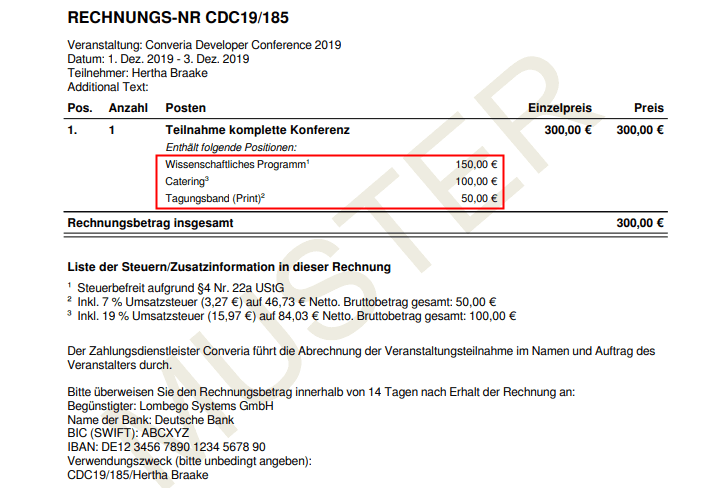
To ensure that sub-packages appear as individual items on invoice documents, you only need to change one setting for the invoice template.
The invoices themselves are automatically generated for all participants at the start of the registration period, provided with the respective tax information for the offer packages, and sent by email—this also happens automatically if desired.
Special rule: Reverse charge mechanism for international participants (Section 13b of the German VAT Act (UStG))
A common misconception among organizers is that participants from abroad do not pay VAT. This is correct in the sense that organizers sometimes do not have to pay VAT to the tax office for international conference participants and issue a net invoice that does not contain German VAT.
The tax is still incurred, but is paid by the participant in their home country, where the local tax rate applies. The tax liability is therefore transferred to the participants.
This always depends on three aspects:
1. Which country is the person from?
Tax liability can be reversed for persons based in other EU countries and non-EU countries. If the person is from within the country, the reverse charge procedure does not apply.
2. Is it a company?
For those from other EU countries, this must be verified by entering the VAT ID, which can be done during conference registration, for example.
3. What type of service is it?
In-person attendance at a conference is not eligible for the reverse charge mechanism and, under EU law, is always taxed at the location of the event. Different regulations may apply to virtual or hybrid conferences.
On-site, catering during the conference days must also be taxed. However, the reverse charge mechanism can be applied to conference proceedings, exhibition stands, and other ancillary services.
This results in invoices with two types of items: those for which VAT is due at the conference location, and those for which tax is due at the participant's place of business. This must be clearly stated in the invoice details.
Organizers are therefore better advised to use software from the very beginning that can handle the reverse charge mechanism and generate invoices based on the information provided. Anyone who knows the details of their conference taxation can easily map them in conference software like Converia.
Is the offer structure of your planned conference similar, and are you unsure which tax rates you should apply to your offers and how? We are happy to help and work with you to determine if and how you can make your event's registration process simple and transparent.
If you would like to test how to set up tax rates in the software and see what the invoices look like, try our free Converia demo.
Note
This article is intended as an overview of the taxation of event tickets and does not constitute legal advice. The text does not claim to be exhaustive and cannot replace professional tax advice. For specific questions regarding special regulations for your event, you should always consult a tax advisor.