


Why publish conference proceedings at all?
Aside from being useful for anyone interested who couldn't be there in person, they can also be a great help to those who did attend. Often, simply hearing a conference presentation isn't enough. Suppose the majority of scientific papers presented at a conference are never published. This means no one can refer to them later, as personal notes from a talk are rarely suitable as a source in a bibliography. Whether the results of a study are confirmed or refuted by others is only possible if they were published beforehand.
And the more often others refer to your work, the more important it becomes and the more familiar your name will be to other researchers. For speakers who don't yet have an endless list of publications, conference proceedings are perfect for drawing the attention of colleagues.
Not least, they can also increase your h-index, the number used to indicate a scientist's reputation and the interest in their publications. An h-index of seven, for example, means that seven of your publications have been cited at least seven times. When applying for university positions or research grants, this value is often a decisive criterion, which is why hardly anyone would object to their contribution being part of the proceedings.
But what if the conference papers have already appeared in anthologies or journals? In most disciplines, this is unlikely to be the case. This is because the peer-review process for journals often takes a long time, while authors have not been idle in the meantime and have continued their research based on their findings. It is not uncommon for a conference volume to contain a version of the paper that includes new insights.
Planning with conference management software
If you want to produce conference proceedings, extensive planning is required in advance. Involving authors from the very beginning is particularly worthwhile. Inform them of all important formal requirements before they submit their contributions. The best way to do this is via the conference website, where you can also announce the planned proceedings. If submissions are made via email, not everyone will always follow the guidelines. If you then have to remind authors individually, you lose valuable time. Using conference management software, however, means less effort for you because the requirements are clear. For example, you can set a maximum length for a contribution and specify how it should be submitted. An author can either enter an abstract or a full paper as plain text via a form or upload a text with graphics, formulas, and tables in a specified file format. Alternatively, there can be a combination of both, using a form for the abstract and an upload function for the full paper.
All contributions submitted via the software are then available in the system, which proves advantageous for the peer review process. Paper evaluation can then take place via the same platform, avoiding chaos in email inboxes. Once the decision has been made regarding who is allowed to present at the conference, you can start compiling the contributions for the proceedings. Just because they are all in the system doesn't mean that those rejected by the program committee must be part of the publication. Ideally, the software should have a function that allows you to select only the accepted papers.
In the next step, these are exported. You should be free to choose the order of the export, depending on whether you want the data organized by topic or author name, for example. You should also be able to decide on the file format yourself.
Subsequently, the exported papers can be formatted and processed into the final conference volume, so that it includes a table of contents, a title page, or an index alongside the contributions.
Publication
The publication of proceedings is usually organized through a publisher. Some universities publish their conference volumes via their own university press. Alternatively, an external publisher can be commissioned. However, Prof. Dr. Lorenz M. Hilty discovered that working with academic publishers is no longer as easy as it was a few years ago and can certainly cause some frustrationProf. Dr. Lorenz M. Hilty had to find out.
To ensure that proceedings published as self-published works are citable, applying for an ISBN from the Agency for Book Market Standards is necessary. When working with a publisher, the organizer does not have to take care of this themselves.
When citing from digitally available conference proceedings, the URL is usually given as the source. This provides a reference to where the proceedings can currently be found, but it might lead to a dead end in six months. The solution to this is so-called persistent identifiers such as URNs (uniform resource names), which are assigned by the German National Library. The conference volume is thus given a unique name, which, just like an ISBN, serves to identify the volume precisely, regardless of which server the document is stored on. With the help of a URN resolving service, the URN is then translated into a URL that can be accessed normally in a browser. If someone cites the proceedings, both the URL and URN of the source are provided – the digital conference volume is therefore citable.
With the help of Converia, entering and importing URNs is easy, and they can then be automatically distributed to the individual contributions.
When to publish?
Publishing the complete proceedings a while before the conference is likely risky for organizers. If there are still changes to the program before the event, these can no longer be taken into account. If, for example, scheduled speakers have to cancel their participation, the conference volume will contain contributions that were not presented at the conference. This means additional work for the editors, who then have to take care of removing the contribution at short notice.
On the other hand, waiting several months to publish after the conference has ended is not an ideal solution either. Such a late release can lead to some of the findings being outdated or at least no longer at the cutting edge of research.
The best solution is therefore the middle ground, i.e., publishing at the beginning of the conference or shortly after it ends.
In the run-up to the conference, an abstract volume is sometimes published, which helps participants to selectively choose the presentations whose content interests them most and which can also be created with the help of software.
How to publish?
If the proceedings appear in electronic form, the organizer can be more flexible regarding the publication date because no printing phase needs to be scheduled. Many organizers therefore limit themselves to a PDF publication and make the conference volume available to participants online via the conference website.
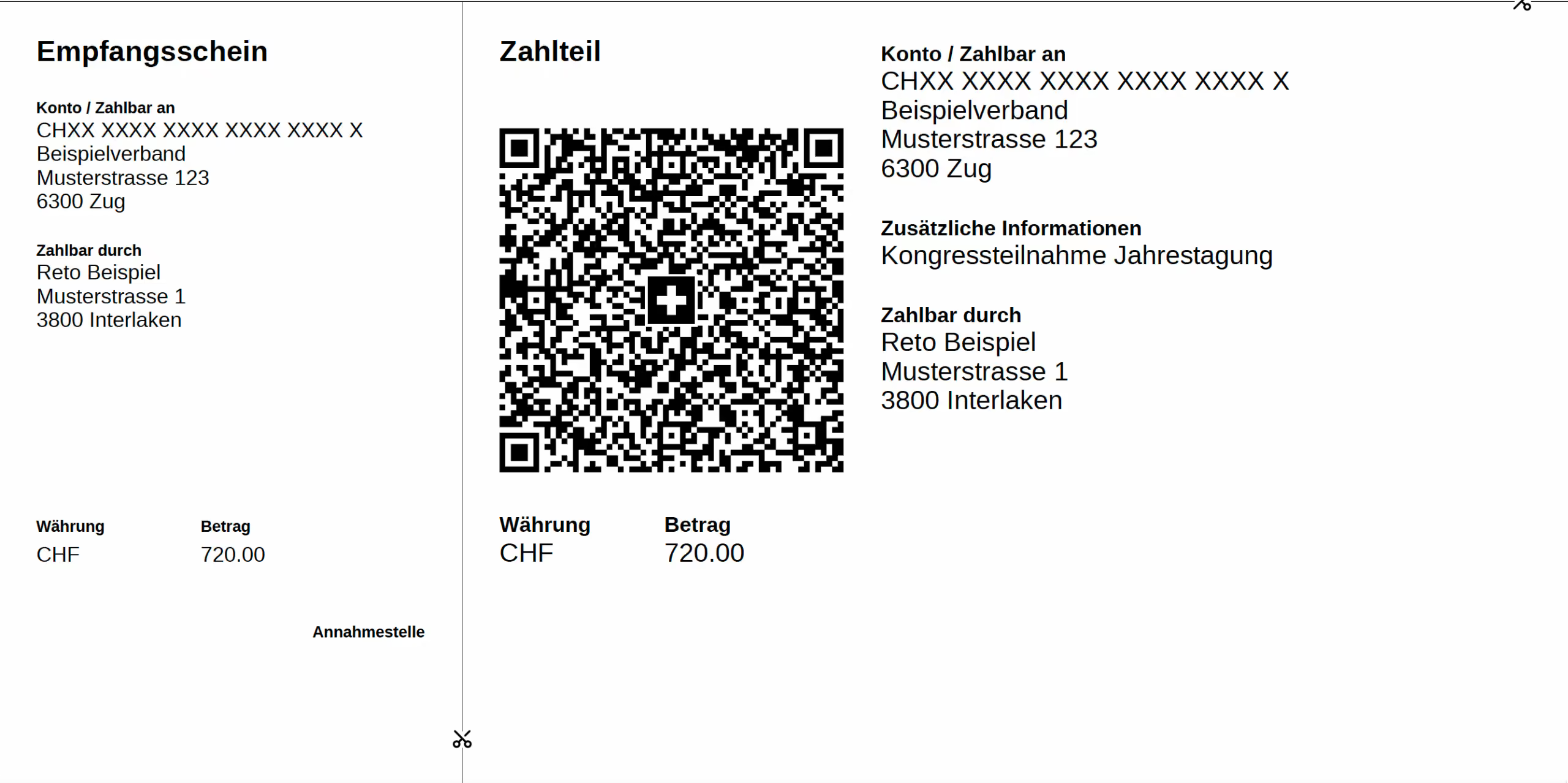
For printed proceedings, things look a bit different. Production costs require precise planning here, which is why you should know how many copies are actually needed. Visitors can provide the answer in advance by selecting the option for the conference volume during registration. This option should be offered with an appropriate surcharge to cover production costs.
If the conference proceedings are already included in the ticket price, you should carefully review your tax treatment: the portion of the price allocated to the proceedings may be subject to a different tax rate than the conference attendance itself. With conference management software like Converia, you can easily sell tickets with mixed tax rates online.
On-site, these are either handed out directly at check-in, or attendees are provided with instructions on where to collect their copy.