
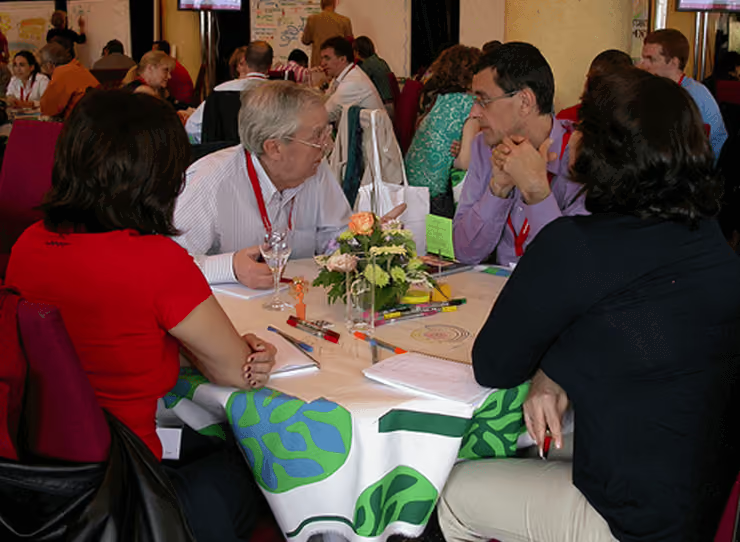
World Café, Fishbowl, and Open Space are three formats that make this possible at conferences. All of these methods prioritize exchange over one-way presentations and break down rigid hierarchical structures. The motto: Good food – good conversation – good ideas. From the agenda to the final wrap-up, everyone plays a part in shaping the event.
Die Konferenz-Management-Software Converia unterstützt Veranstalter bei allen Aufgaben rund um die Veranstaltungsorganisation - egal ob World-Café, Barcamp oder mit klassischem Kongressprogramm/Tagungsprogramm.
Breakout Session
In a breakout session, small groups of up to 10 participants discuss specific aspects of the conference topic.
This often happens following a short keynote or within a moderated workshop. The advantage: The manageable group size encourages active participation and makes it easier for people to speak up spontaneously. This is why breakout sessions are no longer limited to interactive formats. Even traditional conferences now reserve dedicated time slots for parallel sessions.
Quick info: Breakout sessions at conferences
🎯What is it suitable for?
Goal-oriented or case discussions: when the focus is on finding the best solution together. Breakout sessions are also ideal for brainstorming or sharing experiences at your conference.
👥Who is it for?
Research, medicine, product development – anywhere knowledge is shared and developed further through collaboration.
🧪Application example for a breakout session
In oncology, for instance, representatives from various disciplines (radiology, neurology, oncology) come together in a "tumor board" to discuss the best treatment approach for individual patients. This is a classic breakout situation where teamwork takes precedence over hierarchy.
Barcamp
Barcamps operate on a unique principle, which is what makes them so exciting. Unlike a breakout session, which is often part of a traditional conference program, a Barcamp turns the entire conference concept on its head. It’s not for nothing that it’s often called an unconference.
The idea originated in the IT scene, where people would meet for a weekend, sleep in tents (hence the term "camp"), and discuss current issues in an open atmosphere. The special feature: the agenda doesn't exist beforehand. It is created on-site.
All participants suggest topics at the beginning, and anyone who wants to can moderate a session themselves.
The result: maximum participation, relevant content, and tangible outcomes.
Quick info: Barcamp
🎯What is it suitable for?
Solving specific problems together or exploring new topics. There are no rigid schedules or fixed roles.
👥Who is it for?
It’s long since moved beyond just developers. Barcamps are now held in almost every field: from EduCamp (teaching & learning) to SpaCamp (wellness & health). If you want to foster open exchange, this is the right place for you.
🧪Example of a Barcamp in practice
The EduCamp is an established barcamp format in German-speaking countries that focuses on topics related to education and learning, positioning itself as a participatory conference. Since 2008, EduCamps have been held regularly, bringing together teachers, students, and anyone interested in education to discuss innovative teaching and learning methods. These events promote open exchange and collaboration among everyone involved in the field of education.
Open Space
Coffee breaks sometimes yield more useful ideas than the scheduled program. That is the principle behind Open Space. This conference format fosters creative solutions because it requires diverse perspectives and there are no simple answers on the table.
Unlike the casual barcamp, Open Space provides a clearer basic structure while still leaving the responsibility in the hands of the participants.
How does the Open Space method work?
At the beginning, everyone sits in a circle. If there are more than 50 participants, they form concentric circles so that everyone can see each other.
After a brief introduction, things get down to business and the marketplace phase begins.
Anyone who wants to introduce a topic goes to the center of the circle, presents it briefly, and posts it on the documentation wall. This acts as a bulletin board and the central planning tool for the event.
From this moment on, everything organizes itself.
Groups form spontaneously around the proposed topics. Anyone who wants to join the discussion signs up, finds a location, sets a time, and gets started. If someone realizes they have nothing (more) to contribute, they simply join another group.
There are breaks, too, but not according to a schedule.
Each group decides for itself when and how it works and when it wants to take a break. At the end of each day, every group summarizes its results, ideas, and decisions. The documentation is then posted back on the wall for everyone to see.
At the end, participants receive a complete record of all groups' results and work together to develop corresponding action steps and shared agreements.
Quick Info: Open Space
🎯What is this method suitable for?
For gathering creative ideas, sharing knowledge, or reaching a decision together with others.
👥Who is it for?
Associations, clubs, companies, and educational institutions are most likely to benefit from this.
🧪Example of Open Space in practice
The University of Basel's Unconference relies on the principles of the Open Space method. Since 2015, participants have been able to contribute questions and topics for discussion. What started as a format for IT staff is now open to everyone at the university.
World Café
A good conversation can change a lot. That is why dialogue is at the heart of the World Café. The format is characterized by a coffee-house atmosphere and is open, inspiring, and dynamic.
At this point, we would like to quote Patricia Munro, Executive Board Member of World Cafés Europe: “The core of the World Café dialogue process consists of inspiring questions, listening without prejudice, and intensive conversation. Over the course of successive rounds of conversation, participants change tables several times, so that the composition of the groups is constantly shifting, allowing ideas and perspectives to be carried forward. In this way, the group’s understanding reaches new dimensions, and new perspectives open up for every participant. This movement of people and ideas creates a collective creativity, a kind of shared force field. New possibilities are explored, innovative approaches emerge, and ideas are born. This generates and fosters the intrinsic motivation to put new thoughts into action.”
The format is based on the principle: when people start talking, ideas start moving. This creates a network of perspectives and a shared process of reflection.
The World Café works because it is so simple. All it takes to explore topics together is a clear structure, a relaxed atmosphere, and insightful questions.
You can see a World Café in action here:
Quick Info: World Café
🎯What is this method suitable for?
Generating ideas together, making decisions, fostering collaboration, and internalizing concepts.
👥Who is a World Café suitable for?
Civic engagement, interdisciplinary teams, educational institutions, or companies with various departments—for example, a PCO (Professional Congress Organizer): sales, project management, participant registration, program and speaker management, sponsor management.
🧪Application example for a World Café
For its Strategy 2030 method pool, the German Red Cross presented a concept for a World Café with various thematic tables. The central task is to work on a shared vision of the future for the DRK. To do this, participants exchange ideas on a specific question in small groups of up to 10 people over 30 minutes.
Fishbowl
Listening or joining the discussion is possible at any time.
The Fishbowl method uses two circles of chairs: the outer circle is for listeners, while the inner circle is for those participating in the discussion.
Anyone who wants to contribute to the discussion changes seats.
Either the person sits in an empty chair in the inner circle or stands behind the chair of the person currently speaking. The speaker is allowed to finish their thought before giving up their seat to the new person.
This keeps things moving. The method regulates itself without the need for a moderator: frequent speakers naturally step back, and new perspectives are given space. This ensures that it is not the loudest, the "frequent speakers," or the "know-it-alls" who dominate, but those who truly have something to say. This makes the Fishbowl method particularly effective for controversial topics or when the goal is to make a diversity of opinions visible.
Quick Info: Fishbowl
🎯What is the Fishbowl suitable for?
Clarifying contentious issues, exchanging arguments, and weighing alternatives.
👥Who is a Fishbowl suitable for?
For organizations with flat or entrenched hierarchies, teams in transition, and decision-making bodies.
🧪Fishbowl application example
A medium-sized company could use this format, for instance, to discuss a new overtime policy.
Conclusion: Real alternatives to traditional conference formats
Alternatives to traditional conference formats are no longer niche. They are increasingly becoming established at academic conferences, where slides previously dominated and discussions were often cut short by scheduling constraints.
What all these methods have in common is that they move participants out of the passive role of listeners. They foster exchange, open up room for action, and create productive energy and tangible results.
Whether it's a World Café, Barcamp, or Fishbowl: These formats make the group's collective knowledge visible, motivate participants to take action, and often produce more than just a good conversation. They provide momentum that extends far beyond the conference itself.
The advantages of these methods are clear:
- collaborative conversation is encouraged
- all participants act independently and truly contribute
- action plans are developed and agreed upon. At best, this triggers a sense of personal responsibility and a "can-do" attitude that carries over into everyday work life.
We would like to thank
www.worldcafe.eu
For explanations of the World Café and the image used in this post.
www.boscop.org
Here you will find brilliant explanations as well as numerous examples & templates.
Is your conference program still in the works and you're looking for inspiration? Here are a few more resources:
💬Also interactive: Q&A sessions. With a few tips, these can also lead to lively discussions.
🤔A few questions you should always ask yourself before filling out your conference program.
Conference training for academics: Take your conference organization skills to the next level!
Use this Converia voucher code to get a 10% discount: Converia_Earlybird_10
👉 DESIGN successful events: Where creativity meets strategy!
Do you want to design events that exceed your attendees' expectations?
This training will ensure your events are inspiring and memorable!
👉 PLAN conferences stress-free
Would you like to start planning conferences with seasoned ease?
Get the methodological expertise you need for a successful project launch!
👉 EXECUTE conferences successfully
Would you like to start running conferences with seasoned ease?
Gain the methodological expertise to guide you through the event day with confidence and calm.